Results by title
163 books match the query 'Homosexuality' and 6 start with h
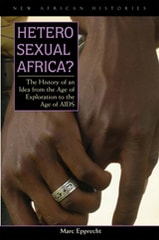
Heterosexual Africa?
The History of an Idea from the Age of Exploration to the Age of AIDSMarc Epprecht
Ohio University Press, 2008
Heterosexual Africa? The History of an Idea from the Age of Exploration to the Age of AIDS builds from Marc Epprecht’s previous book, Hungochani (which focuses explicitly on same-sex desire in southern Africa), to explore the historical processes by which a singular, heterosexual identity for Africa was constructed—by anthropologists, ethnopsychologists, colonial officials, African elites, and most recently, health care workers seeking to address the HIV/AIDS pandemic. This is an eloquently written, accessible book, based on a rich and diverse range of sources, that will find enthusiastic audiences in classrooms and in the general public.
Epprecht argues that Africans, just like people all over the world, have always had a range of sexualities and sexual identities. Over the course of the last two centuries, however, African societies south of the Sahara have come to be viewed as singularly heterosexual. Epprecht carefully traces the many routes by which this singularity, this heteronormativity, became a dominant culture. In telling a fascinating story that will surely generate lively debate, Epprecht makes his project speak to a range of literatures—queer theory, the new imperial history, African social history, queer and women’s studies, and biomedical literature on the HIV/AIDS pandemic. He does this with a light enough hand that his story is not bogged down by endless references to particular debates.
Heterosexual Africa? aims to understand an enduring stereotype about Africa and Africans. It asks how Africa came to be defined as a “homosexual-free zone” during the colonial era, and how this idea not only survived the transition to independence but flourished under conditions of globalization and early panicky responses to HIV/AIDS.
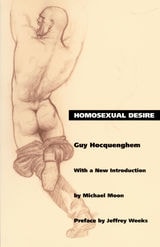
Homosexual Desire
Guy Hocquenghem
Duke University Press, 1993
Significant as one of the earliest products of the international gay liberation movement, Hocquenghem's work was influenced by the extraordinary energies unleashed by the political upheavals of both the Paris "May Days" of 1968 and the gay and lesbian political rebellions that occurred in cities around the world in the wake of New York's Stonewall riots of June 1969.
Drawing on the theoretical work of Gilles Deleuze and Félix Guattari and on the shattering effects of innumerable gay "comings-out," Hocquenghem critiqued the influential models of the psyche and sexual desire derived from Lacan and Freud. The author also addressed the relation of capitalism to sexualities, the dynamics of anal desire, and the political effects of gay group-identities.
Homosexual Desire remains an exhilarating analysis of capitalist societies' pervasive fascination with, and violent fear of, same-sex desire and addresses issues that continue to be highly charged and productive ones for queer politics.
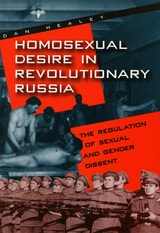
Homosexual Desire in Revolutionary Russia
The Regulation of Sexual and Gender DissentDan Healey
University of Chicago Press, 2001
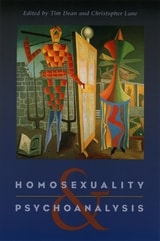
Homosexuality and Psychoanalysis
Edited by Tim Dean and Christopher Lane
University of Chicago Press, 2001
Why has homosexuality always fascinated and vexed psychoanalysis? This groundbreaking collection of original essays reconsiders the troubled relationship between same-sex desire and psychoanalysis, assessing homosexuality's status in psychoanalytic theory and practice, as well as the value of psychoanalytic ideas for queer theory. The contributors, each distinguished clinicians and specialists, reexamine works by Freud, Klein, Reich, Lacan, Laplanche, and their feminist and queer revisionists. Sharing a commitment to conscious and unconscious forms of homosexual desire, they offer new perspectives on pleasure, perversion, fetishism, disgust, psychosis, homophobia, AIDS, otherness, and love. Including two previously untranslated essays by Michel Foucault, Homosexuality and Psychoanalysis will interest cultural theorists, psychoanalysts, and anyone concerned with the fate of sexuality in our time.
Contributors:
Lauren Berlant
Leo Bersani
Daniel L. Buccino
Arnold I. Davidson
Tim Dean
Jonathan Dollimore
Brad Epps
Michel Foucault
Lynda Hart
Jason B. Jones
Christopher Lane
H. N. Lukes
Catherine Millot
Elizabeth A. Povinelli
Ellie Ragland
Paul Robinson
Judith Roof
Joanna Ryan
Ramón E. Soto-Crespo
Suzanne Yang
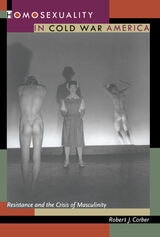
Homosexuality in Cold War America
Resistance and the Crisis of MasculinityRobert J. Corber
Duke University Press, 1997
By exploring the representation of gay men in film noir, Corber suggests that even as this Hollywood genre reinforced homophobic stereotypes, it legitimized the gay male "gaze." He emphasizes how film noir’s introduction of homosexual characters countered the national "project" to render gay men invisible, and marked a deep subversion of the Cold War mentality. Corber then considers the work of gay male writers Tennessee Williams, Gore Vidal, and James Baldwin, demonstrating how these authors declined to represent homosexuality as a discrete subculture and instead promoted a model of political solidarity rooted in the shared experience of oppression. Homosexuality in Cold War America reveals that the ideological critique of the dominant culture made by gay male authors of the 1950s laid the foundation for the gay liberation movement of the following decade.

How to Do the History of Homosexuality
David M. Halperin
University of Chicago Press, 2002
Dealing both with male homosexuality and with lesbianism, this study imparts to the history of sexuality a renewed sense of adventure and daring. It recovers the radical design of Michel Foucault's epochal work, salvaging Foucault's insights from common misapprehensions and making them newly available to historians, so that they can once again provide a powerful impetus for innovation in the field. Far from having exhausted Foucault's revolutionary ideas, Halperin maintains that we have yet to come to terms with their startling implications. Exploring the broader significance of historicizing desire, Halperin questions the tendency among scholars to reduce the history of sexuality to a mere history of sexual classifications instead of a history of human subjectivity itself. Finally, in a theoretical tour de force, Halperin offers an altogether new strategy for approaching the history of homosexuality—one that can accommodate both ruptures and continuities, both identity and difference in sexual experiences across time and space.
Impassioned but judicious, controversial but deeply informed, How to Do the History of Homosexuality is a book rich in suggestive propositions as well as eye-opening details. It will prove to be essential reading for anyone interested in the history of sexuality.