Results by title
76 books match the query 'House' and 20 start with h

HOUSE OF POURED OUT WATERS
POEMSJane Mead
University of Illinois Press, 2001
More than anything, it is her spiritual dimension that offers Mead a way into the future--but that way must be paved, image by image, with the world before her. Simultaneously conversational and lyrical, these fearless poems extend the possibilities of narrative verse.
House A
Jennifer S. Cheng
Omnidawn, 2016
House A is the winner of the 2015 Omnidawn 1st/2nd Poetry Book Prize, selected by Claudia Rankine.

House Of Cards
Baseball Card Collecting and Popular CultureJohn Bloom
University of Minnesota Press, 1997
Explores the connection between baseball card collecting and nostalgia among men of the baby boom.
Baseball card collecting carries with it images of idealized boyhoods in the sprawling American suburbs of the postwar era. Yet in the past twenty years, it has grown from a pastime for children to a big-money pursuit taken seriously by adults. In A House of Cards, John Bloom uses interviews with collectors, dealers, and hobbyists as well as analysis of the baseball card industry and extensive firsthand observations to ask what this hobby tells us about nostalgia, work, play, masculinity, and race and gender relations among collectors.
Beginning in the late 1970s and into the early 1990s, baseball card collecting grew into a business that embodied traditional masculine values such as competition, savvy, and industry. In A House of Cards, Bloom interviews collectors who reveal ambivalence about the hobby’s emphasis on these values, often focusing on its alienating, lonely, and unfulfilling aspects. They express nostalgia for the ideal childhood world many middle-class white males experienced in the postwar years, when they perceived baseball card collecting as a form of play, not a moneymaking enterprise. Bloom links this nostalgia to anxieties about deindustrialization and the rise of the civil rights, feminist, and gay rights movements. He examines the gendered nature of swap meets as well as the views of masculinity expressed by the collectors: Is the purpose of baseball card collecting to form a community of adults to reminisce or to inculcate young men with traditional masculine values? Is it to establish “connectedness” or to make money? Are collectors striving to reinforce the dominant culture or question it through their attempts to create their own meaning out of what are, in fact, mass-produced commercial artifacts? Bloom provides a fascinating exploration of male fan culture, ultimately providing insight into the ways white men of the baby boom view themselves, masculinity, and the culture at large. [Excerpt:]“Collectors often decried how money had ruined their hobby, making it hard for them to form meaningful friendships through their cards. Money, however, made the hobby not only profitable but also more serious, more instrumental, and therefore more manly. The same collectors who complained about greed often bragged in the same interview about the value of their cards. Yet money, in turn, made the hobby less akin to child’s play and more like work: lonely, competitive, unfulfilling, and alienating.”
House Of Incest
Anaïs Nin
Ohio University Press, 1958
With an introduction by Allison Pease, this new edition of House of Incest is a lyrical journey into the subconscious mind of one of the most celebrated feminist writers of the twentieth-century.
Originally published in 1936, House of Incest is Anaïs Nin’s first work of fiction. Based on Nin’s dreams, the novel is a surrealistic look within the narrator’s subconscious as she attempts to distance herself from a series of all-consuming and often taboo desires she cannot bear to let go. The incest Nin depicts is a metaphor—a selfish love wherein a woman can appreciate only qualities in a lover that are similar to her own. Through a descriptive exploration of romances and attractions between women, between a sister and her beloved brother, and with a Christ-like man, Nin’s narrator discovers what she thinks is truth: that a woman’s most perfect love is of herself. At first, this self-love seems ideal because it is attainable without fear and risk of heartbreak. But in time, the narrator’s chosen isolation and self-possessed anguish give way to a visceral nightmare from which she is unable to wake.
House and Street
The Domestic World of Servants and Masters in Nineteenth-Century Rio de JaneiroBy Sandra Lauderdale Graham
University of Texas Press, 1992
During the later half of the nineteenth century, a majority of Brazilian women worked, most as domestic servants, either slave or free. House and Street re-creates the working and personal lives of these women, drawing on a wealth of documentation from archival, court, and church records.
Lauderdale Graham traces the intricate and ambivalent relations that existed between masters and servants. She shows how for servants the house could be a place of protection—as well as oppression—while the street could be dangerous—but also more autonomous. She integrates her discoveries with larger events taking place in Rio de Janeiro during the period, including the epidemics of the 1850s, the abolition of slavery, the demolition of slums, and major improvements in sanitation during the first decade of the 1900s.
House of Day, House of Night
Olga Tokarczuk
Northwestern University Press, 2003
Winner of the Gunter Grass Prize
Nowa Ruda is a small town in Silesia, an area that has been a part of Poland, Germany, and the former Czechoslovakia in the past. When the narrator moves into the area, she and discovers everyone-and everything-has its own story. With the help of Marta, her enigmatic neighbor, the narrator accumulates these stories, tracing the history of Nowa Ruda from the founding of the town to the lives of its saints, from the caller who wins the radio quiz every day to the tale of the man who causes international tension when he dies on the border, one leg on the Polish side, the other on the Czech side. Each of the stories represents a brick and they interlock to reveal the immense monument that is the town. What emerges is the message that the history of any place--no matter how humble--is limitless, that by describing or digging at the roots of a life, a house, or a neighborhood, one can see all the connections, not only with one's self and one's dreams but also with all of the universe.
Richly imagined, weaving in anecdote with recipes and gossip, Tokarczuk's novel is an epic of a small place. Since its original publication in 1998 it has remained a bestseller in Poland. House of Day, House of Night is the English-language debut of one of Europe's best young writers.
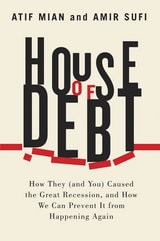
House of Debt
How They (and You) Caused the Great Recession, and How We Can Prevent It from Happening AgainAtif Mian and Amir Sufi
University of Chicago Press, 2014
Though the banking crisis captured the public’s attention, Mian and Sufi argue strongly with actual data that current policy is too heavily biased toward protecting banks and creditors. Increasing the flow of credit, they show, is disastrously counterproductive when the fundamental problem is too much debt. As their research shows, excessive household debt leads to foreclosures, causing individuals to spend less and save more. Less spending means less demand for goods, followed by declines in production and huge job losses. How do we end such a cycle? With a direct attack on debt, say Mian and Sufi. More aggressive debt forgiveness after the crash helps, but as they illustrate, we can be rid of painful bubble-and-bust episodes only if the financial system moves away from its reliance on inflexible debt contracts. As an example, they propose new mortgage contracts that are built on the principle of risk-sharing, a concept that would have prevented the housing bubble from emerging in the first place.
Thoroughly grounded in compelling economic evidence, House of Debt offers convincing answers to some of the most important questions facing the modern economy today: Why do severe recessions happen? Could we have prevented the Great Recession and its consequences? And what actions are needed to prevent such crises going forward?
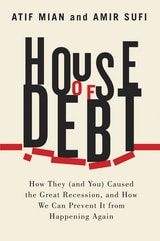
House of Debt
How They (and You) Caused the Great Recession, and How We Can Prevent It from Happening AgainAtif Mian and Amir Sufi
University of Chicago Press, 2014
Though the banking crisis captured the public’s attention, Mian and Sufi argue strongly with actual data that current policy is too heavily biased toward protecting banks and creditors. Increasing the flow of credit, they show, is disastrously counterproductive when the fundamental problem is too much debt. As their research shows, excessive household debt leads to foreclosures, causing individuals to spend less and save more. Less spending means less demand for goods, followed by declines in production and huge job losses. How do we end such a cycle? With a direct attack on debt, say Mian and Sufi. More aggressive debt forgiveness after the crash helps, but as they illustrate, we can be rid of painful bubble-and-bust episodes only if the financial system moves away from its reliance on inflexible debt contracts. As an example, they propose new mortgage contracts that are built on the principle of risk-sharing, a concept that would have prevented the housing bubble from emerging in the first place.
Thoroughly grounded in compelling economic evidence, House of Debt offers convincing answers to some of the most important questions facing the modern economy today: Why do severe recessions happen? Could we have prevented the Great Recession and its consequences? And what actions are needed to prevent such crises going forward?
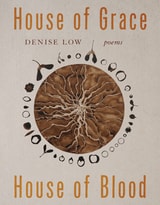
House of Grace, House of Blood
PoemsDenise Low
University of Arizona Press, 2024
In a personal poetic treatment of documents, oral tradition, and images, the author embodies the contradictions she unravels. From a haunting first-person perspective, Low’s formally inventive archival poetry combines prose and lyric, interweaving verse with historical voices in a dialogue with the source material. Each poem builds into a larger narrative on American genocide, the ways in which human loss corresponds to ecological destruction, and how intimate knowledge of the past can enact healing.
Ultimately, these poems not only reconstruct an important historical event, but they also put pressure on the gaps, silences, and violence of the archive. Low asks readers to question not only what is remembered, but how history is remembered—and who is forgotten from it. Reflecting on the injustice of the massacre, the Shawnee leader Tecumseh lamented that though “the Americans murdered all the men, women, and children, even as they prayed to Jesus . . . no American ever was punished, not one.” These poems challenge this attempted erasure.
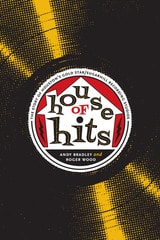
House of Hits
The Story of Houston's Gold Star/SugarHill Recording StudiosBy Andy Bradley and Roger Wood
University of Texas Press, 2010
Founded in a working-class neighborhood in southeast Houston in 1941, Gold Star/SugarHill Recording Studios is a major independent studio that has produced a multitude of influential hit records in an astonishingly diverse range of genres. Its roster of recorded musicians includes Lightnin' Hopkins, George Jones, Willie Nelson, Bobby "Blue" Bland, Junior Parker, Clifton Chenier, Sir Douglas Quintet, 13th Floor Elevators, Freddy Fender, Kinky Friedman, Ray Benson, Guy Clark, Lucinda Williams, Beyoncé and Destiny's Child, and many, many more.
In House of Hits, Andy Bradley and Roger Wood chronicle the fascinating history of Gold Star/SugarHill, telling a story that effectively covers the postwar popular music industry. They describe how Houston's lack of zoning ordinances allowed founder Bill Quinn's house studio to grow into a large studio complex, just as SugarHill's willingness to transcend musical boundaries transformed it into of one of the most storied recording enterprises in America. The authors offer behind-the-scenes accounts of numerous hit recordings, spiced with anecdotes from studio insiders and musicians who recorded at SugarHill. Bradley and Wood also place significant emphasis on the role of technology in shaping the music and the evolution of the music business. They include in-depth biographies of regional stars and analysis of the various styles of music they represent, as well as a list of all of Gold Star/SugarHill's recordings that made the Billboard charts and extensive selected historical discographies of the studio's recordings.
House of Houses
Pat Mora
University of Arizona Press, 1997
House of Incest
Anaïs Nin
Ohio University Press, 1958
With an introduction by Allison Pease, this new edition of House of Incest is a lyrical journey into the subconscious mind of one of the most celebrated feminist writers of the twentieth-century.
Originally published in 1936, House of Incest is Anaïs Nin’s first work of fiction. Based on Nin’s dreams, the novel is a surrealistic look within the narrator’s subconscious as she attempts to distance herself from a series of all-consuming and often taboo desires she cannot bear to let go. The incest Nin depicts is a metaphor—a selfish love wherein a woman can appreciate only qualities in a lover that are similar to her own. Through a descriptive exploration of romances and attractions between women, between a sister and her beloved brother, and with a Christ-like man, Nin’s narrator discovers what she thinks is truth: that a woman’s most perfect love is of herself. At first, this self-love seems ideal because it is attainable without fear and risk of heartbreak. But in time, the narrator’s chosen isolation and self-possessed anguish give way to a visceral nightmare from which she is unable to wake.
House of McQueen
Valerie Wallace
Four Way Books, 2018
House of Mourning
A Biocultural History of the Mountain Meadows MassacreShannon A Novak
University of Utah Press, 2008
On September 11, 1857, some 120 men, women, and children from the Arkansas hills were murdered in the remote desert valley of Mountain Meadows, Utah. This notorious massacre was, in fact, a mass execution: having surrendered their weapons, the victims were bludgeoned to death or shot at point-blank range. The perpetrators were local Mormon militiamen whose motives have been fiercely debated for 150 years.
In House of Mourning, Shannon A. Novak goes beyond the question of motive to the question of loss. Who were the victims at Mountain Meadows? How had they settled and raised their families in the American South, and why were they moving west once again? What were they hoping to find or make for themselves at the end of the trail? By integrating archival records and oral histories with the first analysis of skeletal remains from the massacre site, Novak offers a detailed and sensitive portrait of the victims as individuals, family members, cultural beings, and living bodies.
The history of the massacre has often been treated as a morality tale whose chief purpose was to vilify (or to glorify) some collective body. Resisting this tendency to oversimplify the past, Novak explores Mountain Meadows as a busy and dangerous intersection of cultural and material forces in antebellum America. House of Mourning is a bold experiment in a new kind of history, the biocultural analysis of complex events.
Winner of the Society for Historical Archaeology James Deetz Book Award.
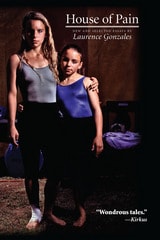
House of Pain
New and Selected EssaysLaurence Gonzales
University of Arkansas Press, 2013
Laurence Gonzales began his successful publishing career in 1989 with the publication of The Still Point and later The Hero’s Apprentice (1994), both with the University of Arkansas Press. From these collections of essays he went on to write for renowned magazines in addition to publishing several books, including the best selling Deep Survival. His journalism garnered two National Magazine Awards, and his latest nonfiction book, Surviving Survival, was named by Kirkus as one of the best books of 2012.
This new collection of essays shows us the sometimes hair-raising, sometimes heart-wrenching writing that Gonzales has become known for. This “compelling and trustworthy guide” (Booklist) takes us from a maximum-security prison to a cancer ward, from a mental institution to the World Trade Center. Among the essays included is “Marion Prison,” a National Magazine Award finalist, with its intimate view inside the most maximum security prison in America. “House of Pain” takes the reader into the life of a brain surgeon at Chicago’s Cook County Hospital, a grim world that few ever see. “Rites of Spring,” another National Magazine Award finalist, follows Gonzales and his wife on their journey through cancer, not once, but twice.
Other stories venture above the Arctic Circle, flying deep into the Alaskan wilderness among grizzly bears and trumpeter swans; explore aerobatics in high-performance aircraft; and eulogize Memphis and Miami as American cities that mourn their fates in uniquely different ways.
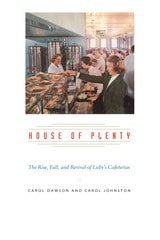
House of Plenty
The Rise, Fall, and Revival of Luby's CafeteriasBy Carol Dawson and Carol Johnston
University of Texas Press, 2006
Violet Crown Award, Writers League of Texas, 2007
Citation, San Antonio Conservation Society, 2009
Scarred by the deaths of his mother and sisters and the failure of his father's business, a young man dreamed of making enough money to retire early and retreat into the secure world that his childhood tragedies had torn from him. But Harry Luby refused to be a robber baron. Turning totally against the tide of avaricious capitalism, he determined to make a fortune by doing good. Starting with that unlikely, even naive, ambition in 1911, Harry Luby founded a cafeteria empire that by the 1980s had revenues second only to McDonald's. So successfully did Luby and his heirs satisfy the tastes of America that Luby's became the country's largest cafeteria chain, creating more millionaires per capita among its employees than any other corporation of its size. Even more surprising, the company stayed true to Harry Luby's vision for eight decades, making money by treating its customers and employees exceptionally well.
Written with the sweep and drama of a novel, House of Plenty tells the engrossing story of Luby's founding and phenomenal growth, its long run as America's favorite family restaurant during the post-World War II decades, its financial failure during the greed-driven 1990s when non-family leadership jettisoned the company's proven business model, and its recent struggle back to solvency. Carol Dawson and Carol Johnston draw on insider stories and company records to recapture the forces that propelled the company to its greatest heights, including its unprecedented practices of allowing store managers to keep 40 percent of net profits and issuing stock to all employees, which allowed thousands of Luby's workers to achieve the American dream of honestly earned prosperity. The authors also plumb the depths of the Luby's drama, including a hushed-up theft that split the family for decades; the 1991 mass shooting at the Killeen Luby's, which splattered the company's good name across headlines nationwide; and the rapacious over-expansion that more than doubled the company's size in nine years (1987-1996), pushed it into bankruptcy, and drove president and CEO John Edward Curtis Jr. to violent suicide.
Disproving F. Scott Fitzgerald's adage that "there are no second acts in American lives," House of Plenty tells the epic story of an iconic American institution that has risen, fallen, and found redemption—with no curtain call in sight.
House of Sparrows
New and Selected PoemsBetsy Sholl
University of Wisconsin Press, 2019
House of Sugar, House of Stone
Emily Pérez
University Press of Colorado, 2016

House, but No Garden
Apartment Living in Bombay's Suburbs, 1898-1964Nikhil Rao
University of Minnesota Press, 2013
Between the well-documented development of colonial Bombay and sprawling contemporary Mumbai, a profound shift in the city’s fabric occurred: the emergence of the first suburbs and their distinctive pattern of apartment living. In House, but No Garden Nikhil Rao considers this phenomenon and its significance for South Asian urban life. It is the first book to explore an organization of the middle-class neighborhood that became ubiquitous in the mid-twentieth-century city and that has spread throughout the subcontinent.
Rao examines how the challenge of converting lands from agrarian to urban use created new relations between the state, landholders, and other residents of the city. At the level of dwellings, apartment living in self-contained flats represented a novel form of urban life, one that expressed a compromise between the caste and class identities of suburban residents who are upper caste but belong to the lower-middle or middle class. Living in such a built environment, under the often conflicting imperatives of maintaining the exclusivity of caste and subcaste while assembling residential groupings large enough to be economically viable, led suburban residents to combine caste with class, type of work, and residence to forge new metacaste practices of community identity.
As it links the colonial and postcolonial city—both visually and analytically—Rao’s work traces the appearance of new spatial and cultural configurations in the middle decades of the twentieth century in Bombay. In doing so, it expands our understanding of how built environments and urban identities are constitutive of one another.
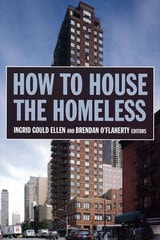
How to House the Homeless
Ingrid Gould Ellen
Russell Sage Foundation, 2010