Results by title
52 books match the query 'Idea' and 3 start with h
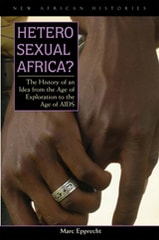
Heterosexual Africa?
The History of an Idea from the Age of Exploration to the Age of AIDSMarc Epprecht
Ohio University Press, 2008
Heterosexual Africa? The History of an Idea from the Age of Exploration to the Age of AIDS builds from Marc Epprecht’s previous book, Hungochani (which focuses explicitly on same-sex desire in southern Africa), to explore the historical processes by which a singular, heterosexual identity for Africa was constructed—by anthropologists, ethnopsychologists, colonial officials, African elites, and most recently, health care workers seeking to address the HIV/AIDS pandemic. This is an eloquently written, accessible book, based on a rich and diverse range of sources, that will find enthusiastic audiences in classrooms and in the general public.
Epprecht argues that Africans, just like people all over the world, have always had a range of sexualities and sexual identities. Over the course of the last two centuries, however, African societies south of the Sahara have come to be viewed as singularly heterosexual. Epprecht carefully traces the many routes by which this singularity, this heteronormativity, became a dominant culture. In telling a fascinating story that will surely generate lively debate, Epprecht makes his project speak to a range of literatures—queer theory, the new imperial history, African social history, queer and women’s studies, and biomedical literature on the HIV/AIDS pandemic. He does this with a light enough hand that his story is not bogged down by endless references to particular debates.
Heterosexual Africa? aims to understand an enduring stereotype about Africa and Africans. It asks how Africa came to be defined as a “homosexual-free zone” during the colonial era, and how this idea not only survived the transition to independence but flourished under conditions of globalization and early panicky responses to HIV/AIDS.
How New York Stole the Idea of Modern Art
Serge Guilbaut
University of Chicago Press, 1985
Husserl and the Idea of Europe
Timo Miettinen
Northwestern University Press, 2020
Husserl and the Idea of Europe argues that Edmund Husserl’s late reflections on Europe should not be read either as departures from his early transcendental phenomenology or as simple exercises of cultural criticism but rather as systematic phenomenological reflections on generativity and historicity. Timo Miettinen shows that Husserl’s deliberations on Europe contain his most compelling and radical interpretation of the intersubjective, communal, and historical dimensions of phenomenology.
Husserl and his generation worked in the aftermath of World War I, as Europe struggled to redefine itself, and he penned his late writings as the clouds of World War II gathered. Decades later, the fall of the Soviet Union again altered the continent’s identity and its political and economic divisions. Miettinen writes as a European involved in the question of Europe, and many of the recent authors and critics he addresses in this work—such as Michel Foucault, Jacques Derrida, and Giorgio Agamben—likewise deeply engaged with this new problem of European identity. The book illuminates the multifaceted problem of the idea of European rationality, and it defends novel conceptions of universalism and teleology as necessary components of radical philosophical reflection.