Results by title
69 books match the query 'Images' and 2 start with h
Haeckel's Embryos
Images, Evolution, and FraudNick Hopwood
University of Chicago Press, 2015
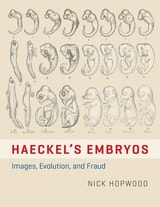
Pictures from the past powerfully shape current views of the world. In books, television programs, and websites, new images appear alongside others that have survived from decades ago. Among the most famous are drawings of embryos by the Darwinist Ernst Haeckel in which humans and other vertebrates begin identical, then diverge toward their adult forms. But these icons of evolution are notorious, too: soon after their publication in 1868, a colleague alleged fraud, and Haeckel’s many enemies have repeated the charge ever since. His embryos nevertheless became a textbook staple until, in 1997, a biologist accused him again, and creationist advocates of intelligent design forced his figures out. How could the most controversial pictures in the history of science have become some of the most widely seen?
In Haeckel’s Embryos, Nick Hopwood tells this extraordinary story in full for the first time. He tracks the drawings and the charges against them from their genesis in the nineteenth century to their continuing involvement in innovation in the present day, and from Germany to Britain and the United States. Emphasizing the changes worked by circulation and copying, interpretation and debate, Hopwood uses the case to explore how pictures succeed and fail, gain acceptance and spark controversy. Along the way, he reveals how embryonic development was made a process that we can see, compare, and discuss, and how copying—usually dismissed as unoriginal—can be creative, contested, and consequential.
With a wealth of expertly contextualized illustrations, Haeckel’s Embryos recaptures the shocking novelty of pictures that enthralled schoolchildren and outraged priests, and highlights the remarkable ways these images kept on shaping knowledge as they aged.
[more]
Happy Days
Images of the Pre-Sixties Past in Seventies AmericaBenjamin L. Alpers
Rutgers University Press, 2024
After the techno-futurism of the 1950s and the utopian 1960s vision of a “great society,” the 1970s saw Americans turning to the past as a source for both nostalgic escapism and serious reflection on the nation’s history. While some popular works like Grease presented the relatively recent past as a more innocent time, far away from the nation’s post-Vietnam, post-Watergate malaise, others like Roots used America’s bicentennial as an occasion for deep soul-searching.
Happy Days investigates how 1970s popular culture was obsessed with America’s past but often offered radically different interpretations of the same historical events and icons. Even the figure of the greaser, once an icon of juvenile delinquency, was made family-friendly by Henry Winkler’s Fonzie at the same time that he was being appropriated in more threatening ways by punk and gay subcultures. The cultural historian Benjamin Alpers discovers similar levels of ambivalence toward the past in 1970s neo-noir films, representations of America’s founding, and neo-slave narratives by Alex Haley and Octavia Butler. By exploring how Americans used the 1970s to construct divergent representations of their shared history, he identifies it as a pivotal moment in the nation’s ideological fracturing.
Happy Days investigates how 1970s popular culture was obsessed with America’s past but often offered radically different interpretations of the same historical events and icons. Even the figure of the greaser, once an icon of juvenile delinquency, was made family-friendly by Henry Winkler’s Fonzie at the same time that he was being appropriated in more threatening ways by punk and gay subcultures. The cultural historian Benjamin Alpers discovers similar levels of ambivalence toward the past in 1970s neo-noir films, representations of America’s founding, and neo-slave narratives by Alex Haley and Octavia Butler. By exploring how Americans used the 1970s to construct divergent representations of their shared history, he identifies it as a pivotal moment in the nation’s ideological fracturing.
[more]