Results by title
65 books match the query 'Imperialism in literature' and 2 start with h

Heartless Immensity
Literature, Culture, and Geography in Antebellum AmericaAnne Baker
University of Michigan Press, 2010
Building on extensive archival research as well as insights from cultural geographers and theorists of nationhood, Heartless Immensity demonstrates that national expansion had a far more complicated, multifaceted impact on antebellum American culture than has previously been recognized. Baker shows that Americans developed a variety of linguistic strategies for imagining the form of the United States and its position in relation to other geopolitical entities. Comparisons
to European empires, biblical allusions, body politic metaphors, and metaphors derived from science all reflected—and often attempted to assuage—fears that the nation was becoming either monstrously large or else misshapen in ways that threatened cherished beliefs and national self-images.
Heartless Immensity argues that, in order to understand the nation’s shift from republic to empire and to understand American culture in a global context, it is first necessary to pay close attention to the processes by which the physical entity known as the United States came into being. This impressively thorough study will make a valuable contribution to the fields of American studies and literary studies.
Anne Baker is Assistant Professor of English at North Carolina State University.
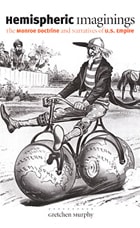
Hemispheric Imaginings
The Monroe Doctrine and Narratives of U.S. EmpireGretchen Murphy
Duke University Press, 2005
Murphy juxtaposes close readings of novels with analyses of nonfiction texts. From uncovering the literary inspirations for the Monroe Doctrine itself to tracing visions of hemispheric unity and transatlantic separation in novels by Lydia Maria Child, Nathaniel Hawthorne, María Amparo Ruiz de Burton, Lew Wallace, and Richard Harding Davis, she reveals the Doctrine’s forgotten cultural history. In making a vital contribution to the effort to move American Studies beyond its limited focus on the United States, Murphy questions recent proposals to reframe the discipline in hemispheric terms. She warns that to do so risks replicating the Monroe Doctrine’s proprietary claim to isolate the Americas from the rest of the world.