Results by title
130 books match the query 'Indonesia' and 2 start with h
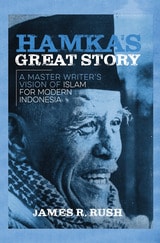
Hamka’s Great Story
A Master Writer’s Vision of Islam for Modern IndonesiaJames R. Rush
University of Wisconsin Press, 2016
Hamka’s Great Story presents Indonesia through the eyes of an impassioned, popular thinker who believed that Indonesians and Muslims everywhere should embrace the thrilling promises of modern life, and navigate its dangers, with Islam as their compass.
Hamka (Haji Abdul Malik Karim Amrullah) was born when Indonesia was still a Dutch colony and came of age as the nation itself was emerging through tumultuous periods of Japanese occupation, revolution, and early independence. He became a prominent author and controversial public figure. In his lifetime of prodigious writing, Hamka advanced Islam as a liberating, enlightened, and hopeful body of beliefs around which the new nation could form and prosper. He embraced science, human agency, social justice, and democracy, arguing that these modern concepts comported with Islam’s true teachings. Hamka unfolded this big idea—his Great Story—decade by decade in a vast outpouring of writing that included novels and poems and chatty newspaper columns, biographies, memoirs, and histories, and lengthy studies of theology including a thirty-volume commentary on the Holy Qur’an. In introducing this influential figure and his ideas to a wider audience, this sweeping biography also illustrates a profound global process: how public debates about religion are shaping national societies in the postcolonial world.
Hamka (Haji Abdul Malik Karim Amrullah) was born when Indonesia was still a Dutch colony and came of age as the nation itself was emerging through tumultuous periods of Japanese occupation, revolution, and early independence. He became a prominent author and controversial public figure. In his lifetime of prodigious writing, Hamka advanced Islam as a liberating, enlightened, and hopeful body of beliefs around which the new nation could form and prosper. He embraced science, human agency, social justice, and democracy, arguing that these modern concepts comported with Islam’s true teachings. Hamka unfolded this big idea—his Great Story—decade by decade in a vast outpouring of writing that included novels and poems and chatty newspaper columns, biographies, memoirs, and histories, and lengthy studies of theology including a thirty-volume commentary on the Holy Qur’an. In introducing this influential figure and his ideas to a wider audience, this sweeping biography also illustrates a profound global process: how public debates about religion are shaping national societies in the postcolonial world.
[more]
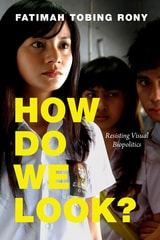
How Do We Look?
Resisting Visual BiopoliticsFatimah Tobing Rony
Duke University Press, 2022
In How Do We Look? Fatimah Tobing Rony draws on transnational images of Indonesian women as a way to theorize what she calls visual biopolitics—the ways visual representation determines which lives are made to matter more than others. Rony outlines the mechanisms of visual biopolitics by examining Paul Gauguin’s 1893 portrait of Annah la Javanaise—a trafficked thirteen-year-old girl found wandering the streets of Paris—as well as US ethnographic and documentary films. In each instance, the figure of the Indonesian woman is inextricably tied to discourses of primitivism, savagery, colonialism, exoticism, and genocide. Rony also focuses on acts of resistance to visual biopolitics in film, writing, and photography. These works, such as Rachmi Diyah Larasati’s The Dance that Makes You Vanish, Vincent Monnikendam’s Mother Dao (1995), and the collaborative films of Nia Dinata, challenge the naturalized methods of seeing that justify exploitation, dehumanization, and early death of people of color. By theorizing the mechanisms of visual biopolitics, Rony elucidates both its violence and its vulnerability.
[more]