Results by title
71 books match the query 'Inequality' and 2 start with h

Hierarchies of Care
Girls, Motherhood, and Inequality in PeruKrista E. Van Vleet
University of Illinois Press, 2019
Palomitáy is an orphanage in highland Peru that provides a home for unmarried mothers as young as twelve years old. In their ordinary lives, these young women encounter diverse social expectations and face moral dilemmas. They endeavor to create a ‘good life’ for themselves and their children in a context complicated by competing demands, economic uncertainties, and structured relations of power. Drawing on a year of qualitative on-site research, Krista E. Van Vleet offers a rich ethnography of Palomitáy's young women. She pays particular attention to the moral entanglements that emerge via people's efforts to provide care amid the inequalities and insecurities of today's Peru. State and nonstate participants involved in the women's intimate lives influence how the women see themselves as mothers, students, and citizens. Both deserving of care and responsible for caring for others, the young women must navigate practices interwoven with a range of a racial, gendered, and class hierarchies. Groundbreaking and original, Hierarchies of Care highlights the moral engagement of young women seeking to understand themselves and their place in society in the presence of circumstances that are both precarious and full of hope.
[more]
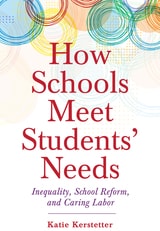
How Schools Meet Students' Needs
Inequality, School Reform, and Caring LaborKatie Kerstetter
Rutgers University Press, 2023
Meeting students’ basic needs – including ensuring they have access to nutritious meals and a sense of belonging and connection to school – can positively influence students’ academic performance. Recognizing this connection, schools provide resources in the form of school meals programs, school nurses, and school guidance counselors. However, these resources are not always available to students and are not always prioritized in school reform policies, which tend to focus more narrowly on academic learning. This book is about the balancing act that schools and their teachers undertake to respond to the social, emotional, and material needs of their students in the context of standardized testing and accountability policies. Drawing on conversations with teachers and classroom observations in two elementary schools, How Schools Meet Students’ Needs explores the factors that both enable and constrain teachers in their efforts to meet students’ needs and the consequences of how schools organize this work on teachers’ labor and students’ learning.
[more]