84 books match the query 'Instruction & Study' and 4 start with h

cover of Harmony

Harmony

Heinrich Schenker

University of Chicago Press, 1954
Harmony, Heinrich Schenker's first published work, originally appeared in German in 1906 as "New Musical Theories and Phantasies, by an Artist." Its unusual title indicates what was to be the rationale of Schenker's lifework, that artistic problems call for artistic solutions. Schenker's dedication to the formulation of a complete musical theory above the commonplace theoretical discussions was, in essence, his quest for a pattern in nature for music as art. Schenker's theory draws upon a profound understanding of the works of the masters and every proposition is illustrated by a living musical example.
[more]
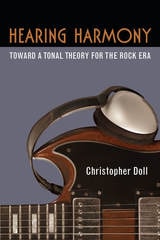
cover of Hearing Harmony: Toward a Tonal Theory for the Rock Era

Hearing Harmony

Toward a Tonal Theory for the Rock Era

Christopher Doll

University of Michigan Press, 2017
Hearing Harmony offers a listener-based, philosophical-psychological theory of harmonic effects for Anglophone popular music since the 1950s. It begins with chords, their functions and characteristic hierarchies, then identifies the most common and salient harmonic-progression classes, or harmonic schemas. The identification of these schemas, as well as the historical contextualization of many of them, allows for systematic exploration of the repertory’s typical harmonic transformations (such as chord substitution) and harmonic ambiguities. Doll provides readers with a novel explanation of the assorted aural qualities of chords, and how certain harmonic effects result from the interaction of various melodic, rhythmic, textural, timbral, and extra-musical contexts, and how these interactions can determine whether a chordal riff is tonally centered or tonally ambiguous, whether it sounds aggressive or playful or sad, whether it seems to evoke an earlier song using a similar series of chords, whether it sounds conventional or unfamiliar.

[more]
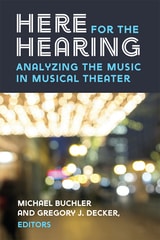
cover of Here for the Hearing: Analyzing the Music in Musical Theater

Here for the Hearing

Analyzing the Music in Musical Theater

Michael Buchler and Gregory J. Decker, Editors

University of Michigan Press, 2023

Winner of the Society for Music Theory's Outstanding Multi-Author Collection Award

This book offers a series of essays that show the integrated role that musical structure (including harmony, melody, rhythm, meter, form, and musical association) plays in making sense of what transpires onstage in musicals. Written by a group of music analysts who care deeply about musical theater, this collection provides new understanding of how musicals are put together, how composers and lyricists structure words and music to complement one another, and how music helps us understand the human relationships and historical and social contexts. Using a wide range of musical examples, representing the history of musical theater from the 1920s to the present day, the book explores how music interacts with dramatic elements within individual shows and other pieces within and outside of the genre. These essays invite readers to consider issues that are fundamental both to our understanding of musical theater and to the multiple ways we engage with music.
[more]
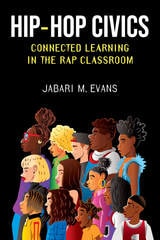
cover of Hip-Hop Civics: Connected Learning in the Rap Classroom

Hip-Hop Civics

Connected Learning in the Rap Classroom

Jabari M. Evans

University of Michigan Press, 2025

In Hip-Hop Civics, Jabari Evans demonstrates how Hip-Hop can be deployed in revamping formal civic education for Black and Brown youth. Based on an original ethnographic study of a Hip-Hop-based education program, the Songwriting and Production Program (SWP) administered by the Foundation of Music in two of Chicago’s lowest performing public schools, Evans argues that Hip-Hop culture is central to students’ lives and can be used as a vehicle for students to engage in civic practices and extract critical lessons about mainstream media, relational currency, identity development, and race/racism within the classroom. Through a compelling exploration of the SWP program, Evans contends that Hip-Hop should be part of formal education spaces and instruction, a conclusion he reaches through his understanding of how Hip-Hop impacted his own life, and by witnessing students discuss, write, and produce Hip-Hop music as part of the SWP program. 
 
[more]