Results by title
84 books match the query 'International cooperation' and 3 start with h

Handbook for International Management Research
Betty Jane Punnett and Oded Shenkar, Editors
University of Michigan Press, 2004
Success in business today requires an understanding of the nature of globalization and its impact on managers. Now in a fully revised second edition, The Handbook for International Management Research provides a complete and up-to-date assessment of the field of international management. Part 1 provides a useful context and overview for the book. Part 2, "Designing Effective Research," will help readers develop effective, rigorous, and theory-based research designs for international management research, including qualitative research and experimental methods. Part 3, "Topical Issues in International Management Research," explores areas such as cross-cultural management, international alliances, human resources, and negotiations research. The conclusion to the volume considers where and how the field should progress.
Intended primarily for those doing research in the field of international management, this book should also interest scholars and students of public institutions, sociology, and industrial psychology. Managers will find the book's comprehensive overview of international management to be invaluable. Its global perspective will appeal to readers around the world.
[more]

How Knowledge Moves
Writing the Transnational History of Science and TechnologyEdited by John Krige
University of Chicago Press, 2019
Knowledge matters, and states have a stake in managing its movement to protect a variety of local and national interests. The view that knowledge circulates by itself in a flat world, unimpeded by national boundaries, is a myth. The transnational movement of knowledge is a social accomplishment, requiring negotiation, accommodation, and adaptation to the specificities of local contexts. This volume of essays by historians of science and technology breaks the national framework in which histories are often written. Instead, How Knowledge Moves takes knowledge as its central object, with the goal of unraveling the relationships among people, ideas, and things that arise when they cross national borders.
This specialized knowledge is located at multiple sites and moves across borders via a dazzling array of channels, embedded in heads and hands, in artifacts, and in texts. In the United States, it shapes policies for visas, export controls, and nuclear weapons proliferation; in Algeria, it enhances the production of oranges by colonial settlers; in Vietnam, it facilitates the exploitation of a river delta. In India it transforms modes of agricultural production. It implants American values in Latin America. By concentrating on the conditions that allow for knowledge movement, these essays explore travel and exchange in face-to-face encounters and show how border-crossings mobilize extensive bureaucratic technologies.
This specialized knowledge is located at multiple sites and moves across borders via a dazzling array of channels, embedded in heads and hands, in artifacts, and in texts. In the United States, it shapes policies for visas, export controls, and nuclear weapons proliferation; in Algeria, it enhances the production of oranges by colonial settlers; in Vietnam, it facilitates the exploitation of a river delta. In India it transforms modes of agricultural production. It implants American values in Latin America. By concentrating on the conditions that allow for knowledge movement, these essays explore travel and exchange in face-to-face encounters and show how border-crossings mobilize extensive bureaucratic technologies.
[more]
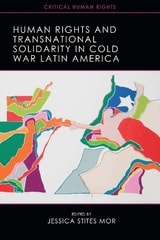
Human Rights and Transnational Solidarity in Cold War Latin America
Edited by Jessica Stites Mor
University of Wisconsin Press, 2013
With the end of the global Cold War, the struggle for human rights has emerged as one of the most controversial forces of change in Latin America. Many observers seek the foundations of that movement in notions of rights and models of democratic institutions that originated in the global North. Challenging that view, this volume argues that Latin American community organizers, intellectuals, novelists, priests, students, artists, urban pobladores, refugees, migrants, and common people have contributed significantly to new visions of political community and participatory democracy. These local actors built an alternative transnational solidarity from below with significant participation of the socially excluded and activists in the global South.
Edited by Jessica Stites Mor, this book offers fine-grained case studies that show how Latin America’s re-emerging Left transformed the struggles against dictatorship and repression of the Cold War into the language of anti-colonialism, socioeconomic rights, and identity.
Edited by Jessica Stites Mor, this book offers fine-grained case studies that show how Latin America’s re-emerging Left transformed the struggles against dictatorship and repression of the Cold War into the language of anti-colonialism, socioeconomic rights, and identity.
[more]