Results by title
328 books match the query 'Islam' and 6 start with h
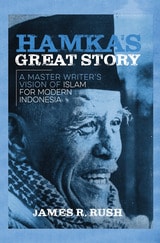
Hamka’s Great Story
A Master Writer’s Vision of Islam for Modern IndonesiaJames R. Rush
University of Wisconsin Press, 2016
Hamka’s Great Story presents Indonesia through the eyes of an impassioned, popular thinker who believed that Indonesians and Muslims everywhere should embrace the thrilling promises of modern life, and navigate its dangers, with Islam as their compass.
Hamka (Haji Abdul Malik Karim Amrullah) was born when Indonesia was still a Dutch colony and came of age as the nation itself was emerging through tumultuous periods of Japanese occupation, revolution, and early independence. He became a prominent author and controversial public figure. In his lifetime of prodigious writing, Hamka advanced Islam as a liberating, enlightened, and hopeful body of beliefs around which the new nation could form and prosper. He embraced science, human agency, social justice, and democracy, arguing that these modern concepts comported with Islam’s true teachings. Hamka unfolded this big idea—his Great Story—decade by decade in a vast outpouring of writing that included novels and poems and chatty newspaper columns, biographies, memoirs, and histories, and lengthy studies of theology including a thirty-volume commentary on the Holy Qur’an. In introducing this influential figure and his ideas to a wider audience, this sweeping biography also illustrates a profound global process: how public debates about religion are shaping national societies in the postcolonial world.
Hamka (Haji Abdul Malik Karim Amrullah) was born when Indonesia was still a Dutch colony and came of age as the nation itself was emerging through tumultuous periods of Japanese occupation, revolution, and early independence. He became a prominent author and controversial public figure. In his lifetime of prodigious writing, Hamka advanced Islam as a liberating, enlightened, and hopeful body of beliefs around which the new nation could form and prosper. He embraced science, human agency, social justice, and democracy, arguing that these modern concepts comported with Islam’s true teachings. Hamka unfolded this big idea—his Great Story—decade by decade in a vast outpouring of writing that included novels and poems and chatty newspaper columns, biographies, memoirs, and histories, and lengthy studies of theology including a thirty-volume commentary on the Holy Qur’an. In introducing this influential figure and his ideas to a wider audience, this sweeping biography also illustrates a profound global process: how public debates about religion are shaping national societies in the postcolonial world.
[more]
Heir to the Crescent Moon
Abdur-Rahman, Sufiya
University of Iowa Press, 2021
From age five, Sufiya Abdur-Rahman, the daughter of two Black Power–era converts to Islam, feels drawn to the faith even as her father, a devoted Muslim, introduces her to and, at the same time, distances her from it. Abdur-Rahman’s father and mother abandoned their Harlem mosque before she was born and divorced when she was twelve. Forced apart from her father—her portal into Islam—she yearns to reconnect with the religion and, through it, reconnect with him.
In Heir to the Crescent Moon, Abdur-Rahman’s longing to comprehend her father’s complicated relationship with Islam leads her first to recount her own history, and then delves into her father’s past. She journeys from the Christian righteousness of Adam Clayton Powell Jr.’s 1950s Harlem, through the Malcolm X–inspired college activism of the late 1960s, to the unfulfilled potential of the early 1970s Black American Muslim movement. Told at times with lighthearted humor or heartbreaking candor, Abdur-Rahman’s story of adolescent Arabic lessons, fasting, and Muslim mosque, funeral, and Eid services speaks to the challenges of bridging generational and cultural divides and what it takes to maintain family amidst personal and societal upheaval. She weaves a vital tale about a family: Black, Muslim, and distinctly American.
In Heir to the Crescent Moon, Abdur-Rahman’s longing to comprehend her father’s complicated relationship with Islam leads her first to recount her own history, and then delves into her father’s past. She journeys from the Christian righteousness of Adam Clayton Powell Jr.’s 1950s Harlem, through the Malcolm X–inspired college activism of the late 1960s, to the unfulfilled potential of the early 1970s Black American Muslim movement. Told at times with lighthearted humor or heartbreaking candor, Abdur-Rahman’s story of adolescent Arabic lessons, fasting, and Muslim mosque, funeral, and Eid services speaks to the challenges of bridging generational and cultural divides and what it takes to maintain family amidst personal and societal upheaval. She weaves a vital tale about a family: Black, Muslim, and distinctly American.
[more]
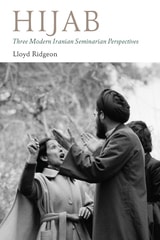
Hijab
Three Modern Iranian Seminarian PerspectivesLloyd Ridgeon
Gingko, 2021
This book provides an overview of the range of seminarian thinking in Iran on the controversial topic of the hijab. During the modern period, Iran has suffered a great deal of conflict and confusion caused by the impact of Western views on the hijab in the 19th century, Riza Shah Pahlavi’s 1936 decree banning Islamic head coverings, and the imposition of the veil in the wake of the Islamic Revolution in 1979.
Ḥijāb addresses the differences of opinion among seminarians on the hijab in the Islamic Republic of Iran, focusing on three representative thinkers: Murtaza Mutahhari who held veiling to be compulsory, Ahmad Qabil who argued for the desirability of the hijab, and Muhsin Kadivar who considers it neither necessary nor desirable. In the first chapter, the views of these three scholars are contextualized within the framework known as ‘new religious thinking’ among the seminarians. Comprehending the hermeneutics of this new religious thinking is key to appreciating how and why the younger generation of scholars have offered divergent judgements about the hijab. Following the first chapter, the book is divided into three parallel sections, each devoted to one of the three seminarians. These present a chronological approach, and each scholar’s position on the hijab is assessed with reference to historical specificity and their own general jurisprudential perspective. Extensive examples of the writings of the three scholars on the hijab are also provided.
Ḥijāb addresses the differences of opinion among seminarians on the hijab in the Islamic Republic of Iran, focusing on three representative thinkers: Murtaza Mutahhari who held veiling to be compulsory, Ahmad Qabil who argued for the desirability of the hijab, and Muhsin Kadivar who considers it neither necessary nor desirable. In the first chapter, the views of these three scholars are contextualized within the framework known as ‘new religious thinking’ among the seminarians. Comprehending the hermeneutics of this new religious thinking is key to appreciating how and why the younger generation of scholars have offered divergent judgements about the hijab. Following the first chapter, the book is divided into three parallel sections, each devoted to one of the three seminarians. These present a chronological approach, and each scholar’s position on the hijab is assessed with reference to historical specificity and their own general jurisprudential perspective. Extensive examples of the writings of the three scholars on the hijab are also provided.
[more]
Holy Terrors
Thinking about Religion after September 11Bruce Lincoln
University of Chicago Press, 2002
In the wake of the September 11 terrorist attacks, it is tempting to regard their perpetrators as evil incarnate. But their motives, as Bruce Lincoln shows in this timely offering, were profoundly and intensely religious. What we need, then, after September 11 is greater clarity about what we take religion to be. With rigor and incisiveness, Holy Terrors examines the implications of September 11 for our understanding of religion and how it interrelates with politics and culture.
Lincoln begins with a gripping dissection of the instruction manual given to each of the hijackers. In their evocation of passages from the Quran, we learn how the terrorists justified acts of destruction and mass murder "in the name of God, the most merciful, the most compassionate." Lincoln then offers a provocative comparison of President Bush's October 7 speech announcing U.S. military action in Afghanistan and Osama bin Laden's videotape released hours later. Each speech, he argues, betrays telling contradictions. Bin Laden, for instance, conceded implicitly that Islam is not unitary, as his religious rhetoric would have it, but is torn by deep political divisions. And Bush, steering clear of religious rhetoric for the sake of political unity, still reassured his constituents through coded allusions that American policy is firmly rooted in faith.
Lincoln ultimately broadens his discussion further to consider the role of religion since September 11 and how it came to be involved with such fervent acts of political revolt. In the postcolonial world, he argues, religion is widely considered the most viable and effective instrument of rebellion against economic and social injustices. It is the institution through which unified communities ensure the integrity and continuity of their culture in the wake of globalization. Brimming with insights such as these, Holy Terrors will become one of the essential books on September 11 and a classic study on the character of religion.
[more]
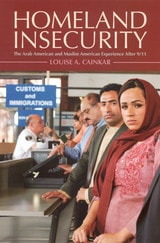
Homeland Insecurity
The Arab American and Muslim American Experience After 9/11Louis A. Cainkar
Russell Sage Foundation, 2009
In the aftermath of 9/11, many Arab and Muslim Americans came under intense scrutiny by federal and local authorities, as well as their own neighbors, on the chance that they might know, support, or actually be terrorists. As Louise Cainkar observes, even U.S.-born Arabs and Muslims were portrayed as outsiders, an image that was amplified in the months after the attacks. She argues that 9/11 did not create anti-Arab and anti-Muslim suspicion; rather, their socially constructed images and social and political exclusion long before these attacks created an environment in which misunderstanding and hostility could thrive and the government could defend its use of profiling. Combining analysis and ethnography, Homeland Insecurity provides an intimate view of what it means to be an Arab or a Muslim in a country set on edge by the worst terrorist attack in its history. Focusing on the metropolitan Chicago area, Cainkar conducted more than a hundred research interviews and five in-depth oral histories. In this, the most comprehensive ethnographic study of the post-9/11 period for American Arabs and Muslims, native-born and immigrant Palestinians, Egyptians, Lebanese, Iraqis, Yemenis, Sudanese, Jordanians, and others speak candidly about their lives as well as their experiences with government, public mistrust, discrimination, and harassment after 9/11. The book reveals that Arab Muslims were more likely to be attacked in certain spatial contexts than others and that Muslim women wearing the hijab were more vulnerable to assault than men, as their head scarves were interpreted by some as a rejection of American culture. Even as the 9/11 Commission never found any evidence that members of Arab- or Muslim-American communities were involved in the attacks, respondents discuss their feelings of insecurity—a heightened sense of physical vulnerability and exclusion from the guarantees of citizenship afforded other Americans. Yet the vast majority of those interviewed for Homeland Insecurity report feeling optimistic about the future of Arab and Muslim life in the United States. Most of the respondents talked about their increased interest in the teachings of Islam, whether to counter anti-Muslim slurs or to better educate themselves. Governmental and popular hostility proved to be a springboard for heightened social and civic engagement. Immigrant organizations, religious leaders, civil rights advocates, community organizers, and others defended Arabs and Muslims and built networks with their organizations. Local roundtables between Arab and Muslim leaders, law enforcement, and homeland security agencies developed better understanding of Arab and Muslim communities. These post-9/11 changes have given way to stronger ties and greater inclusion in American social and political life. Will the United States extend its values of freedom and inclusion beyond the politics of "us" and "them" stirred up after 9/11? The answer is still not clear. Homeland Insecurity is keenly observed and adds Arab and Muslim American voices to this still-unfolding period in American history.
[more]
How the Workers Became Muslims
Immigration, Culture, and Hegemonic Transformation in EuropeFerruh Yilmaz
University of Michigan Press, 2016
Writing in the beginning of the 1980s, Ernesto Laclau and Chantal Mouffe explored possibilities for a new socialist strategy to capitalize on the period’s fragmented political and social conditions. Two and a half decades later, Ferruh Yilmaz acknowledges that the populist Far Right—not the socialist movement—has demonstrated greater facility in adopting successful hegemonic strategies along new structural lines Laclau and Mouffe imagined. Right-wing hegemonic strategy, Yilmaz argues, has led to the reconfiguration of internal fault lines in European societies.
Yilmaz’s primary case study is Danish immigration discourse, but his argument contextualizes his study in terms of questions of current concern across Europe, where right-wing groups that were long on the fringes of “legitimate” politics have managed to make significant gains with populations traditionally aligned with the Left. Specifically, Yilmaz argues that sociopolitical space has been transformed in the last three decades such that group classification has been destabilized to emphasize cultural rather than economic attributes.
According to this point-of-view, traditional European social and political splits are jettisoned for new “cultural” alliances pulling the political spectrum to the right, against the “corrosive” presence of Muslim immigrants, whose own social and political variety is flattened into an illusion of alien sameness.
[more]