Results by title
52 books match the query 'Islam and politics' and 5 start with h

Hamas
A Beginner's GuideKhaled Hroub
Pluto Press, 2010
This beginner's guide to Hamas has been fully revised and updated. It now covers all the major events since the January 2006 elections, including the conflict with Fatah and Israel's brutal offensive in Gaza at the end of 2008.
Explaining the reasons for Hamas's popularity, leading Al-Jazeera journalist and Cambridge academic Khaled Hroub provides the key facts that are so often missing from conventional news reports. It's a one-stop guide that gives a clear overview of Hamas's history, key beliefs, and its political agenda.
This unique book provides a refreshing perspective that gets to the heart of Hamas.
Hezbollah
The Political Economy of Lebanon's Party of GodJoseph Daher
Pluto Press, 2016
By discarding more common approaches to the party that focus on religious discourse or military questions, Daher is freed up to analyze what the party actually is: an organization that is operating within a specific political and socio-economic context, one that simultaneously offers it a rich ground of support and limits its range of action. Daher clearly and carefully positions Hezbollah within that context, focusing on its historic ties with its main sponsor, Iran, its media and cultural wings, its relationship with Western economic policies, and the impact of the Shi’a population on the sectarian politics of Lebanon. Offering additional attention to the party’s positions on worker’s rights and women’s issues, this fresh take on Hezbollah will be incredibly useful for understanding the world’s most tumultuous region.
Hizbu'llah
Politics and ReligionAmal Saad-Ghorayeb
Pluto Press, 2001
Hizbu’llah is the largest and most prominent political party in Lebanon, and one of the most renowned Islamist movements in the world. In this book, Amal Saad-Ghorayeb examines the organisation’s understanding of jihad and how this, together with its belief in martyrdom, brought about the withdrawal of Israeli occupation forces from Lebanon in May 2000.
Saad-Ghorayeb explores the nature of the party’s struggle against the West by studying its views on the use of violence against Westerners. Crucially, she also addresses the question of whether Hizbu’llah depicts this struggle in purely political or civilisational terms. The existential nature of the movement’s conflict with Israel is analysed and the Islamic roots of its anti-Judaism is unearthed.
The author explores the mechanics and rationale behind the party’s integration into the Lebanese political system, and sheds light on how it has reconciled its national idenitity with its solidarity with the Muslim umma.

How Informal Institutions Matter
Evidence from Turkish Social and Political SpheresZeki Sarigil
University of Michigan Press, 2023
In How Informal Institutions Matter, Zeki Sarigil examines the role of informal institutions in sociopolitical life and addresses the following questions: Why and how do informal institutions emerge? To ask this differently, why do agents still create or resort to informal institutions despite the presence of formal institutional rules and regulations? How do informal institutions matter? What roles do they play in sociopolitical life? How can we classify informal institutions? What novel types of informal institutions can we identify and explain? How do informal institutions interact with formal institutions? How do they shape formal institutional rules, mechanisms, and outcomes? Finally, how do existing informal institutions change? What factors might trigger informal institutional change? In order to answer these questions, Sarigil examines several empirical cases of informal institution as derived from various issue areas in the Turkish sociopolitical context (i.e., civil law, conflict resolution, minority rights, and local governance) and from multiple levels (i.e., national and local).
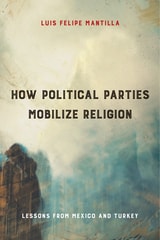
How Political Parties Mobilize Religion
Lessons from Mexico and TurkeyLuis Felipe Mantilla
Temple University Press, 2021
Political mobilization tends to take different forms in contemporary Catholic- and Sunni-majority countries. Luis Felipe Mantilla attributes this dynamic to changes taking place in religious communities and the political institutions that govern religious political engagement.
In How Political Parties Mobilize Religion, Mantillaevenhandedly traces the emergence and success of religious parties in Mexico and Turkey, two countries shaped by assertive secular regimes. In doing so, he demonstrates that religious parties are highly responsive to political institutions, such as electoral laws, as well as to the structure of broader religious communities.
Whereas in both countries, the electoral success of religious mobilizers was initially a boon for democracy, in Mexico it was marred by political mismanagement and became entangled with persistent corruption and escalating violence. In Turkey, the democratic credentials of religious mobilizers were profoundly eroded as the government became increasingly autocratic, concentrating power in very few hands and rolling back basic liberal rights.
Mantilla investigates the role religious mobilization plays in the evolution of electoral politics and democratic institutions, and to what extent their trajectories reflect broader trends in political Catholicism and Islam.