Results by title
645 books match the query 'Judaism' and 19 start with h
Haneirot Halalu
These Lights Are HolyElyse D. Frishman
Central Conference of American Rabbis, 1989
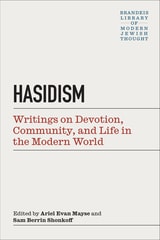
Hasidism
Writings on Devotion, Community, and Life in the Modern WorldEdited by Ariel Evan Mayse Editor and Sam Berrin Shonkoff
Brandeis University Press, 2020
While this volume focuses on Hasidism, it wrestles with a core set of questions that permeate modern Jewish thought and religious thought more generally: What is the relationship between God and the world? What is the relationship between God and the human being? But Hasidic thought is cast with mystical, psychological, and even magical accents, and offers radically different answers to core issues of modern concern. The editors draw selections from an array of genres including women’s supplications; sermons and homilies; personal diaries and memoirs; correspondence; stories; polemics; legal codes; and rabbinic response. These selections consciously move between everyday lived experience and the most ineffable mystical secrets, reflecting the multidimensional nature of this unusual religious and social movement. The editors include canonical texts from the first generation of Hasidic leaders up through present-day ultra-orthodox, as well as neo-Hasidic voices and, in so doing, demonstrate the unfolding of a rich and complex phenomenon that continues to evolve today.
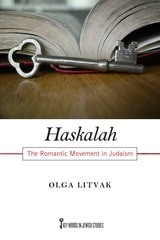
Haskalah
The Romantic Movement in JudaismLitvak, Olga
Rutgers University Press, 2012
Commonly translated as the “Jewish Enlightenment,” the Haskalah propelled Jews into modern life. Olga Litvak argues that the idea of a Jewish modernity, championed by adherents of this movement, did not originate in Western Europe’s age of reason. Litvak contends that the Haskalah spearheaded a Jewish religious revival, better understood against the background of Eastern European Romanticism.
Based on imaginative and historically grounded readings of primary sources, Litvak presents a compelling case for rethinking the relationship between the Haskalah and the experience of political and social emancipation. Most importantly, she challenges the prevailing view that the Haskalah provided the philosophical mainspring for Jewish liberalism.
In Litvak’s ambitious interpretation, nineteenth-century Eastern European intellectuals emerge as the authors of a Jewish Romantic revolution. Fueled by contradictory longings both for community and for personal freedom, the poets and scholars associated with the Haskalah questioned the moral costs of civic equality and the achievement of middle-class status. In the nineteenth century, their conservative approach to culture as the cure for the spiritual ills of the modern individual provided a powerful argument for the development of Jewish nationalism. Today, their ideas are equally resonant in contemporary debates about the ramifications of secularization for the future of Judaism.
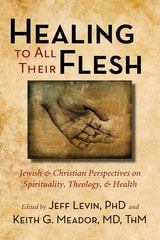
Healing to All Their Flesh
Jewish and Christian Perspectives on Spirituality, Theology, and HealthJeff Levin
Templeton Press, 2012
The editors of this collection, Drs. Jeff Levin and Keith G. Meador, have gathered together the writings of leading Jewish and Christian theological, pastoral, ethical, and religious scholars to answer these important questions. Contributors include Richard Address, William Cutter, Elliot N. Dorff, Dayle A. Friedman, Stanley Hauerwas, Warren Kinghorn, M. Therese Lysaught, Stephen G. Post, John Swinton, and Simkha Y. Weintraub, with a foreword by Samuel E. Karff.
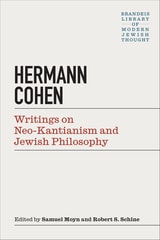
Hermann Cohen
Writings on Neo-Kantianism and Jewish PhilosophyEdited by Samuel Moyn and Robert Schine
Brandeis University Press, 2021
Hermann Cohen (1842–1918) was among the most accomplished Jewish philosophers of modern times—if not the single most significant. But his work has not yet received the attention it deserves. This newly translated collection of his writings—most of which are appearing in English for the first time—illuminates his achievements for student readers and rectifies lapses in his intellectual reception by prior generations. It presents chapters from Cohen’s Ethics of Pure Will, conflicting interpretations of Cohen by Franz Rosenzweig and Alexander Altmann, and finally the eulogy to Cohen delivered at graveside by Ernst Cassirer. Containing full annotations and selections that concentrate both on the philosophical core of Cohen’s writings and the politics of interpretation of his work at the time of his death and after, Hermann Cohen truly brings to light all of Cohen’s accomplishments.
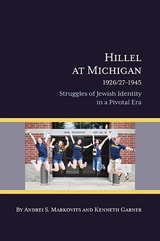
Hillel at Michigan, 1926/27-1945
Struggles of Jewish Identity in a Pivotal EraAndrei S. Markovits and Kenneth Garner
Michigan Publishing Services, 2016
The study analyzes Hillel's challenges as a big-tent, catch-all institution trying to represent all Jewish students on campus regardless of their religious orientation, cultural preferences, and ideological predilections. It looks at Hillel's interactions with the then powerful Jewish fraternities and sororities that provided the main locus of Jewish life on campus at the time, as well as its relations with the University's leadership and many of its cultural and political constituencies. Most of these activities occurred at a time when anti-Semitism was rife in the United States, particularly in the larger Detroit area, home to Henry Ford and Father Charles Edward Coughlin.
History of Religious Ideas, Volume 2
From Gautama Buddha to the Triumph of ChristianityMircea Eliade
University of Chicago Press, 1982
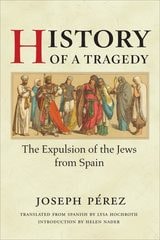
History of a Tragedy
THE EXPULSION OF THE JEWS FROM SPAINJoseph Perez
University of Illinois Press, 2006
Few events in the history of Spain have provoked as much controversy as the expulsion of the Jews in 1492. Conflicts within the Catholic Church, suspicions within the newly unified Spain, and the claims of Spanish merchants combined to make the Spain of Ferdinand and Isabella intolerant and inquisitorial. Yet the roots of Spanish anti-Semitism went deeper. In this concise survey of the expulsion of the Sephardic Jews, Joseph Pérez studies the evolution of the Jewish community in Spain from the time of the Visigoths to the reign of the Catholic kings. He explores the Jewish community’s role in creating and sustaining the vibrant cultural, political, and economic world of medieval Spain, and how growing religious intolerance, a pervasive resentment of the “others,” and a string of escalating encroachments culminated in expulsion.
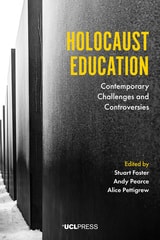
Holocaust Education
Contemporary Challenges and ControversiesEdited by Stuart Foster, Andy Pearce, and Alice Pettigrew
University College London, 2020
Teaching and learning about the Holocaust is central to school curriculums across the globe. But the history of the Holocaust remains controversial and can render teaching it daunting, even to the most experienced instructors. Drawing on landmark research into teaching practices and students’ knowledge, Holocaust Education provides unique insights about classroom learning. It sheds light on key challenges in Holocaust education, including the impact of misconceptions and misinformation, the dilemma posed by images of atrocity, and how to approach teaching in ethnically diverse environments. Overviews of the most significant debates in Holocaust education provide wider context for the classroom evidence. Holocaust Education offers a vital guide, leading readers through some of the most vexed areas of Holocaust challenges and controversies for teachers, researchers, and policymakers.
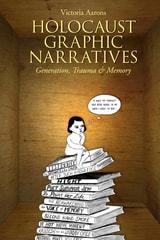
Holocaust Graphic Narratives
Generation, Trauma, and MemoryVictoria Aarons
Rutgers University Press, 2020
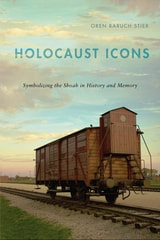
Holocaust Icons
Symbolizing the Shoah in History and MemoryOren Baruch Stier
Rutgers University Press, 2015
Jewish studies scholar Oren Stier offers in this volume new insight into symbols and the symbol-making process, as he traces the lives and afterlives of certain remnants of the Holocaust and their ongoing impact. Stier focuses in particular on four icons: the railway cars that carried Jews to their deaths, symbolizing the mechanics of murder; the Arbeit Macht Frei (“work makes you free”) sign over the entrance to Auschwitz, pointing to the insidious logic of the camp system; the number six million that represents an approximation of the number of Jews killed as well as mass murder more generally; and the persona of Anne Frank, associated with victimization. Stier shows how and why these icons—an object, a phrase, a number, and a person—have come to stand in for the Holocaust: where they came from and how they have been used and reproduced; how they are presently at risk from a variety of threats such as commodification; and what the future holds for the memory of the Shoah.
In illuminating these icons of the Holocaust, Stier offers valuable new perspective on one of the defining events of the twentieth century. He helps readers understand not only the Holocaust but also the profound nature of historical memory itself.
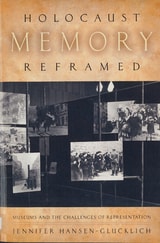
Holocaust Memory Reframed
Museums and the Challenges of RepresentationHansen-Glucklich, Jennifer
Rutgers University Press, 2014
In Holocaust Memory Reframed, Jennifer Hansen-Glucklich examines representations in three museums: Israel’s Yad Vashem in Jerusalem, Germany’s Jewish Museum in Berlin, and the United States Holocaust Memorial Museum in Washington, D.C. She describes a variety of visually striking media, including architecture, photography exhibits, artifact displays, and video installations in order to explain the aesthetic techniques that the museums employ. As she interprets the exhibits, Hansen-Glucklich clarifies how museums communicate Holocaust narratives within the historical and cultural contexts specific to Germany, Israel, and the United States. In Yad Vashem, architect Moshe Safdie developed a narrative suited for Israel, rooted in a redemptive, Zionist story of homecoming to a place of mythic geography and renewal, in contrast to death and suffering in exile. In the Jewish Museum in Berlin, Daniel Libeskind’s architecture, broken lines, and voids emphasize absence. Here exhibits communicate a conflicted ideology, torn between the loss of a Jewish past and the country’s current multicultural ethos. The United States Holocaust Memorial Museum presents yet another lens, conveying through its exhibits a sense of sacrifice that is part of the civil values of American democracy, and trying to overcome geographic and temporal distance. One well-know example, the pile of thousands of shoes plundered from concentration camp victims encourages the visitor to bridge the gap between viewer and victim.
Hansen-Glucklich explores how each museum’s concept of the sacred shapes the design and choreography of visitors’ experiences within museum spaces. These spaces are sites of pilgrimage that can in turn lead to rites of passage.
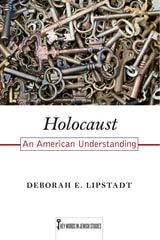
Holocaust
An American UnderstandingLipstadt, Deborah E
Rutgers University Press, 2016
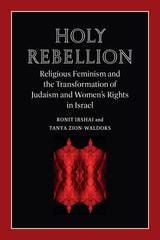
Holy Rebellion
Religious Feminism and the Transformation of Judaism and Women's Rights in IsraelRonit Irshai and Tanya Zion-Waldoks
Brandeis University Press, 2024
In Holy Rebellion, Ronit Irshai and Tanya Zion-Waldoks examine social change in Israel through a rigorous analysis of the shifting entanglements of religion, gender, and law in times of cultural transformation. They explore theological, halakhic, political, and sociological processes and show how they interact with one another in ways that advance women’s rights, as well as how they are met with a conservative backlash in the discourses and actions of the rabbinic establishment. Irshai and Zion-Waldoks build on legal philosopher Robert Cover’s 1982 paper “Nomos and Narrative,” which explained how cultural narratives and legal norms are reciprocally enforced or transformed. Expanding on this notion, Irshai and Zion-Waldoks propose a “narrative ripeness test,” an analytic tool that evaluates the relationship between culture and law to assess how and when change within a minority cultural community may be accelerated or hindered by state intervention.
Religious feminisms are emerging around the world, not solely in Israel, and this book helps elucidate how they create enduring and radical change. Many liberal states are also confronting an illiberal backlash and question the multicultural framework’s ability to serve the needs of minorities within minorities. Therefore, the theoretical framework offered by Irshai and Zion-Waldoks is applicable beyond the Israeli case, even as it offers deeper insights into an Israeli society in turmoil.
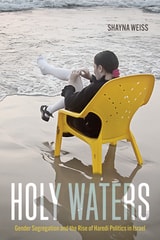
Holy Waters
Gender Segregation and the Rise of Haredi Politics in IsraelShayna Weiss
Rutgers University Press, 2027
Examining the politics of pools and beaches, Holy Waters reveals a surprising history about Haredi Jews and Israel. By looking at the battles to establish gender segregating swimming in Israel, which required a partnership between the Israeli government and its Haredi population to reshape public space, the book argues that the establishment of Israel created a new Haredi pragmatic politics. Unlike some Ultra-Orthodox Jews, who rejected the Jewish state entirely, these radical moderates worked with the state to make it feel more Jewish, and to improve life for its Haredi population, without embracing Zionist ideology. Holy Waters examines three cases: a failure to prevent mixed swimming in Jerusalem, the successful establishment of a separate beach in Tel Aviv, and the mixed results of a Diaspora awareness campaign. Connecting historical controversies to today’s debates of gender segregation, the book demonstrates how these radical moderates still influence Israel today.
This book is published with the support of the Jordan Schnitzer First Book Publication Award, administered by the Association for Jewish Studies.
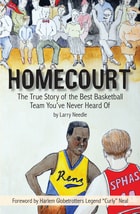
Homecourt
The True Story of the Best Basketball Team You've Never Heard OfLarry Needle
Temple University Press, 2012
Homelands
Southern Jewish Identity in Durham-Chapel Hill and North CarolinaLeonard Rogoff
University of Alabama Press, 2001
Exploring how Southern Jews forged identity, community, and belonging in the evolving landscape of the New South.
Homelands is a case study of a unique ethnic group in North America—small-town southern Jews. Both Jews and southerners, Leonard Rogoff points out, have long struggled with questions of identity and whether to retain their differences or try to assimilate into the national culture. Rogoff shows how, as immigrant Jews became small-town southerners, they constantly renegotiated their identities and reinvented their histories.
The Durham-Chapel Hill Jewish community was formed during the 1880s and 1890s, when the South was recovering from the Reconstruction era and Jews were experiencing ever-growing immigration as well as challenging the religious traditionalism of the previous 4,000 years. Durham and Chapel Hill Jews, recent arrivals from the traditional societies of eastern Europe, assimilated and secularized as they lessened their differences with other Americans. Some Jews assimilated through intermarriage and conversion, but the trajectory of the community as a whole was toward retaining their religious and ethnic differences while attempting to integrate with their neighbors.
The Durham-Chapel Hill area is uniquely suited to the study of the southern Jewish experience, Rogoff maintains, because the region is exemplary of two major trends: the national population movement southward and the rise of Jews into the professions. The Jewish peddler and storekeeper of the 1880s and the doctor and professor of the 1990s, Rogoff says, are representative figures of both Jewish upward mobility and southern progress.
Honoring Tradition, Embracing Modernity
A Reader for the Union for Reform Judaism's Introduction to Judaism CourseRabbi Beth Lieberman and Rabbi Hara E. Person
Central Conference of American Rabbis, 2017
This is a PDF electronic download. Once you've purchased the PDF, you can download your file by logging into ccarpress.org and clicking on "My Account."
Honoring Tradition, Embracing Modernity, created in partnership between the Central Conference of American Rabbis and the Union for Reform Judaism, is for readers who seek to deepen their knowledge of Judaism--its wisdom, its practices, its beliefs, its customs, its people, and our story. This sourcebook includes selections from Judaism's rich library of wisdom literature, classic and contemporary, in a format designed for use with the URJ's Introduction to Judaism classes.
Honoring Tradition, Embracing Modernity includes five units, as listed below:
- Beginnings: What is Judaism? What are the ethics and values of the Jewish People? How can we understand humanity and human potential through our relationship to God?
- Creating a Jewish Life in Time: An exploration of the Jewish calendar of celebration and sanctity, as well as how life in the community connects and intertwines with life at home.
- The Cycle of Jewish Life: Relationship and marriage traditions, raising a family, growing into later adulthood, and the central role of learning for all generations.
- Creating a Jewish Theology: Different understandings of God, and the diverse roles that synagogue, prayer, and sacred texts play in our lives.
- The Jewish Story and Creating a Jewish Journey: The historical journey of the Jewish People, and the many identities that have emerged from it.
[Note: This is the PDF version, and is for individual use only. It is not to be copied, distributed, or sold without express written permission from CCAR Press.
For bulk orders of 10 or more, contact info@ccarpress.org. Orders consisting of 10 or more will receive a special bulk discount of $23 per PDF.]
How America Met the Jews
Hasia R. Diner
SBL Press, 2017
Explore how American conditions and Jewish circumstances collided in the nineteenth and early twentieth centuries
In this new book award-winning author Hasia R. Diner explores the issues behind why European Jews overwhelmingly chose to move to the United States between the 1820s and 1920s. Unlike books that tend to romanticize American freedom as the force behind this period of migration or that tend to focus on Jewish contributions to America or that concentrate on how Jewish traditions of literacy and self-help made it possible for them to succeed, Diner instead focuses on aspects of American life and history that made it the preferred destination for 90 percent of European Jews.
Features:
- Examination of the realities of race, immigration, color, money, economic development, politics, and religion in America
- Exploration of an America agenda that sought out white immigrants to help stoke economic development and that valued religion as a force for morality