Results by title
72 books match the query 'Korea (South)' and 3 start with h
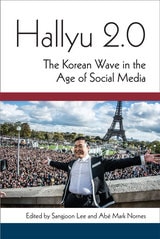
Hallyu 2.0
The Korean Wave in the Age of Social MediaSangjoon Lee and Abé Mark Nornes, editors
University of Michigan Press, 2015
Collectively known as Hallyu, Korean music, television programs, films, online games, and comics enjoy global popularity, thanks to new communication technologies. In recent years, Korean popular culture has also become the subject of academic inquiry. Whereas the Hallyu’s impact on Korea’s national image and domestic economy, as well as on transnational cultural flows, have received much scholarly attention, there has been little discussion of the role of social media in Hallyu’s propagation.
Contributors to Hallyu 2.0: The Korean Wave in the Age of Social Media explore the ways in which Korean popular cultural products are shared by audiences around the globe; how they generate new fans, markets, and consumers through social media networks; and how scholars can analyze, interpret, and envision the future of this unprecedented cultural phenomenon.
[more]
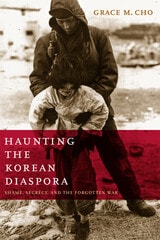
Haunting the Korean Diaspora
Shame, Secrecy, and the Forgotten WarGrace M. Cho
University of Minnesota Press, 2008
Since the Korean War—the forgotten war—more than a million Korean women have acted as sex workers for U.S. servicemen. More than 100,000 women married GIs and moved to the United States. Through intellectual vigor and personal recollection, Haunting the Korean Diaspora explores the repressed history of emotional and physical violence between the United States and Korea and the unexamined reverberations of sexual relationships between Korean women and American soldiers.
Grace M. Cho exposes how Koreans in the United States have been profoundly affected by the forgotten war and uncovers the silences and secrets that still surround it, arguing that trauma memories have been passed unconsciously through a process psychoanalysts call “transgenerational haunting.” Tracing how such secrets have turned into “ghosts,” Cho investigates the mythic figure of the yanggongju, literally the “Western princess,” who provides sexual favors to American military personnel. She reveals how this figure haunts both the intimate realm of memory and public discourse, in which narratives of U.S. benevolence abroad and assimilation of immigrants at home go unchallenged. Memories of U.S. violence, Cho writes, threaten to undo these narratives—and so they have been rendered unspeakable.
At once political and deeply personal, Cho’s wide-ranging and innovative analysis of U.S. neocolonialism and militarism under contemporary globalization brings forth a new way of understanding—and remembering—the impact of the Korean War.
[more]
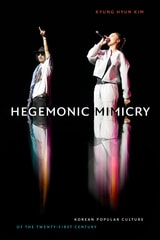
Hegemonic Mimicry
Korean Popular Culture of the Twenty-First CenturyKyung Hyun Kim
Duke University Press, 2021
In Hegemonic Mimicry, Kyung Hyun Kim considers the recent global success of Korean popular culture—the Korean wave of pop music, cinema, and television, which is also known as hallyu—from a transnational and transcultural perspective. Using the concept of mimicry to think through hallyu's adaptation of American sensibilities and genres, he shows how the commercialization of Korean popular culture has upended the familiar dynamic of major-to-minor cultural influence, enabling hallyu to become a dominant global cultural phenomenon. At the same time, its worldwide popularity has rendered its Koreanness opaque. Kim argues that Korean cultural subjectivity over the past two decades is one steeped in ethnic rather than national identity. Explaining how South Korea leaped over the linguistic and cultural walls surrounding a supposedly “minor” culture to achieve global ascendance, Kim positions K-pop, Korean cinema and television serials, and even electronics as transformative acts of reappropriation that have created a hegemonic global ethnic identity.
[more]