171 books match the query 'Labor unions' and 6 start with h
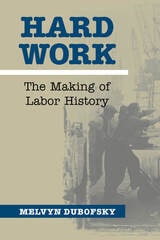
cover of Hard Work: The Making of Labor History

Hard Work

The Making of Labor History

Melvyn Dubofsky

University of Illinois Press, 2000

A career-spanning collection of writings by the legendary labor historian

One of American labor history's most prominent scholars, Melvyn Dubofsky curated an accessible style and historical reach that have long marked his work as required reading for students and scholars. 

This collection juxtaposes Dubofsky's early writings with scholarship from the 1990s. Selections include work on western working-class radicalism, U.S. labor history in transnational and comparative settings, and the impact of technological change on American worker’s movements. Throughout, the writings provide an invaluable eyewitness perspective on the academic and political climate of the 1960s and 1970s while tracing the development of labor history as a discipline. 

An exploration of important themes in labor history, Hard Work combines essential scholarship with the story of how past and present interact in the work of historians.
[more]
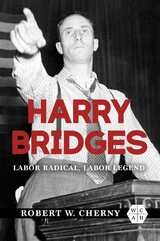
cover of Harry Bridges: Labor Radical, Labor Legend

Harry Bridges

Labor Radical, Labor Legend

Robert W. Cherny

University of Illinois Press, 2023

The iconic leader of one of America’s most powerful unions, Harry Bridges put an indelible stamp on the twentieth century labor movement. Robert Cherny’s monumental biography tells the life story of the figure who built the International Longshore and Warehouse Union (ILWU) into a labor powerhouse that still represents almost 30,000 workers.

An Australian immigrant, Bridges worked the Pacific Coast docks. His militant unionism placed him at the center of the 1934 West Coast Waterfront Strike and spurred him to expand his organizing activities to warehouse laborers and Hawaiian sugar and pineapple workers. Cherny examines the overall effectiveness of Bridges as a union leader and the decisions and traits that made him effective. Cherny also details the price paid by Bridges as the US government repeatedly prosecuted him for his left-wing politics.

Drawing on personal interviews with Bridges and years of exhaustive research, Harry Bridges places an extraordinary individual and the ILWU within the epic history of twentieth-century labor radicalism.
[more]
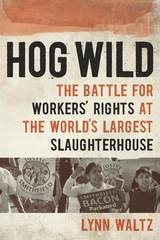
cover of Hog Wild: The Battle for Workers' Rights at the World's Largest Slaughterhouse

Hog Wild

The Battle for Workers' Rights at the World's Largest Slaughterhouse

Lynn Waltz

University of Iowa Press, 2018

When Smithfield Foods opened its pork processing plant in Tar Heel, North Carolina, in 1992, workers in the rural area were thrilled to have jobs at what was billed as “the largest slaughterhouse in the world.” However, they soon left in droves because of the fast, unrelenting line speed and high rate of injury. Those who stayed wanted higher wages and safer working conditions, but every time they tried to form a union, the company quickly cracked down, firing union leaders, assaulting organizers, and setting minority groups against each other. 
Author and journalist Lynn Waltz reveals how these aggressive tactics went unchecked for years until Sherri Buffkin, a higher-up manager at Smithfield, blew the lid off the company’s corrupt practices. Through meticulous reporting, in-depth interviews with key players, and a mind for labor and environmental histories, Waltz weaves a fascinating tale of the nearly two-decade struggle that eventually brought justice to the workers and accountability to the food giant, pitting the world’s largest slaughterhouse against the world’s largest meatpacking union. 
Following in a long tradition of books that expose the horrors of the meatpacking industry—from Upton Sinclair’s The Jungle to Eric Schlosser’s Fast Food Nation—Hog Wild uncovers rampant corporate environmental hooliganism, labor exploitation, and union-busting by one of the nation’s largest meat producers. Waltz’s eye-opening examination sheds new light on the challenges workers face not just in meatpacking, but everywhere workers have lost their power to collectively bargain with powerful corporations. 
 
[more]
cover of Hollywood Unions

Hollywood Unions

Kate Fortmueller

Rutgers University Press, 2025
Hollywood Unions is a unique collection that tells the stories of the unions and guilds that have organized motion picture and television labor: IATSE, the DGA, SAG-AFTRA, and the WGA. The Hollywood unions represent a wide swath of the workers making media: from directors and stars to grips and makeup artists. People today know some of these organizations from their glitzy annual awards celebrations, but the unions’ actual importance is in bargaining with the Association of Motion Picture and Television Producers (AMPTP) on behalf of 331,000 workers in the motion picture and television industry. The Hollywood unions are not neutral institutions but rather have long histories of jurisdictional battles, competitions with rival unions, and industry-altering strikes. They have supported the industry’s workers through the Great Depression, World War II, the McCarthy era, the collapse of the studio system, the rise of television, runaway production, fights for gender parity, the digital revolution, and a global pandemic. The history of these unions has contributed to making media work sustainable in the long term and helped shape the conditions and production cultures of Hollywood.
[more]
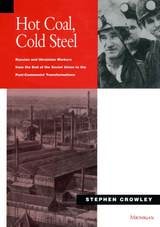
cover of Hot Coal, Cold Steel: Russian and Ukrainian Workers from the End of the Soviet Union to the Post-Communist Transformations

Hot Coal, Cold Steel

Russian and Ukrainian Workers from the End of the Soviet Union to the Post-Communist Transformations

Stephen Crowley

University of Michigan Press, 1997
Well after the disintegration of the Communist Party and the Soviet state--and through several years of economic collapse--industrial workers in almost every sector of the former Soviet Union have remained quiescent and the same ineffective and unpopular trade unions still hold a virtual monopoly on worker's representation. Why? While many argue that labor is a central variable in the development of economic and political systems, little is known about workers in the states of the former Soviet Union since the fall of Communism. In a comparative study of two groups of industrial workers--the coal miners and steelworkers--at the end of the Soviet era, Stephen Crowley sheds light on where these workers have been and where they are going.
Coal miners in the final years of the Soviet Union effectively organized and led strikes which supported the end of Communism, even though their heavy subsidies would be threatened by capitalism. Steel workers, in contrast, did not effectively organize and strike. This pattern has continued under the new governments, with the coal miners effectively organized and seeking protection from the worst consequences of marketization, while the steel workers remain weakly organized despite deteriorating economic conditions.
Based on extensive on-site research including interviews with miners and steelworkers, labor leaders and plant managers, Crowley develops a detailed picture of the conditions under which workers organize. His findings have application beyond the conditions of post-Communist Russia and Ukraine to other societies undergoing fundamental change.
This book will be of interest to sociologists and political scientists interested in the role of labor in transitional societies, the patterns of organization of labor, as well as area specialists.
Stephen Crowley is Associate Professor of Political Science, Oberlin College.
[more]
cover of Houston Blue: The Story of the Houston Police Department

Houston Blue

The Story of the Houston Police Department

Mitchel P. Roth

University of North Texas Press, 2012

[more]