Results by title
135 books match the query 'Landscape' and 6 start with h
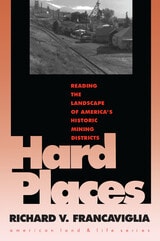
Hard Places
Reading the Landscape of America's Historic Mining DistrictsRichard V. Francaviglia
University of Iowa Press, 1997
Working with the premise that there are much meaning and value in the "repelling beauty" of mining landscapes, Richard Francaviglia identifies the visual clues that indicate an area has been mined and tells us how to read them, showing the interconnections among all of America's major mining districts. With a style as bold as the landscape he reads and with photographs to match, he interprets the major forces that have shaped the architecture, design, and topography of mining areas. Covering many different types of mining and mining locations, he concludes that mining landscapes have come to symbolize the turmoil between what our society elects to view as two opposing forces: culture and nature.
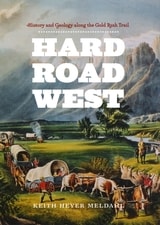
Hard Road West
History and Geology along the Gold Rush TrailKeith Heyer Meldahl
University of Chicago Press, 2007
“Alternates seamlessly between vivid accounts of the 19th-century journey and lucid explanations of the geological events that shaped the landscape traveled. . . . The reader comes away with both an appreciation for the arduous cross-continental wagon journey and an understanding of the events that created such a vast and difficult landscape.”—Library Journal
Holocene Hunter-Gatherers of the Lower Ohio River Valley
Richard Jefferies
University of Alabama Press, 2009
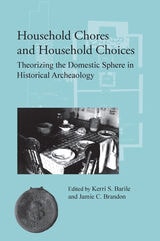
Household Chores and Household Choices
Theorizing the Domestic Sphere in Historical ArchaeologyEdited by Kerri S. Barile and James C. Brandon
University of Alabama Press, 2004
Discusses the concepts of “home,” “house,” and “household” in past societies
Because archaeology seeks to understand past societies, the concepts of "home," "house," and "household" are important. Yet they can be the most elusive of ideas. Are they the space occupied by a nuclear family or by an extended one? Is it a built structure or the sum of its contents? Is it a shelter against the elements, a gendered space, or an ephemeral place tied to emotion? We somehow believe that the household is a basic unit of culture but have failed to develop a theory for understanding the diversity of households in the historic (and prehistoric) periods.
In an effort to clarify these questions, this volume examines a broad range of households—a Spanish colonial rancho along the Rio Grande, Andrew Jackson's Hermitage in Tennessee, plantations in South Carolina and the Bahamas, a Colorado coal camp, a frontier Arkansas farm, a Freedman's Town eventually swallowed by Dallas, and plantations across the South—to define and theorize domestic space. The essays devolve from many disciplines, but all approach households from an archaeological perspective, looking at landscape analysis, excavations, reanalyzed collections, or archival records. Together, the essays present a body of knowledge that takes the identification, analysis, and interpretation of households far beyond current conceptions.
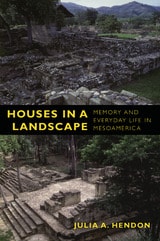
Houses in a Landscape
Memory and Everyday Life in MesoamericaJulia A. Hendon
Duke University Press, 2010
Hendon conducted research on three contemporaneous Native American civilizations that flourished from the seventh century through the eleventh CE: the Maya kingdom of Copan, the hilltop center of Cerro Palenque, and the dispersed settlement of the Cuyumapa valley. She analyzes domestic life in these societies, from cooking to crafting, as well as public and private ritual events including the ballgame. Combining her findings with a rich body of theory from anthropology, history, and geography, she explores how objects—the things people build, make, use, exchange, and discard—help people remember. In so doing, she demonstrates how everyday life becomes part of the social processes of remembering and forgetting, and how “memory communities” assert connections between the past and the present.
How Will the Heart Endure
Elizabeth Bowen and the Landscape of WarHeather Bryant Jordan
University of Michigan Press, 1992