Results by title
1917 books match the query 'Law' and 36 start with h
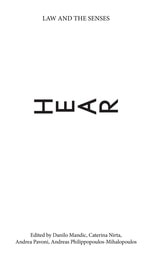
HEAR
Danilo Mandic, Caterina Nirta, Andrea Pavoni and Andreas Philippopoulos-Mihalopoulos
University of Westminster Press, 2023
Hearing is an intricate but delicate modality of sensory perception, continuously enfolded in the surroundings in which it takes place. While passive in its disposition, it is integral to the movement and fluctuations of one’s environment. Always attuned to the present and immersed in the murmur of its background, hearing remains a situated perception but fundamentally overarching and extended into the open. It is an immanent modality of being in and with the world. It is also the ultimate juridical act, a sense-making activity that adjudicates and informs the spatio-temporal acoustics of law and justice.
This collection gathers multidisciplinary contributions on the relationship between law and hearing, the human vocalisations and non-human echolocations, the spatial and temporal conditions in which hearing takes place, as well as the forms of order and control that listening entails. Contributors explore, challenge and expand the structural and sensorial qualities of law, and recognise how hearing directs us to perceiving and understanding the intrinsic acoustic sphere of simultaneous relations, which challenge and break the normative distinctions that law informs and maintains. In exploring the ambiguous, indefinable and unembodied nature of hearing, as well as its objects – sound and silence – this volume approaches it as both an ontological and epistemological device to think with and about law.
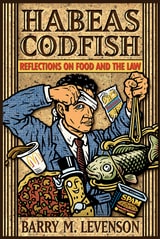
Habeas Codfish
Reflections on Food and the LawBarry M. Levenson
University of Wisconsin Press, 2001
From the McDonald’s hot coffee case to the cattle ranchers’ beef with Oprah Winfrey, from the old English "Assize of Bread" to current nutrition labeling laws, what we eat and how we eat are shaped as much by legal regulations as by personal taste. Barry M. Levenson, the curator of the world-famous (really!) Mount Horeb Mustard Museum and a self-proclaimed "recovering lawyer," offers in Habeas Codfish an entertaining and expert overview of the frustrating, frightening, and funny intersections of food and the law.
Discover how Mr. Peanut shaped the law of trademark infringement for the entire food industry. Consider the plight of the restaurant owner besmirched by a journalist’s negative review. Find out how traditional Jewish laws of kashrut ran afoul of the First Amendment. Prison meals, butter vs. margarine, definitions of organic food, undercover ABC reporters at the Food Lion, the Massachusetts Supreme Court case that saved fish chowder, even recipes—it’s all in here, so tuck in!
Habeas for the Twenty-First Century
Uses, Abuses, and the Future of the Great WritNancy J. King and Joseph L. Hoffmann
University of Chicago Press, 2011
For centuries, the writ of habeas corpus has served as an important safeguard against miscarriages of justice, and today it remains at the center of some of the most contentious issues of our time—among them terrorism, immigration, crime, and the death penalty. Yet, in recent decades, habeas has been seriously abused. In this book, Nancy J. King and Joseph L. Hoffmann argue that habeas should be exercised with greater prudence.
Through historical, empirical, and legal analysis, as well as illustrative case studies, the authors examine the current use of the writ in the United States and offer sound reform proposals to help ensure its ongoing vitality in today’s justice system. Comprehensive and thoroughly grounded in a modern understanding of habeas corpus, this informative book will be an insightful read for legal scholars and anyone interested in the importance of habeas corpus for American government.
Happiness and Utility
Essays Presented to Frederick RosenEdited by Georgios Varouxakis and Mark Philp
University College London, 2019
The chapters are written in celebration of the career of Professor Fredrick Rosen. They follow his work by concentrating on Bentham and the two Mills, and by the subtleties and sophistication of their understanding of one of the most alluring but elusive ideas of modern times. The volume will be of interest not only to admirers of Rosen but to academics and postgraduate students in disciplines such as philosophy, political theory, the history of political thought, legal theory and legal history.
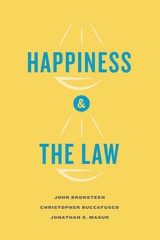
Happiness and the Law
John Bronsteen, Christopher Buccafusco, and Jonathan S. Masur
University of Chicago Press, 2014
Drawing on new research in psychology, neuroscience, and economics, the authors of Happiness and the Law assess how the law affects people’s quality of life—and how it can do so in a better way. Taking readers through some of the common questions about and objections to the use of happiness research in law and policy, they consider two areas in depth: criminal punishment and civil lawsuits. More broadly, the book proposes a comprehensive approach to assessing human welfare—well-being analysis—that is a valuable alternative to the strictly economically based cost-benefit analyses currently dominating how we evaluate public policy. The study of happiness is the next step in the evolution from traditional economic analysis of the law to a behavioral approach. Happiness and the Law will serve as the definitive, yet accessible, guide to understanding this new paradigm.
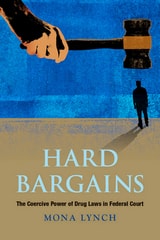
Hard Bargains
The Coercive Power of Drug Laws in Federal CourtMona Lynch
Russell Sage Foundation, 2016
As a result of the War on Drugs, the number of drug cases prosecuted each year in federal courts has increased fivefold since 1980. Lynch goes behind the scenes in three federal court districts and finds that federal prosecutors have considerable discretion in adjudicating these cases. Federal drug laws are wielded differently in each district, but with such force to overwhelm defendants’ ability to assert their rights. For drug defendants with prior convictions, the stakes are even higher since prosecutors can file charges that incur lengthy prison sentences—including life in prison without parole. Through extensive field research, Lynch finds that prosecutors frequently use the threat of extremely severe sentences to compel defendants to plead guilty rather than go to trial and risk much harsher punishment. Lynch also shows that the highly discretionary ways in which federal prosecutors work with law enforcement have led to significant racial disparities in federal courts. For instance, most federal charges for crack cocaine offenses are brought against African Americans even though whites are more likely to use crack. In addition, Latinos are increasingly entering the federal system as a result of aggressive immigration crackdowns that also target illicit drugs.
Hard Bargains provides an incisive and revealing look at how legal reforms over the last five decades have shifted excessive authority to federal prosecutors, resulting in the erosion of defendants’ rights and extreme sentences for those convicted. Lynch proposes a broad overhaul of the federal criminal justice system to restore the balance of power and retreat from the punitive indulgences of the War on Drugs.
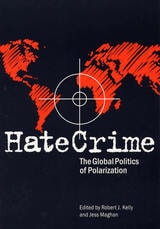
Hate Crime
The Global Politics of PolarizationEdited by Robert J. Kelly and Jess Maghan
Southern Illinois University Press, 1998
These twelve previously unpublished essays explore the international phenomenon of hate crime, examining the socio-psychological dynamics of these crimes and the settings in which they occur, the relationships between offenders and their victims, the emotional states of the participants, and the legal and law enforcement responses to these crimes.
The essays address religious, racial, ethnic, and sexual crimes in the United States, Latin America, Africa, Europe, and the Middle East. The essayists provide historical reviews of the problems and the ways local authorities understand and cope with the dilemmas as well as prognoses about the persistence of hate crime and the measures that can be taken to control and contain it.
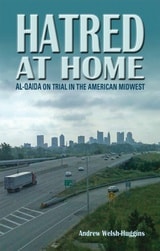
Hatred at Home
al-Qaida on Trial in the American MidwestAndrew Welsh-Huggins
Ohio University Press, 2011
One day in 2002, three friends—a Somali immigrant, a Pakistan–born U.S. citizen, and a hometown African American—met in a Columbus, Ohio coffee shop and vented over civilian casualties in the war in Afghanistan. Their conversation triggered an investigation that would become one of the most unusual and far–reaching government probes into terrorism since the 9/11 attacks.
Over several years, prosecutors charged each man with unrelated terrorist activities in cases that embodied the Bush administration’s approach to fighting terrorism at home.
Government lawyers spoke of catastrophes averted; defense attorneys countered that none of the three had done anything but talk. The stories of these homegrown terrorists illustrate the paradox the government faces after September 11: how to fairly wage a war against alleged enemies living in our midst.
Hatred at Home is a true crime drama that will spark debate from all political corners about safety, civil liberties, free speech, and the government’s war at home.
Healthcare and Human Dignity
Law MattersFrank M. McClellan
Rutgers University Press, 2020
Hegel’s Theory of Normativity
The Systematic Foundations of the Philosophical Science of RightKevin Thompson
Northwestern University Press, 2019
Heracles' Bow
Essays On The Rhetoric & Poetics Of The LawJames B. White
University of Wisconsin Press, 1989
White’s essays, though bound by a common perspective, are thematically varied. Each of these pieces makes eloquent and insightful reading. Taken as a whole, they establish, by triangulation, a position from which they all proceed: a view of poetry, law, and rhetoric as essentially synonymous. Only when we perceive the links between these processes, White stresses, can we begin to unite the concerns of truth, beauty, and justice in a single field of action and expression.
Hidden Histories of Unauthorized Migrations from Europe to the United States
Edited by Danielle Battisti and S. Deborah Kang
University of Illinois Press, 2025
Often depicted as the nation’s iconic legal immigrant, unauthorized European migrants are often overlooked by scholars, policymakers, and the media. This volume tells the stories of European migrants who adopted irregular migration strategies to enter and remain in the United States throughout the twentieth century. Contributors explore facets of this history with essays on migration patterns from Russia, Italy, Ireland, the Ottoman Empire, and Poland. They also offer important arguments about the treatment of unauthorized European migrants by states and societies on both sides of the Atlantic and how the reception of undocumented immigrants has been and continues to be impacted by the dynamics of racial, class, and gender constructions in the United States and abroad. As the contributors show, the reception accorded unauthorized European migrants frequently obscured and even normalized their irregular migration strategies, easing their access to American citizenship.
Revealing and insightful, Hidden Histories of Unauthorized Migrations from Europe to the United States sheds new light our intertwined notions of race, legality, and immigration.
Contributors: Danielle Battisti, Ashley Johnson Bavery, Mary Patrice Erdmans, Polina Ermoshkina, Torsten Feys, Carly Goodman, S. Deborah Kang, E. Kyle Romero, Randa Tawil, and Joanna Wojdon
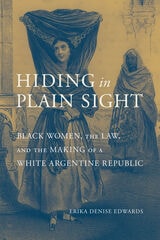
Hiding in Plain Sight
Black Women, the Law, and the Making of a White Argentine RepublicErika Denise Edwards
University of Alabama Press, 2020
WINNER OF THE ASSOCIATION OF BLACK WOMEN HISTORIANS 2020 LETITIA WOODS-BROWN AWARD FOR THE BEST BOOK IN AFRICAN AMERICAN WOMEN'S HISTORY
WINNER OF THE WESTERN ASSOCIATION OF WOMEN HISTORIAN'S BARBARA “PENNY” KANNER AWARD
2021 FINALIST FOR THE HARRIET TUBMAN BOOK PRIZE
2020 FINALIST BERSHIRE CONFERENCE OF WOMEN HISTORIANS BOOK PRIZE
Uncovering the Afro-Argentine women behind the myth of a white nation.
Argentina promotes itself as a country of European immigrants. This makes it an exception to other Latin American countries, which embrace a more mixed—African, Indian, European—heritage. Hiding in Plain Sight: Black Women, the Law, and the Making of a White Argentine Republic traces the origins of what some white Argentines mischaracterize as a “black disappearance” by delving into the intimate lives of black women and explaining how they contributed to the making of a “white” Argentina. Erika Denise Edwards has produced the first comprehensive study in English of the history of African descendants outside of Buenos Aires in the late colonial and early republican periods, with a focus on how these women sought whiteness to better their lives and that of their children.
Edwards argues that attempts by black women to escape the stigma of blackness by recategorizing themselves and their descendants as white began as early as the late eighteenth century, challenging scholars who assert that the black population drastically declined at the end of the nineteenth century because of the whitening or modernization process. She further contends that in Córdoba, Argentina, women of African descent (such as wives, mothers, daughters, and concubines) were instrumental in shaping their own racial reclassifications and destinies.
This volume makes use of a wealth of sources to relate these women’s choices. The sources consulted include city censuses and notarial and probate records that deal with free and enslaved African descendants; criminal, ecclesiastical, and civil court cases; marriages and baptisms records and newsletters. These varied sources provide information about the day-to-day activities of cordobés society and how women of African descent lived, formed relationships, thrived, and partook in the transformation of racial identities in Argentina.
Historical Justice and Memory
Edited by Klaus Neumann and Janna Thompson
University of Wisconsin Press, 2015
The historical justice movement has inspired the spread of truth and reconciliation processes around the world and has pushed governments to make reparations and apologies for past wrongs. It has changed the public understanding of justice and the role of memory. In this book, leading scholars in philosophy, history, political science, and semiotics offer new essays that discuss and assess these momentous global developments. They evaluate the strength and weaknesses of the movement, its accomplishments and failings, its philosophical assumptions and social preconditions, and its prospects for the future.
History of the Death Penalty in Colorado
Michael Radelet
University Press of Colorado, 2017
In The History of the Death Penalty in Colorado, noted death penalty scholar Michael Radelet chronicles the details of each capital punishment trial and execution that has taken place in Colorado since 1859. The book describes the debates and struggles that Coloradans have had over the use of the death penalty, placing the cases of the 103 men whose sentences were carried out and 100 more who were never executed into the context of a gradual worldwide trend away from this form of punishment.
For more than 150 years, Coloradans have been deeply divided about the death penalty, with regular questions about whether it should be expanded, restricted, or eliminated. It has twice been abolished, but both times state lawmakers reinstated the contentious punitive measure. Prison administrators have contributed to this debate, with some refusing to participate in executions and some lending their voices to abolition efforts. Colorado has also had a rich history of experimenting with execution methods, first hanging prisoners in public and then, starting in 1890, using the "twitch-up gallows" for four decades. In 1933, Colorado began using a gas chamber and eventually moved to lethal injection in the 1990s.
Based on meticulous archival research in official state archives, library records, and multimedia sources, The History of the Death Penalty in Colorado, will inform the conversation on both sides of the issue anywhere the future of the death penalty is under debate.
History, Memory, and the Law
Austin Sarat and Thomas R. Kearns, Editors
University of Michigan Press, 2002
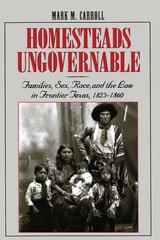
Homesteads Ungovernable
Families, Sex, Race, and the Law in Frontier Texas, 1823-1860By Mark M. Carroll
University of Texas Press, 2001
When he settled in Mexican Texas in 1832 and began courting Anna Raguet, Sam Houston had been separated from his Tennessee wife Eliza Allen for three years, while having already married and divorced his Cherokee wife Tiana and at least two other Indian "wives" during the interval. Houston's political enemies derided these marital irregularities, but in fact Houston's legal and extralegal marriages hardly set him apart from many other Texas men at a time when illicit and unstable unions were common in the yet-to-be-formed Lone Star State.
In this book, Mark Carroll draws on legal and social history to trace the evolution of sexual, family, and racial-caste relations in the most turbulent polity on the southern frontier during the antebellum period (1823-1860). He finds that the marriages of settlers in Texas were typically born of economic necessity and that, with few white women available, Anglo men frequently partnered with Native American, Tejano, and black women. While identifying a multicultural array of gender roles that combined with law and frontier disorder to destabilize the marriages of homesteaders, he also reveals how harsh living conditions, land policies, and property rules prompted settling spouses to cooperate for survival and mutual economic gain. Of equal importance, he reveals how evolving Texas law reinforced the substantial autonomy of Anglo women and provided them material rewards, even as it ensured that cross-racial sexual relationships and their reproductive consequences comported with slavery and a regime that dispossessed and subordinated free blacks, Native Americans, and Tejanos.
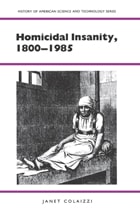
Homicidal Insanity, 1800-1985
Janet Colaizzi, with a foreword by Jonas R. Rappeport
University of Alabama Press, 1989
Where madness meets the law, history leaves no easy verdict.
Homicidal insanity has remained a vexation to both the psychiatric and legal professions despite the panorama of scientific and social change during the past 200 years. The predominant opinion today among psychiatrists is that no correlation exists between dangerousness and specific mental disorders. But for generation after generation, psychiatrists have reported cases of insane homicide that were clinically similar. Although psychiatric theory changed and psychiatric nosology was inconsistent, the mental phenomena psychiatrists identified in such cases remained the same. The central thesis of Homicidal Insanity is that as psychiatric theory changed, psychiatrists regarded these phenomena variously as symptoms of mental disease or the disease in itself. It is possible to trace these phenomena throughout the history of Anglo-American psychiatric theory and practice. A secondary thesis of the book is that psychiatrists have used these phenomena as predictors and markers in the practical matters of preventing insane homicide and of testifying in the courts to defend the irresponsible and expose the culpable.
For 200 years, scientific and philosophical disagreement raised controversy and brought the issues to public attention. Still, to this day no rational method exists to discriminate the dangerous from the harmless in matters of involuntary commitment, nor insanity from crime in the courts.
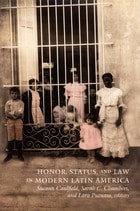
Honor, Status, and Law in Modern Latin America
Sueann Caulfield, Sarah C. Chambers, and Lara Putnam, eds.
Duke University Press, 2005
Each essay examines honor in the context of specific historical processes, including early republican nation-building in Peru; the transformation in Mexican villages of the cargo system, by which men rose in rank through service to the community; the abolition of slavery in Rio de Janeiro; the growth of local commerce and shifts in women’s status in highland Bolivia; the formation of a multiethnic society on Costa Rica’s Caribbean coast; and the development of nationalist cultural responses to U.S. colonialism in Puerto Rico. By connecting liberal projects that aimed to modernize law and society with popular understandings of honor and status, this volume sheds new light on broad changes and continuities in Latin America over the course of the long nineteenth century.
Contributors. José Amador de Jesus, Rossana Barragán, Sueann Caulfield, Sidney Chalhoub, Sarah C. Chambers, Eileen J. Findley, Brodwyn Fischer, Olívia Maria Gomes da Cunha, Laura Gotkowitz, Keila Grinberg, Peter Guardino, Cristiana Schettini Pereira, Lara Elizabeth Putnam
Hostages of Each Other
The Transformation of Nuclear Safety since Three Mile IslandJoseph V. Rees
University of Chicago Press, 1996
How Does Law Matter?
Fundamental Issues in Law And SocietyBryant G. Garth and Austin Sarat
Northwestern University Press, 1998
These essays show how law is relevant in both an "instrumental" and a "constitutive" sense, as a tool to accomplish particular purposes and as an important force in shaping the everyday worlds in which we live. Essays examine these issues by focusing on legal consciousness, the body, discrimination, and colonialism as well as on more traditional legal concerns such as juries and criminal justice.
How Failed Attempts to Amend the Constitution Mobilize Political Change
Roger C. Hartley
Vanderbilt University Press, 2017
This book is a demonstration of how social reformers and politicians have used the amendment process to achieve favorable political results even as their proposed amendments have failed to be adopted. For example, the ERA "failed" in the sense that it was never ratified, but the mobilization to ratify the ERA helped build the feminist movement (and also sparked a countermobilization). Similarly, the Supreme Court's ban on compulsory school prayer led to a barrage of proposed amendments to reverse the Court. They failed to achieve the requisite two-thirds support from Congress, but nevertheless had an impact on the political landscape. The definition of the relationship between Congress and the President in the conduct of foreign policy can also be traced directly to failed efforts to amend the Constitution during the Cold War.
Roger Hartley examines familiar examples like the ERA, balanced budget amendment proposals, and pro-life attempts to overturn Roe v. Wade, but also takes the reader on a three-century tour of lesser-known amendments. He explains how often the mere threat of calling a constitutional convention (at which anything could happen) effected political change.

How Free Can Religion Be?
Randall P. Bezanson
University of Illinois Press, 2010
In tracking the evolution of the First Amendment's Free Exercise and Establishment Clause doctrine through Key Supreme Court decisions on religious freedom, legal scholar Randall P. Bezanson focuses on the court's shift from strict separation of church and state to a position where the government accommodates and even fosters religion. Beginning with samples from the latter half of the nineteenth century, the detailed case studies present new problems and revisit old ones as well: the purported belief of polygamy in the Mormon Church; state support for religious schools; the teaching of evolution and creationism in public schools; Amish claims for exemption from compulsory education laws; comparable claims for Native American religion in relation to drug laws; and rights of free speech and equal access by religious groups in colleges and public schools.
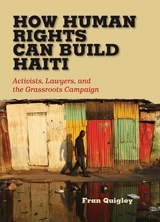
How Human Rights Can Build Haiti
Activists, Lawyers, and the Grassroots CampaignFran Quigley
Vanderbilt University Press, 2014
The only way to transform Haiti's dismal human rights legacy is through a bottom-up social movement, supported by local and international challenges to the status quo. That recipe for reform mirrors the strategy followed by Mario Joseph, Brian Concannon, and their clients and colleagues profiled in this book. Together, Joseph, Concannon, and their allies represent Haiti's best hope to escape the cycle of disaster, corruption, and violence that has characterized the country's two-hundred-year history. At the same time, their efforts are creating a template for a new and more effective human rights-focused strategy to turn around failed states and end global poverty.
How Lawyers Lose Their Way
A Profession Fails Its Creative MindsJean Stefancic and Richard Delgado
Duke University Press, 2005
Stefancic and Delgado dramatize the plight of modern lawyers by exploring the unlikely friendship between Archibald MacLeish, who gave up a successful but unsatisfying law career to pursue his literary yearnings, and Ezra Pound. Reading the forty-year correspondence between MacLeish and Pound, Stefancic and Delgado draw lessons about the difficulties of attorneys trapped in worlds that give them power, prestige, and affluence but not personal satisfaction, much less creative fulfillment. Long after Pound had embraced fascism, descended into lunacy, and been institutionalized, MacLeish took up his old mentor’s cause, turning his own lack of fulfillment with the law into a meaningful crusade and ultimately securing Pound’s release from St. Elizabeths Hospital. Drawing on MacLeish’s story, Stefancic and Delgado contend that literature, public interest work, and critical legal theory offer tools to contemporary attorneys for finding meaning and overcoming professional dissatisfaction.
How Machines Came to Speak
Media Technologies and Freedom of SpeechJennifer Petersen
Duke University Press, 2022
How to Be French
Nationality in the Making since 1789Patrick Weil
Duke University Press, 2008
Throughout How to Be French, Weil compares French laws to those of other countries, including the United States, Great Britain, and Germany, showing how France both borrowed from and influenced other nations’ legislation. Examining moments when a racist approach to nationality policy held sway, Weil brings to light the Vichy regime’s denaturalization of thousands of citizens, primarily Jews and anti-fascist exiles, and late-twentieth-century efforts to deny North African immigrants and their children access to French nationality. He also reveals stark gender inequities in nationality policy, including the fact that until 1927 French women lost their citizenship by marrying foreign men. More than the first complete, systematic study of the evolution of French nationality policy, How to be French is a major contribution to the broader study of nationality.
How to Do Things with Legal Doctrine
Pierre Schlag and Amy J. Griffin
University of Chicago Press, 2020
How to Lobby Alaska State Government
Clive S. Thomas
University of Alaska Press, 2019
This book starts by helping new lobbyists to think politically, by explaining the structure and operation of state government, the psychology and needs of public officials, and where the power lies in Juneau—who’s got political clout. How to Lobby then moves into the nitty-gritty of a lobbying campaign. It covers the basics of group influence, campaign planning and management, the pros and cons of various group tactics, tips on face-to-face meetings, and the challenges of lobbying day-to-day. In addition to extensive guidance on what to do, this book also emphasizes the things to avoid that will undermine or eliminate a lobbyist’s chances of success. Pragmatic and portable, this book will be valuable to new and professional lobbyists both, and anyone looking for fresh perspectives on this important business.
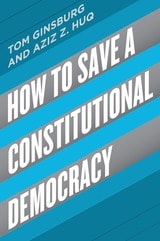
How to Save a Constitutional Democracy
Tom Ginsburg and Aziz Z. Huq
University of Chicago Press, 2018
How to Save a Constitutional Democracy mounts an urgent argument that we can no longer afford to be complacent. Drawing on a rich array of other countries’ experiences with democratic backsliding, Tom Ginsburg and Aziz Z. Huq show how constitutional rules can both hinder and hasten the decline of democratic institutions. The checks and balances of the federal government, a robust civil society and media, and individual rights—such as those enshrined in the First Amendment—often fail as bulwarks against democratic decline. The sobering reality for the United States, Ginsburg and Huq contend, is that the Constitution’s design makes democratic erosion more, not less, likely. Its structural rigidity has had unforeseen consequence—leaving the presidency weakly regulated and empowering the Supreme Court conjure up doctrines that ultimately facilitate rather than inhibit rights violations. Even the bright spots in the Constitution—the First Amendment, for example—may have perverse consequences in the hands of a deft communicator who can degrade the public sphere by wielding hateful language banned in many other democracies. We—and the rest of the world—can do better. The authors conclude by laying out practical steps for how laws and constitutional design can play a more positive role in managing the risk of democratic decline.
How to Save a Constitutional Democracy
Tom Ginsburg and Aziz Z. Huq
University of Chicago Press, 2018
Democracies are in danger. Around the world, a rising wave of populist leaders threatens to erode the core structures of democratic self-rule. In the United States, the tenure of Donald Trump has seemed decisive turning point for many. What kind of president intimidates jurors, calls the news media the “enemy of the American people,” and seeks foreign assistance investigating domestic political rivals? Whatever one thinks of President Trump, many think the Constitution will safeguard us from lasting damage. But is that assumption justified?
How to Save a Constitutional Democracy mounts an urgent argument that we can no longer afford to be complacent. Drawing on a rich array of other countries’ experiences with democratic backsliding, Tom Ginsburg and Aziz Z. Huq show how constitutional rules can both hinder and hasten the decline of democratic institutions. The checks and balances of the federal government, a robust civil society and media, and individual rights—such as those enshrined in the First Amendment—often fail as bulwarks against democratic decline. The sobering reality for the United States, Ginsburg and Huq contend, is that the Constitution’s design makes democratic erosion more, not less, likely. Its structural rigidity has had unforeseen consequence—leaving the presidency weakly regulated and empowering the Supreme Court conjure up doctrines that ultimately facilitate rather than inhibit rights violations. Even the bright spots in the Constitution—the First Amendment, for example—may have perverse consequences in the hands of a deft communicator who can degrade the public sphere by wielding hateful language banned in many other democracies. We—and the rest of the world—can do better. The authors conclude by laying out practical steps for how laws and constitutional design can play a more positive role in managing the risk of democratic decline.
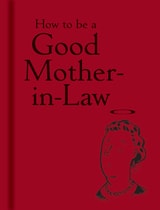
How to be a Good Mother-in-Law
Edited by the Bodleian Library
Bodleian Library Publishing, 2013
Originally published in the 1930s, How to be a Good Mother-in-Law offers advice that ranges from the amusingly old-fashioned to the surprisingly still relevant today. Among the topics discussed are how not to behave on your son or daughter’s wedding day, how to visit the couple in their new home, how to interact with the grandchildren, and what degree of independence should be granted to married sons. For mothers-in-law considering living with the married couple, a chapter presents suggestions for how to negotiate this famously fraught situation. In another chapter called “Are They as Bad as They are Painted?,” the book reproduces a selection of tabloid tragedies, including the story of a mother-in-law that surprised a hapless couple by accompanying them on their honeymoon.
Whether you’re a new mother-in-law, a veteran to this much-maligned role, or a long-suffering spouse whose partner’s parent seems impossible to please—the pithy advice on-hand in How to be a Good Mother-in-Law will be warmly welcomed.
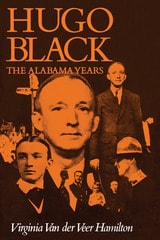
Hugo Black
The Alabama YearsVirginia Van Der Veer Hamilton
University of Alabama Press, 1982
The making of a Supreme Court justice in the crucible of Alabama politics.
Hugo Black: The Alabama Years by Virginia Van der Veer Hamilton is a richly researched political biography that explores the formative experiences of Hugo L. Black, one of the most influential justices in the history of the United States Supreme Court. Focusing on his early life and career in Alabama, Hamilton traces Black's journey from his rural upbringing and legal training to his emergence as a prominent attorney, politician, and United States senator. Through careful analysis of Alabama's social, economic, and political landscape, the book reveals the forces that shaped Black's ideas about government, democracy, and constitutional rights.
Hamilton examines Black's rise during a period of profound change in the South, highlighting the alliances, controversies, and challenges that defined his political career. The study places Black within the broader context of Progressive Era reform, the transformation of Southern politics, and the expanding role of the federal government in American life. At the same time, it provides a nuanced portrait of a complex public figure whose beliefs and actions continue to inspire debate among historians and legal scholars.
Essential reading for students of legal history, political science, Southern studies, and American government, this volume offers valuable insight into the Alabama roots of a justice who would profoundly influence modern constitutional interpretation and civil liberties jurisprudence.
Human Rights
Concepts, Contests, ContingenciesAustin Sarat and Thomas R. Kearns, Editors
University of Michigan Press, 2002
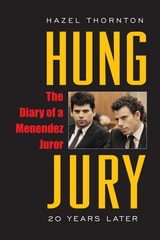
Hung Jury
The Diary of a Menendez JurorHazel Thornton
Temple University Press, 2017
More than two decades after serving as a juror on the high-profile seven-month murder trial People v. Erik Galen Menendez, Hazel Thornton updates her book Hung Jury with a new preface and a postscript essay of observations about the Menendez brothers’ second trial. Includes psychological commentary by Lawrence S. Wrightsman and Amy J. Posey, and legal commentary by Alan Scheflin.
Hybrid Constitutions
Challenging Legacies of Law, Privilege, and Culture in Colonial AmericaVicki Hsueh
Duke University Press, 2010
Hsueh traces the historical development and theoretical implications of proprietary constitutionalism by examining the founding of the colonies of Maryland, Carolina, and Pennsylvania. She provides close readings of colonial proclamations, executive orders, and assembly statutes, as well as the charter granting Cecilius Calvert the colony of Maryland in 1632; the Fundamental Constitutions of Carolina, adopted in 1669; and the treaties brokered by William Penn and various Lenni Lenape and Susquehannock tribes during the 1680s and 1690s. These founding documents were shaped by ambition, contingency, and limited resources; they reflected an ambiguous and unwieldy colonialism rather than a purposeful, uniform march to modernity. Hsueh concludes by reflecting on hybridity as a rubric for analyzing the historical origins of colonialism and reconsidering contemporary indigenous claims in former settler colonies such as Australia, New Zealand, and the United States.