Results by title
275 books match the query 'Letters' and 8 start with h
Hannah Whitman Heyde
The Complete CorrespondenceMaire Mullins
Bucknell University Press, 2022
Herndon on Lincoln
LettersWilliam H. Herndon, edited by Douglas L. Wilson and Rodney O. Davis
University of Illinois Press, 2019
Herndon's Informants
Letters, Interviews, and Statements about Abraham LincolnEdited by Douglas L. Wilson and Rodney O. Davis
University of Illinois Press, 2020
More than 600 letters and interviews providing information about Abraham Lincoln's prepolitical and prelegal careers are included in this volume, a priceless collection never before available in one place.
Women to whom Lincoln proposed marriage, political allies and adversaries, judges and fellow attorneys, longtime comrades, erstwhile friends--all speak out here in words first gathered by William H. Herndon, Lincoln's law partner, between 1865 and 1890. Historian David Herbert Donald has called Herndon's materials "the basic source for Abraham Lincoln's early years."
Some of those Herndon questioned were illiterate; others could read but barely write. Completion of this undertaking took the editors to three major collections for the mammoth task of transcribing documents that often were nearly illegible.
Invaluable to Lincoln scholars and intriguing to anyone curious about Lincoln and his times, the book includes an introduction, scholarly annotations, a registry of the informants, and a detailed topical index.
Hold Dear, As Always
Jette, a German Immigrant Life in LettersAdolf E. Schroeder and Carla Schulz-Geisberg
University of Missouri Press, 1988
Henriette Geisberg Bruns was twenty-three when she arrived in 1836 at the isolated Westphalia Settlement in central Missouri with her husband, baby son, two brothers, and a maid. Jette, as she was known to her family and friends, had not come to America by inclination, but from duty. Her husband Bernhard, a physician, had fallen victim to the emigration fever sweeping Germany in the 1830s and was convinced that he could provide a better life for his family in the American Free States where land was plentiful, the soil was fertile, and taxes were low. Born into a large, prosperous, closely knit family, Jette had set out for the New World reluctantly; but once in Missouri, she was determined not to give up and go back home, as a neighboring family did.
Although she maintained her resolve, this collection of letters written to her family in Germany shows that her life in America was often beset by deprivation, disease, and loneliness. Jette had been persuaded to emigrate for the sake of her children’s future; however, of the ten born in central Missouri, five died in childhood, three within three weeks in September and October 1841.Despite the family responsibilities and the hardships she faced in Missouri, Jette maintained a lively interest in American political and social life. For fifteen years in Westphalia and almost fifty in Jefferson City and St. Louis, she observed and offered astute—if sometimes acerbic—commentary on the historic as well as the daily events of nineteenth-century life. Left destitute by the death of her husband, who had served as mayor of Jefferson City during the Civil War, she opened a boarding-house in her home across from the state capitol to support her own children and those of her brother. There the German radicals in state government gathered to argue and debate.This rare collection of personal family letters, combined with an autobiographical sketch Jette wrote after the Civil War, illuminates the experience of one immigrant woman in a land that was always foreign to her.
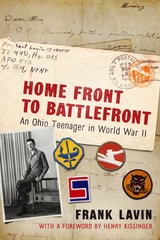
Home Front to Battlefront
An Ohio Teenager in World War IIFrank Lavin
Ohio University Press, 2016
Carl Lavin was a high school senior when Pearl Harbor was attacked. The Canton, Ohio, native was eighteen when he enlisted, a decision that would take him with the US Army from training across the United States and Britain to combat with the 84th Infantry Division in the Battle of the Bulge. Home Front to Battlefront is the tale of a foot soldier who finds himself thrust into a world where he and his unit grapple with the horrors of combat, the idiocies of bureaucracy, and the oddities of life back home—all in the same day. The book is based on Carl’s personal letters, his recollections and those of the people he served beside, official military history, private papers, and more.
Home Front to Battlefront contributes the rich details of one soldier’s experience to the broader literature on World War II. Lavin’s adventures, in turn disarming and sobering, will appeal to general readers, veterans, educators, and students of the war. As a history, the book offers insight into the wartime career of a Jewish Ohioan in the military, from enlistment to training through overseas deployment. As a biography, it reflects the emotions and the role of the individual in a total war effort that is all too often thought of as a machine war in which human soldiers were merely interchangeable cogs.
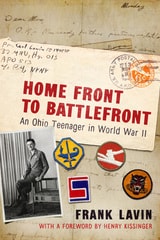
Home Front to Battlefront
An Ohio Teenager in World War IIFrank Lavin
Ohio University Press, 2001
Carl Lavin was a high school senior when Pearl Harbor was attacked. The Canton, Ohio, native was eighteen when he enlisted, a decision that would take him with the US Army from training across the United States and Britain to combat with the 84th Infantry Division in the Battle of the Bulge. Home Front to Battlefront is the tale of a foot soldier who finds himself thrust into a world where he and his unit grapple with the horrors of combat, the idiocies of bureaucracy, and the oddities of life back home—all in the same day. The book is based on Carl’s personal letters, his recollections and those of the people he served beside, official military history, private papers, and more.
Home Front to Battlefront contributes the rich details of one soldier’s experience to the broader literature on World War II. Lavin’s adventures, in turn disarming and sobering, will appeal to general readers, veterans, educators, and students of the war. As a history, the book offers insight into the wartime career of a Jewish Ohioan in the military, from enlistment to training through overseas deployment. As a biography, it reflects the emotions and the role of the individual in a total war effort that is all too often thought of as a machine war in which human soldiers were merely interchangeable cogs.
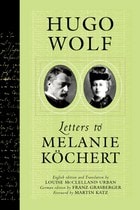
Hugo Wolf
Letters To Melanie KochertHugo Wolf
University of Wisconsin Press, 2003
Wolf’s letters to Köchert—he wrote 245 between 1887 and 1899—were composed during a period of almost unprecedented cultural upheaval in Europe, in the shadow of Vienna during the era of Freud, Mahler, and Klimt. They reveal Wolf at his most optimistic, celebrating his concert successes and the solitude he believed was so precious to his ability to compose. They follow Wolf through times of overwhelming despair, when his musical failures left him profoundly alienated, overcome, as he revealed to Köchert, "by a feeling of unspeakable emptiness and desolation." And they follow Wolf as he struggled to compose the 250 astounding art songs that are his creative legacy, and his almost simultaneous descent into madness.
Hugo Wolf: Letters to Melanie Köchert, sensitively translated by Wolf scholar and interpreter Louise McClelland Urban, is a literary and musical even of the highest order
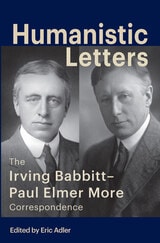
Humanistic Letters
The Irving Babbitt-Paul Elmer More CorrespondenceEric Adler
University of Missouri Press, 2023