Results by title
642 books match the query 'Linguistics' and 11 start with h
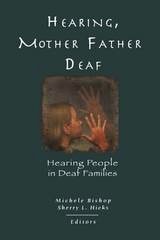
HEARING, MOTHER-FATHER DEAF
Hearing People in Deaf FamiliesMichele Bishop
Gallaudet University Press, 2009
The newest entry in the Sociolinguistics in Deaf Communities series explores the richness and complexity of the lives of hearing people in deaf families. Along with their own contributions, volume editors Michele Bishop and Sherry L. Hicks present the work of an extraordinary cadre of deaf, hearing, and Coda (children of deaf adults) researchers: Susan Adams, Jean Andrews, Oya Ataman, Anne E. Baker, Beppie van den Bogaerde , Helsa B. Borinstein, Karen Emmorey, Tamar H. Gollan, Mara Lúcia Masutti, Susan Mather, Ronice Müller de Quadros, Jemina Napier, Paul Preston, Jennie E. Pyers, Robin Thompson, and Andrea Wilhelm. Their findings represent research in a number of countries, including Australia, Brazil, England, Germany, the Netherlands, and the United States.
Hearing, Mother^Father Deaf: Hearing People in Deaf Families includes a comprehensive description of the societal influences at work in the lives of deaf people and their hearing children, which serves as a backdrop for the essays. The topics range from bimodal bilingualism in adults to cultural and linguistic behaviors of hearing children from deaf families; sign and spoken language contact phenomena; and to issues of self-expression, identity, and experience. A blend of data-based research and personal writings, the articles in this sociolinguistic study provide a thorough understanding of the varied experiences of hearing people and their deaf families throughout the world.

Hand and Mind
What Gestures Reveal about ThoughtDavid McNeill
University of Chicago Press, 1992

Handbook for Language Engineers
Edited by Ali Farghaly
CSLI, 2002
Handbook of French Semantics
Edited by Francis Corblin and Henriëtte de Swart
CSLI, 2003
Handbook of Middle American Indians, Volume 5
LinguisticsRobert Wauchope, series editor; Norman A. McQuown, volume editor
University of Texas Press, 1967
This volume, the fifth in the Handbook of Middle American Indians, presents a summary of work accomplished since the Spanish conquest in the contemporary description and historical reconstruction of the indigenous languages and language families of Mexico and Central America.
The essays include the following: “Inventory of Descriptive Materials” by William Bright; “Inventory of Classificatory Materials” by Maria Teresa Fernández de Miranda, “Lexicostatistic Classification” by Morris Swadesh, “Systemic Comparison and Reconstruction” by Robert Longacre, and “Environmental Correlational Studies” by Sarah C. Gudschinsky.
Sketches of Classical Nahuatl by Stanley Newman, Classical Yucatec Maya by Norman A. McQuown, and Classical Quiché by Munro S. Edmonson provide working tools for tackling the voluminous early postconquest texts in these languages of late preconquest empires (Aztec, Maya, Quiché). Further sketches of Sierra Popoluca by Benjamin F. Elson, of Isthmus Zapotec by Velma B. Pickett, of Huautla de Jiménez Mazatec by Eunice V. Pike, of Jiliapan Pame by Leonardo Manrique C., and of Huamelultec Chontal by Viola Waterhouse—together with those of Nahuatl, Maya, and Quiché—provide not only descriptive outlines of as many different linguistic structures but also linguistic representatives of seven structurally different families of Middle American languages. Miguel Léon-Portilla presents an outline of the relations between language and the culture of which it is a part and provides examples of some of these relations as revealed by contemporary research in indigenous Middle America.
The volume editor, Norman A. McQuown (1914–2005), was Professor of Anthropology at The University of Chicago. He formerly taught at Hunter College and served with the Mexican Department of Indian Affairs. He carried out fieldwork with Totonac, Huastec, Tzeltal-Tzotzil, Mame, and other tribes.
The Handbook of Middle American Indians was assembled and edited at the Middle American Research Institute of Tulane University with the assistance of grants from the National Science Foundation and under the sponsorship of the National Research Council Committee on Latin American Anthropology.

Heartland English
Variation and Transition in the American MidwestTimothy C. Frazer
University of Alabama Press, 1993
Mapping the Diverse Voices of America's Linguistic Heartland.
Heartland English is the first book-length scholarly treatment of English spoken in the Midwest, or the northern interior of the continental United States. For generations, the American Midwest has been portrayed as the home of a single, uniform variety of "standard" American English. Heartland English: Variation and Transition in the American Midwest challenges that assumption through the first book-length scholarly examination of the rich linguistic diversity that exists across the region. Bringing together the work of leading dialectologists and language scholars, editor Timothy C. Frazer presents a groundbreaking exploration of how history, migration, settlement patterns, geography, culture, and social change have shaped the spoken language of the Midwest.
Covering communities across the northern interior of the United States, the volume reveals a complex linguistic landscape marked by regional dialect boundaries, evolving pronunciations, distinctive vocabulary, and shifting patterns of speech. Rather than viewing Midwestern English as a static or homogeneous dialect, the contributors demonstrate how linguistic variation reflects the movement of peoples, the influence of neighboring regions, and the ongoing transformation of American society.
Drawing on research in dialect geography, sociolinguistics, historical linguistics, and language variation studies, Heartland English offers valuable insights into the ways language both shapes and reflects regional identity. The collection examines how speakers perceive dialect differences, how those differences develop over time, and why the Midwest remains one of the most important regions for understanding the evolution of American English. As a landmark contribution to the study of language in North America, the book continues to serve as an essential resource for scholars investigating the relationship between language, culture, and place.
A Publication in the Centennial Series of the American Dialect Society in celebration of the beginning of its second century of research into language variation in America.
Hegemonies of Language and Their Discontents
The Southwest North American Region Since 1540Carlos G. Vélez-Ibáñez
University of Arizona Press, 2017
Well-regarded author Carlos G. Vélez-Ibáñez details the linguistic and cultural processes used by penetrating imperial and national states. He argues that these impositions have been not linear but hydra-headed, complex and contradictory, sometimes accommodated and sometimes forcefully imposed. Such impositions have created discontent resulting in physical and linguistic revolts, translanguage versions, and multilayered capacities of use and misuse of imposed languages—even the invention of community-created trilingual dictionaries.
Vélez-Ibáñez gives particular attention to both sides of the border, explaining the consequences of the fragile splitting of the area through geopolitical border formation. He illustrates the many ways those discontents have manifested in linguistic, cultural, educational, political, and legal forms.
From revolt to revitalization, from silent objection to expressive defiance, people in the Southwest North American Region have developed arcs of discontent from the Spanish colonial period to the present. These narratives are supported by multiple sources, including original Spanish colonial documents and new and original ethnographic studies of performance rituals like the matachines of New Mexico. This unique work discusses the most recent neurobiological studies of bilingualism and their implications for cognitive development and language as it spans multiple disciplines. Finally, it provides the most important models for dual language development and their integration to the "Funds of Knowledge" concept as creative contemporary discontents with monolingual approaches.
Historical Linguistics and Biblical Hebrew
Steps Toward an Integrated ApproachRobert Rezetko
SBL Press, 2014
A philologically robust approach to the history of ancient Hebrew
In this book the authors work toward constructing an approach to the history of ancient Hebrew that overcomes the chasm of academic specialization. The authors illustrate how cross-textual variable analysis and variation analysis advance research on Biblical Hebrew and correct theories based on extra-linguistic assumptions, intuitions, and ideologies by focusing on variation of forms/uses in the Masoretic text and variation between the Masoretic text and other textual traditions.
Features:
- A unique approach that examines the nature of the sources and the description of their language together
- Extensive bibliography for further research
- Tables of linguistic variables and parallels
How Myths about Language Affect Education
What Every Teacher Should KnowDavid Johnson
University of Michigan Press, 2013
How Myths about Language Affect Education: What Every Teacher Should Know clarifies some of the most common misconceptions about language, particularly those that affect teachers and the decisions they make when they teach English language learners. The chapters in this book address myths about language in general, about first and second language acquisition, about language and society, and about language and thinking. Each chapter concludes with activities for teachers that give examples, exercises, or simple questions that relate directly to teachers' everyday dealings with ELLs and language.
How Myths about Language Affect Education is not intended to be a complete introduction to linguistics; it does not contain information on phonetics or complex syntactic explanations, and technical jargon is kept to a minimum. The aim of this book is not to settle language issues but rather to highlight popular misconceptions and the ways that they influence debates regarding language and affect language policies in and out of the classroom.
How to Shoot the Longbow
A Guide from Historical and Applied SourcesHugh D. H. Soar
Westholme Publishing, 2015
“Soar’s book [The Crooked Stick] is indispensible.”—Bernard Cornwell, New York Times bestselling author
Relying on more than fifty years’ experience in archery, historian Hugh D. H. Soar reflects on how the longbow was drawn and shot across the centuries through examining the design of the bow and early literature about the bow, combined with his and his colleagues’ applied knowledge using replica bows. No complete medieval longbow has survived, but those found aboard the Tudor warship Mary Rose provide the best archaeological evidence to the possible construction of the medieval bow. Contemporary treatises written about the proper manner of shooting the bow, together with the resurgence in interest and construction of replica bows beginning in the late sixteenth century that form part of the author’s collection provide the basis for this work. How to Shoot the Longbow: A Guide from Historical and Applied Sources is a fascinating and practical look at the use of a legendary invention.
Human Organizations and Social Theory
Pragmatism, Pluralism, and AdaptationMurray J. Leaf
University of Illinois Press, 2008