50 books match the query 'Literature, Medieval' and 4 start with h
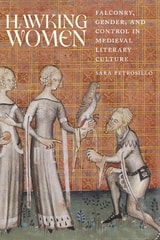
cover of Hawking Women: Falconry, Gender, and Control in Medieval Literary Culture

Hawking Women

Falconry, Gender, and Control in Medieval Literary Culture

Sara Petrosillo

The Ohio State University Press, 2023

While critical discourse about falconry metaphors in premodern literature is dominated by depictions of women as unruly birds in need of taming, women in the Middle Ages claimed the symbol of a hawking woman on their personal seals, trained and flew hawks, and wrote and read poetic texts featuring female falconers. Sara Petrosillo’s Hawking Women demonstrates how cultural literacy in the art of falconry mapped, for medieval readers, onto poetry and challenged patriarchal control. Examining texts written by, for, or about women, Hawking Women uncovers literary forms that arise from representations of avian and female bodies. Readings from Sir Orfeo, Chrétien de Troyes, Guillaume de Machaut, Chaucer’s Troilus and Criseyde, and hawking manuals, among others, show how female characters are paired with their hawks not to assert dominance over the animal but instead to recraft the stand-in of falcon for woman as falcon with woman. In the avian hierarchy female hawks have always been the default, the dominant, and thus these medieval interspecies models contain lessons about how women resisted a culture of training and control through a feminist poetics of the falconry practice.
[more]
cover of Heterosyncrasies: Female Sexuality When Normal Wasn’t

Heterosyncrasies

Female Sexuality When Normal Wasn’t

Karma Lochrie

University of Minnesota Press, 2005
In the early twentieth century, marriage manuals sought to link marital sex to the progress of civilization, searching for the history of what they considered to be normal sexuality. In Heterosyncrasies, Karma Lochrie looks to the foundation of modern society in the Middle Ages to undertake a profound questioning of the heterosexuality of that history. Lochrie begins this provocative rethinking of sexuality by dismantling the very idea of normal through a study of the development of statistics in the nineteenth century. She then intervenes in contemporary debates about queer versus ostensibly stable heterosexual social and sexual categories by exposing the "heterosyncratic" organization of sexuality in the Middle Ages and by clarifying the dubious contribution that the concept of normality has made to the construction of sexuality. In medieval texts from the letters of Heloise to Lollard heretical attacks on the Church, to Chaucer's Canterbury Tales, medical discourse surrounding the clitoris, and finally the Amazons of medieval myth, Lochrie focuses on female sexuality in the Middle Ages in an effort to discern a less binary, more diversified understanding of it. Lochrie demonstrates how the medieval categories of natural and unnatural were distinctly different from our modern categories of normal and abnormal. In her work we see how abandoning heteronormativity as a medieval organizer of sexualities profoundly changes the way we understand all sexualities - past, present, and possibly even future. Heterosyncrasies is a milestone in the study of sexual identity politics, revealing not only how presumptions of normality obscure our understanding of the past, but also how these beliefs affect our present-day laws, society, and daily life.
[more]
cover of How Not to Make a Human: Pets, Feral Children, Worms, Sky Burial, Oysters

How Not to Make a Human

Pets, Feral Children, Worms, Sky Burial, Oysters

Karl Steel

University of Minnesota Press, 2019

From pet keeping to sky burials, a posthuman and ecocritical interrogation of and challenge to human particularity in medieval texts


Mainstream medieval thought, like much of mainstream modern thought, habitually argued that because humans alone had language, reason, and immortal souls, all other life was simply theirs for the taking. But outside this scholarly consensus teemed a host of other ways to imagine the shared worlds of humans and nonhumans. How Not to Make a Human engages with these nonsystematic practices and thought to challenge both human particularity and the notion that agency, free will, and rationality are the defining characteristics of being human.

Recuperating the Middle Ages as a lost opportunity for decentering humanity, Karl Steel provides a posthuman and ecocritical interrogation of a wide range of medieval texts. Exploring such diverse topics as medieval pet keeping, stories of feral and isolated children, the ecological implications of funeral practices, and the “bare life” of oysters from a variety of disanthropic perspectives, Steel furnishes contemporary posthumanists with overlooked cultural models to challenge human and other supremacies at their roots. 

By collecting beliefs and practices outside the mainstream of medieval thought, How Not to Make a Human connects contemporary concerns with ecology, animal life, and rethinkings of what it means to be human to uncanny materials that emphasize matters of death, violence, edibility, and vulnerability. 
[more]
cover of How Soon Is Now?: Medieval Texts, Amateur Readers, and the Queerness of Time

How Soon Is Now?

Medieval Texts, Amateur Readers, and the Queerness of Time

Carolyn Dinshaw

Duke University Press, 2012

How Soon Is Now? performs a powerful critique of modernist temporal regimes through its revelatory exploration of queer ways of being in time as well as of the potential queerness of time itself. Carolyn Dinshaw focuses on medieval tales of asynchrony and on engagements with these medieval temporal worlds by amateur readers centuries later. In doing so, she illuminates forms of desirous, embodied being that are out of sync with ordinarily linear measurements of everyday life, that involve multiple temporalities, that precipitate out of time altogether. Dinshaw claims the possibility of a fuller, denser, more crowded now that theorists tell us is extant but that often eludes our temporal grasp.

Whether discussing Victorian men of letters who parodied the Book of John Mandeville, a fictionalized fourteenth-century travel narrative, or Hope Emily Allen, modern coeditor of the early-fifteenth-century Book of Margery Kempe, Dinshaw argues that these and other medievalists outside the academy inhabit different temporalities than modern professionals operating according to the clock. How Soon Is Now? clears space for amateurs, hobbyists, and dabblers who approach medieval worlds from positions of affect and attachment, from desires to build other kinds of worlds. Unruly, untimely, they urge us toward a disorderly and asynchronous collective.

[more]