65 books match the query 'Literature and the war' and 3 start with h

cover of Hearts and Minds: Bodies, Poetry, and Resistance in the Vietnam Era

Hearts and Minds

Bodies, Poetry, and Resistance in the Vietnam Era

Michael Bibby

Rutgers University Press, 1996

The early 1960s to the mid-1970s was one of the most turbulent periods in American history. The U.S. military was engaged in its longest, costliest overseas conflict, while the home front was torn apart by riots, protests, and social activism. In the midst of these upheavals, an underground and countercultural press emerged, giving activists an extraordinary forum for a range of imaginative expressions. Poetry held a prominent place in this alternative media. The poem was widely viewed by activists as an inherently anti-establishment form of free expression, and poets were often in the vanguards of political activism.

Hearts and Minds is the first book-length study of the poems of the Black Liberation, Women's Liberation, and GI Resistance movements during the Vietnam era. Drawing on recent cultural and literary theories, Bibby investigates the significance of images, tropes, and symbols of human bodies in activist  poetry. Many key political slogans of the period––"black is beautiful," "off our backs"––foreground the body. Bibby demonstrates that figurations of bodies marked important sites of social and political struggle.

Although poetry played such an important role in Vietnam-era activism, literary criticism has largely ignored most of this literature. Bibby recuperates the cultural-historical importance of Vietnam-era activist poetry, highlighting both its relevant contexts and revealing how it engaged political and social struggles that continue to motivate contemporary history. Arguing for the need to read cultural history through these "underground" texts, Hearts and Minds offers new grounds for understanding the recent history of American poetry and the role poetry has played as a medium of imaginative political expression.
 

[more]
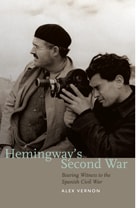
cover of Hemingway’s Second War: Bearing Witness to the Spanish Civil War

Hemingway’s Second War

Bearing Witness to the Spanish Civil War

Alex Vernon

University of Iowa Press, 2011

In 1937 and 1938, Ernest Hemingway made four trips to Spain to cover its civil war for the North American News Alliance wire service and to help create the pro-Republican documentary film The Spanish Earth. Hemingway’s Second War is the first book-length scholarly work devoted to this subject.
     Drawing on primary sources, Alex Vernon provides a thorough account of Hemingway’s involvement in the Spanish Civil War, a messy, complicated, brutal precursor to World War II that inspired Hemingway’s great novel For Whom the Bell Tolls. Vernon also offers the most sustained history and consideration to date of The Spanish Earth. Directed by Joris Ivens, this film was a landmark work in the development of war documentaries, for which Hemingway served as screenwriter and narrator.
      Contributing factual, textual, and contextual information to Hemingway studies in general and his participation in the war specifically, Vernon has written a critical biography for Hemingway’s experiences during the Spanish Civil War that includes discussion of the left-wing politics of the era and the execution of José Robles Pazos. Finally, the book provides readings ofFor Whom the Bell Tollsboth in historical context and on its own terms.
      Marked by both impressive breadth and accessibility, Hemingway’s Second War will be an indispensible resource for students of literature, film, journalism, and European history and a landmark work for readers of Ernest Hemingway.
[more]
cover of How Will the Heart Endure: Elizabeth Bowen and the Landscape of War

How Will the Heart Endure

Elizabeth Bowen and the Landscape of War

Heather Bryant Jordan

University of Michigan Press, 1992

The career of Elizabeth Bowen (1899-1973) has been hard to categorize. As an Anglo-lrish writer, a follower of the modernists but not technically one herself; as an independent woman writer but not, by her admission, a feminist; and as a creative writer in time of war, she has eluded compartmentalization. In How Will the Heart Endure, Heather Bryant Jordan provides a new assessment of Bowen’s achievement, arguing that Bowen’s response to war is the best lens for elucidating the relation between art and life expressed in Bowen’s work.Bowen created novels, short stories, essays, and autobiographical works in a war-torn world that saw successively the Troubles in Ireland, the Irish Civil War, World War I, and World War Il. The strains she felt as a result of these experiences were expressed in the intensely personal vision of loss and betrayal that her fiction conveys.Jordan’s study combines historical and literary analysis and incorporates new archival research on Bowen’s correspondence and on her war reports to the Ministry of Information. How Will the Heart Endure offers not only a new reading of Bowen’s work, but an insightful look into the wartime publishing climate in which Bowen and her circle—which included Virginia Woolf, T. S. Eliot, John and Rosalind Lehmann, Cyril Connolly, Evelyn Waugh, Graham Greene, and Stephen Spender—operated. It will be of interest to specialists in modern British fiction, women’s studies, Irish studies, and Anglo-lrish literature.
[more]