Results by title
98 books match the query 'Marginality, Social' and 3 start with h

Heidegger And The Jews
Jean-Francois Lyotard
University of Minnesota Press, 1990
[more]
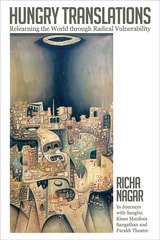
Hungry Translations
Relearning the World through Radical VulnerabilityRicha Nagar
University of Illinois Press, 2019
Experts often assume that the poor, hungry, rural, and/or precarious need external interventions. They frequently fail to recognize how the same people create politics and knowledge by living and honing their own dynamic visions. How might scholars and teachers working in the Global North ethically participate in producing knowledge in ways that connect across different meanings of struggle, hunger, hope, and the good life?Informed by over twenty years of experiences in India and the United States, Hungry Translations bridges these divides with a fresh approach to academic theorizing. Through in-depth reflections on her collaborations with activists, theatre artists, writers, and students, Richa Nagar discusses the ongoing work of building embodied alliances among those who occupy different locations in predominant hierarchies. She argues that such alliances can sensitively engage difference through a kind of full-bodied immersion and translation that refuses comfortable closures or transparent renderings of meanings. While the shared and unending labor of politics makes perfect translation--or retelling--impossible, hungry translations strive to make our knowledges more humble, more tentative, and more alive to the creativity of struggle.
[more]
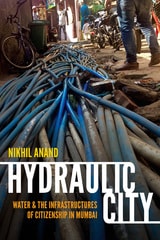
Hydraulic City
Water and the Infrastructures of Citizenship in MumbaiNikhil Anand
Duke University Press, 2017
In Hydraulic City Nikhil Anand explores the politics of Mumbai's water infrastructure to demonstrate how citizenship emerges through the continuous efforts to control, maintain, and manage the city's water. Through extensive ethnographic fieldwork in Mumbai's settlements, Anand found that Mumbai's water flows, not through a static collection of pipes and valves, but through a dynamic infrastructure built on the relations between residents, plumbers, politicians, engineers, and the 3,000 miles of pipe that bind them. In addition to distributing water, the public water network often reinforces social identities and the exclusion of marginalized groups, as only those actively recognized by city agencies receive legitimate water services. This form of recognition—what Anand calls "hydraulic citizenship"—is incremental, intermittent, and reversible. It provides residents an important access point through which they can make demands on the state for other public services such as sanitation and education. Tying the ways Mumbai's poorer residents are seen by the state to their historic, political, and material relations with water pipes, the book highlights the critical role infrastructures play in consolidating civic and social belonging in the city.
[more]