Results by title
58 books match the query 'Mass media and culture' and 3 start with h
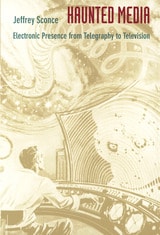
Haunted Media
Electronic Presence from Telegraphy to TelevisionJeffrey Sconce
Duke University Press, 2000
In Haunted Media Jeffrey Sconce examines American culture’s persistent association of new electronic media—from the invention of the telegraph to the introduction of television and computers—with paranormal or spiritual phenomena. By offering a historical analysis of the relation between communication technologies, discourses of modernity, and metaphysical preoccupations, Sconce demonstrates how accounts of “electronic presence” have gradually changed over the decades from a fascination with the boundaries of space and time to a more generalized anxiety over the seeming sovereignty of technology.
Sconce focuses on five important cultural moments in the history of telecommunication from the mid-nineteenth century to the present: the advent of telegraphy; the arrival of wireless communication; radio’s transformation into network broadcasting; the introduction of television; and contemporary debates over computers, cyberspace, and virtual reality. In the process of examining the trajectory of these technological innovations, he discusses topics such as the rise of spiritualism as a utopian response to the electronic powers presented by telegraphy and how radio, in the twentieth century, came to be regarded as a way of connecting to a more atomized vision of the afterlife. Sconce also considers how an early preoccupation with extraterrestrial radio communications tranformed during the network era into more unsettling fantasies of mediated annihilation, culminating with Orson Welles’s legendary broadcast of War of the Worlds. Likewise, in his exploration of the early years of television, Sconce describes how programs such as The Twilight Zone and The Outer Limits continued to feed the fantastical and increasingly paranoid public imagination of electronic media. Finally, Sconce discusses the rise of postmodern media criticism as yet another occult fiction of electronic presence, a mythology that continues to dominate contemporary debates over television, cyberspace, virtual reality, and the Internet.
As an engaging cultural history of telecommunications, Haunted Media will interest a wide range of readers including students and scholars of media, history, American studies, cultural studies, and literary and social theory.
[more]
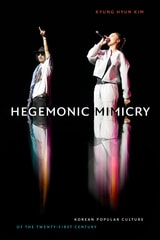
Hegemonic Mimicry
Korean Popular Culture of the Twenty-First CenturyKyung Hyun Kim
Duke University Press, 2021
In Hegemonic Mimicry, Kyung Hyun Kim considers the recent global success of Korean popular culture—the Korean wave of pop music, cinema, and television, which is also known as hallyu—from a transnational and transcultural perspective. Using the concept of mimicry to think through hallyu's adaptation of American sensibilities and genres, he shows how the commercialization of Korean popular culture has upended the familiar dynamic of major-to-minor cultural influence, enabling hallyu to become a dominant global cultural phenomenon. At the same time, its worldwide popularity has rendered its Koreanness opaque. Kim argues that Korean cultural subjectivity over the past two decades is one steeped in ethnic rather than national identity. Explaining how South Korea leaped over the linguistic and cultural walls surrounding a supposedly “minor” culture to achieve global ascendance, Kim positions K-pop, Korean cinema and television serials, and even electronics as transformative acts of reappropriation that have created a hegemonic global ethnic identity.
[more]

Hypertext and the Female Imaginary
Jaishree K. Odin
University of Minnesota Press, 2010
In Hypertext and the Female Imaginary, Jaishree K. Odin reveals how media that use hypertextual strategies of narrative fragmentation provocatively engage questions of gender or cultural difference. Odin addresses hypertext on two levels: as an artistic technique in electronic or film narratives and as a metaphor for describing the complexity of postmodernism in which different cultures, discourses, and media are in continual interaction with one another.
Investigating the work of Trinh T. Minh-ha, Judy Malloy, Shelley Jackson, Stephanie Strickland, and M. D. Coverly, Odin demonstrates how these writers apply hypertextual strategies to subversively convey difference. Through her readings of various transformative hypertext narratives by women writers/artists, she pursues the question of what constitutes empowering descriptions of the world in a technology-mediated culture where the dominant discourse is turning everything into the same.
Using feminist as well as postcolonial perspectives, she explores the embodied state of the human as reflected in critically aware contemporary narratives and examines how these works consider what it means to be human in the twenty-first century.
[more]