Results by title
178 books match the query 'Media' and 3 start with h
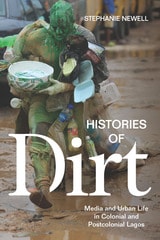
Histories of Dirt
Media and Urban Life in Colonial and Postcolonial LagosStephanie Newell
Duke University Press, 2020
In Histories of Dirt Stephanie Newell traces the ways in which urban spaces and urban dwellers come to be regarded as dirty, as exemplified in colonial and postcolonial Lagos. Newell conceives dirt as an interpretive category that facilitates moral, sanitary, economic, and aesthetic evaluations of other cultures under the rubric of uncleanliness. She examines a number of texts ranging from newspaper articles by elite Lagosians to colonial travel writing, public health films, and urban planning to show how understandings of dirt came to structure colonial governance. Seeing Lagosians as sources of contagion and dirt, British colonizers used racist ideologies and discourses of dirt to justify racial segregation and public health policies. Newell also explores possibilities for non-Eurocentric methods for identifying African urbanites’ own values and opinions by foregrounding the voices of contemporary Lagosians through interviews and focus groups in which their responses to public health issues reflect local aesthetic tastes and values. In excavating the shifting role of dirt in structuring social and political life in Lagos, Newell provides new understandings of colonial and postcolonial urban history in West Africa.
[more]
Horn, or The Counterside of Media
Henning Schmidgen
Duke University Press, 2022
We regularly touch and handle media devices. At the same time, media devices such as body scanners, car seat pressure sensors, and smart phones scan and touch us. In Horn, Henning Schmidgen reflects on the bidirectional nature of touch and the ways in which surfaces constitute sites of mediation between interior and exterior. Schmidgen uses the concept of "horn"—whether manifested as a rhinoceros horn or a musical instrument—to stand for both natural substances and artificial objects as spaces of tactility. He enters into creative dialogue with artists, scientists, and philosophers, ranging from Salvador Dalí, William Kentridge, and Rebecca Horn to Sigmund Freud, Walter Benjamin, and Marshall McLuhan, who plumb the complex interplay between tactility and technological and biological surfaces. Whether analyzing how Dalí conceived of images as tactile entities during his “rhinoceros phase” or examining the problem of tactility in Thomas Pynchon’s The Crying of Lot 49, Schmidgen reconfigures understandings of the dynamic phenomena of touch in media.
[more]

Hush
Media and Sonic Self-ControlMack Hagood
Duke University Press, 2019
For almost sixty years, media technologies have promised users the ability to create sonic safe spaces for themselves—from bedside white noise machines to Beats by Dre's “Hear What You Want” ad campaign, in which Colin Kaepernick's headphones protect him from taunting crowds. In Hush, Mack Hagood draws evidence from noise-canceling headphones, tinnitus maskers, LPs that play ocean sounds, nature-sound mobile apps, and in-ear smart technologies to argue the true purpose of media is not information transmission, but rather the control of how we engage our environment. These devices, which Hagood calls orphic media, give users the freedom to remain unaffected in the changeable and distracting spaces of contemporary capitalism and reveal how racial, gendered, ableist, and class ideologies shape our desire to block unwanted sounds. In a noisy world of haters, trolls, and information overload, guarded listening can be a necessity for self-care, but Hagood argues our efforts to shield ourselves can also decrease our tolerance for sonic and social difference. Challenging our self-defeating attempts to be free of one another, he rethinks media theory, sound studies, and the very definition of media.
[more]