Results by title
128 books match the query 'Men' and 2 start with h

Hints of His Mortality
David Borofka
University of Iowa Press, 1996
The award-winning stories in David Borofka's Hints of His Mortality focus on the male of the species, on bewildered, guilt-ridden, hypersensitive characters adrift in a sea of changing roles and expectations. Although they yearn for the ideal—whether physical or spiritual—and for that sense of divine connection suggested by Wordsworth's Intimations of Immortality, they usually end up settling for what seems the next best thing: sex or religion.
The amorous scrimmage between male and female in these taut, intense stories is a contest that leaves no one unmarked. The hapless ministers in Borofka's memorable collection find that their daily grind of professional piety leaves them with more questions than answers. The men and boys in Hints of His Mortality are always aware of their flaws, for Borofka's vital characters have the capacity to register the shadows of their every blemish. Like Ferguson of the title story, haunted for twenty years by his failures of conscience, each protagonist experiences the inexorable fallibility of his own nature, agonizes over his moral weakness, and longs for escape from this life in which “our birth is but a sleep and a forgetting." Yet each is redeemed by his ongoing struggle for compassion and understanding.
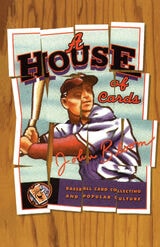
House Of Cards
Baseball Card Collecting and Popular CultureJohn Bloom
University of Minnesota Press, 1997
Explores the connection between baseball card collecting and nostalgia among men of the baby boom.
Baseball card collecting carries with it images of idealized boyhoods in the sprawling American suburbs of the postwar era. Yet in the past twenty years, it has grown from a pastime for children to a big-money pursuit taken seriously by adults. In A House of Cards, John Bloom uses interviews with collectors, dealers, and hobbyists as well as analysis of the baseball card industry and extensive firsthand observations to ask what this hobby tells us about nostalgia, work, play, masculinity, and race and gender relations among collectors.
Beginning in the late 1970s and into the early 1990s, baseball card collecting grew into a business that embodied traditional masculine values such as competition, savvy, and industry. In A House of Cards, Bloom interviews collectors who reveal ambivalence about the hobby’s emphasis on these values, often focusing on its alienating, lonely, and unfulfilling aspects. They express nostalgia for the ideal childhood world many middle-class white males experienced in the postwar years, when they perceived baseball card collecting as a form of play, not a moneymaking enterprise. Bloom links this nostalgia to anxieties about deindustrialization and the rise of the civil rights, feminist, and gay rights movements. He examines the gendered nature of swap meets as well as the views of masculinity expressed by the collectors: Is the purpose of baseball card collecting to form a community of adults to reminisce or to inculcate young men with traditional masculine values? Is it to establish “connectedness” or to make money? Are collectors striving to reinforce the dominant culture or question it through their attempts to create their own meaning out of what are, in fact, mass-produced commercial artifacts? Bloom provides a fascinating exploration of male fan culture, ultimately providing insight into the ways white men of the baby boom view themselves, masculinity, and the culture at large. [Excerpt:]“Collectors often decried how money had ruined their hobby, making it hard for them to form meaningful friendships through their cards. Money, however, made the hobby not only profitable but also more serious, more instrumental, and therefore more manly. The same collectors who complained about greed often bragged in the same interview about the value of their cards. Yet money, in turn, made the hobby less akin to child’s play and more like work: lonely, competitive, unfulfilling, and alienating.”