Results by title
188 books match the query 'Middle Eastern' and 6 start with h
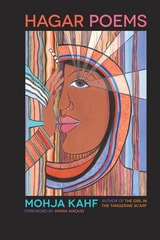
Hagar Poems
Mohja Kahf
University of Arkansas Press, 2016
“Mohja Kahf ’s Hagar Poems is brilliantly original in its conception, thrillingly artful in its execution. Its range is immense, its spiritual depth is profound, it negotiates its shifts between archaic and the contemporary with utmost skill. There’s lyricism, there’s satire, there’s comedy, there’s theology of a high order in this book.”
—Alicia Ostriker, author of For the Love of God: The Bible as an Open Book
“Hagar/ Hajar the immigrant/exile/outcast/refugee mother of a people is given multiple voices and significance in Mohja Kahf’s new book of dramatic monologues, which also reinvents Pharaoh’s daughter, Zuleika, Aïsha, and Mary in poems that are at once lively and learned, agnostic and devout. The sequence on an American mosque, and the poet’s ambivalent love for what it represents, is unique in American poetry.”
—Marilyn Hacker, author of A Stranger’s Mirror
“‘Where have all the goddesses gone,’ writes Mohja Kahf, ‘I tracked down Isis / incognito on Cyprus. /She told me Ishtar / lived under the radar / in southern Iraq. . . .’ In Hagar Poems, Mohja Kahf’s hallmark qualities—irreverence, imagination, wit, poignancy—are all exuberantly in evidence. A wonderful read.”
—Leila Ahmed, author of A Quiet Revolution: The Veil’s Resurgence, from the Middle East to America
“This brilliant collection captures all the ‘patient threading of relationship’ between Hagar and Sarah as between women, and then between women and men, between human and God. . . . At every turn of the page [Kahf] refuses complacency and circumstance but opts instead for exposing the tenuousness of threads that tie and bind and then come loose before our eyes.”
—From the foreword by Amina Wadud
The central matter of this daring new collection is the story of Hagar, Abraham, and Sarah—the ancestral feuding family of Judaism, Christianity, and Islam.
These poems delve into the Hajar story in Islam. They explore other figures from the Near Eastern heritage, such as Mary and Moses, and touch on figures from early Islam, such as Fatima and Aisha. Throughout, there is artful reconfiguring. Readers will find sequels and prequels to the traditional narratives, along with modernized figures claimed for contemporary conflicts.
Hagar Poems is a compelling shakeup of not only Hagar’s story but also of current roles of all kinds of women in all kinds of relationships.
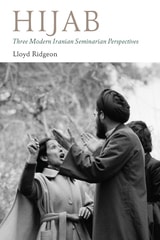
Hijab
Three Modern Iranian Seminarian PerspectivesLloyd Ridgeon
Gingko, 2021
Ḥijāb addresses the differences of opinion among seminarians on the hijab in the Islamic Republic of Iran, focusing on three representative thinkers: Murtaza Mutahhari who held veiling to be compulsory, Ahmad Qabil who argued for the desirability of the hijab, and Muhsin Kadivar who considers it neither necessary nor desirable. In the first chapter, the views of these three scholars are contextualized within the framework known as ‘new religious thinking’ among the seminarians. Comprehending the hermeneutics of this new religious thinking is key to appreciating how and why the younger generation of scholars have offered divergent judgements about the hijab. Following the first chapter, the book is divided into three parallel sections, each devoted to one of the three seminarians. These present a chronological approach, and each scholar’s position on the hijab is assessed with reference to historical specificity and their own general jurisprudential perspective. Extensive examples of the writings of the three scholars on the hijab are also provided.

Hijra
Hala Alyan
Southern Illinois University Press, 2016
The reader sees war, diaspora, and immigration, and hears the marginalized voices of women of color. The poems use lyrical diction and striking imagery to evoke the weight of an emotional and visceral journey. They grow and build in length and form, reflecting the gains the women in the poems make in re-creating selfhood through endurance and strength.
In prose, narrative, and confessional-style poems, Alyan reflects on how physical space is refashioned, transmitted, and remembered. Her voice is distinct, fresh, relevant, and welcoming.
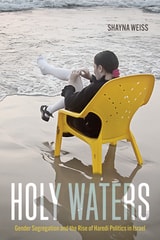
Holy Waters
Gender Segregation and the Rise of Haredi Politics in IsraelShayna Weiss
Rutgers University Press, 2027
Examining the politics of pools and beaches, Holy Waters reveals a surprising history about Haredi Jews and Israel. By looking at the battles to establish gender segregating swimming in Israel, which required a partnership between the Israeli government and its Haredi population to reshape public space, the book argues that the establishment of Israel created a new Haredi pragmatic politics. Unlike some Ultra-Orthodox Jews, who rejected the Jewish state entirely, these radical moderates worked with the state to make it feel more Jewish, and to improve life for its Haredi population, without embracing Zionist ideology. Holy Waters examines three cases: a failure to prevent mixed swimming in Jerusalem, the successful establishment of a separate beach in Tel Aviv, and the mixed results of a Diaspora awareness campaign. Connecting historical controversies to today’s debates of gender segregation, the book demonstrates how these radical moderates still influence Israel today.
This book is published with the support of the Jordan Schnitzer First Book Publication Award, administered by the Association for Jewish Studies.
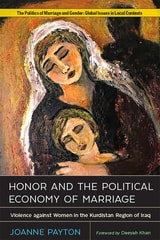
Honor and the Political Economy of Marriage
Violence against Women in the Kurdistan Region of IraqJoanne Payton
Rutgers University Press, 2020
Honor and the Political Economy of Marriage provides a description of ‘honor’-based violence that focuses upon the structure of the family rather than the perpetrator’s culture. The author, Joanne Payton, argues that within societies primarily organized by familial and marital connections, women’s ‘honor’ is a form of symbolic capital within a ‘political economy’ in which marriage organizes intergroup connections.
Drawing on statistical analysis of original data contextualized with historical and anthropological readings, Payton explores forms of marriage and their relationship to ‘honor’, sketching changing norms around the familial control of women from agrarian/pastoral roots to the contemporary era.
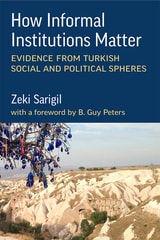
How Informal Institutions Matter
Evidence from Turkish Social and Political SpheresZeki Sarigil
University of Michigan Press, 2023
In How Informal Institutions Matter, Zeki Sarigil examines the role of informal institutions in sociopolitical life and addresses the following questions: Why and how do informal institutions emerge? To ask this differently, why do agents still create or resort to informal institutions despite the presence of formal institutional rules and regulations? How do informal institutions matter? What roles do they play in sociopolitical life? How can we classify informal institutions? What novel types of informal institutions can we identify and explain? How do informal institutions interact with formal institutions? How do they shape formal institutional rules, mechanisms, and outcomes? Finally, how do existing informal institutions change? What factors might trigger informal institutional change? In order to answer these questions, Sarigil examines several empirical cases of informal institution as derived from various issue areas in the Turkish sociopolitical context (i.e., civil law, conflict resolution, minority rights, and local governance) and from multiple levels (i.e., national and local).