Results by title
179 books match the query 'Middle West' and 6 start with h
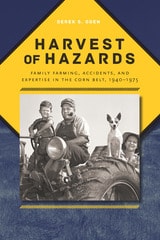
Harvest of Hazards
Family Farming, Accidents, and Expertise in the Corn Belt, 1940-1975Derek S. Oden
University of Iowa Press, 2017
In this study of the farm safety movement in the Corn Belt, historian Derek Oden examines why agriculture was so dangerous and why improvements were so difficult to achieve. Because farmers were self-employed business owners whose employees were mainly family members; because they lived far from aid such as hospitals and fire stations; and because they had to manage such a diverse array of new technologies, they could not easily adopt the workplace safety and public health reforms designed for factories and urban settings. In response, beginning in the 1940s, farmers and a new breed of farm safety specialists relied upon an increasingly elaborate educational campaign to lessen injuries and illnesses on the farm.
Several government, business, and nonprofit organizations—from the US Department of Agriculture to the National Safety Council and 4-H and the Future Farmers of America—worked together to publicize both the dangers of farming and the information farmers needed to stay safe while driving tractors, applying anhydrous ammonia, or repairing machinery. By the 1960s, however, the partnership began to break down, and by the 1970s the safety movement became increasingly contested as professional and policy divisions emerged. This groundbreaking study incorporates agriculture into the histories of occupational safety and public health.

Hatred at Home
al-Qaida on Trial in the American MidwestAndrew Welsh-Huggins
Ohio University Press, 2011
One day in 2002, three friends—a Somali immigrant, a Pakistan–born U.S. citizen, and a hometown African American—met in a Columbus, Ohio coffee shop and vented over civilian casualties in the war in Afghanistan. Their conversation triggered an investigation that would become one of the most unusual and far–reaching government probes into terrorism since the 9/11 attacks.
Over several years, prosecutors charged each man with unrelated terrorist activities in cases that embodied the Bush administration’s approach to fighting terrorism at home.
Government lawyers spoke of catastrophes averted; defense attorneys countered that none of the three had done anything but talk. The stories of these homegrown terrorists illustrate the paradox the government faces after September 11: how to fairly wage a war against alleged enemies living in our midst.
Hatred at Home is a true crime drama that will spark debate from all political corners about safety, civil liberties, free speech, and the government’s war at home.
Haunted Heartland
Michael Norman
University of Wisconsin Press, 2017
For decades, journalist Michael Norman has been tracking down spine-tingling tales that seem to arise from authentic incidents in Illinois, Indiana, Iowa, Kansas, Michigan, Minnesota, Missouri, Nebraska, Ohio, and Wisconsin. In Haunted Heartland he offers more than eighty entertaining, eerie stories. Are they true in the world that we know, or only in a dark vale of twilight?

Heartland English
Variation and Transition in the American MidwestTimothy C. Frazer
University of Alabama Press, 1993
Mapping the Diverse Voices of America's Linguistic Heartland.
Heartland English is the first book-length scholarly treatment of English spoken in the Midwest, or the northern interior of the continental United States. For generations, the American Midwest has been portrayed as the home of a single, uniform variety of "standard" American English. Heartland English: Variation and Transition in the American Midwest challenges that assumption through the first book-length scholarly examination of the rich linguistic diversity that exists across the region. Bringing together the work of leading dialectologists and language scholars, editor Timothy C. Frazer presents a groundbreaking exploration of how history, migration, settlement patterns, geography, culture, and social change have shaped the spoken language of the Midwest.
Covering communities across the northern interior of the United States, the volume reveals a complex linguistic landscape marked by regional dialect boundaries, evolving pronunciations, distinctive vocabulary, and shifting patterns of speech. Rather than viewing Midwestern English as a static or homogeneous dialect, the contributors demonstrate how linguistic variation reflects the movement of peoples, the influence of neighboring regions, and the ongoing transformation of American society.
Drawing on research in dialect geography, sociolinguistics, historical linguistics, and language variation studies, Heartland English offers valuable insights into the ways language both shapes and reflects regional identity. The collection examines how speakers perceive dialect differences, how those differences develop over time, and why the Midwest remains one of the most important regions for understanding the evolution of American English. As a landmark contribution to the study of language in North America, the book continues to serve as an essential resource for scholars investigating the relationship between language, culture, and place.
A Publication in the Centennial Series of the American Dialect Society in celebration of the beginning of its second century of research into language variation in America.
Horse-Drawn Days
A Century of Farming with HorsesJerry Apps
Wisconsin Historical Society Press, 2010
Hostile Heartland
Racism, Repression, and Resistance in the MidwestBrent M. S. Campney
University of Illinois Press, 2019