Results by title
159 books match the query 'Minnesota' and 6 start with h
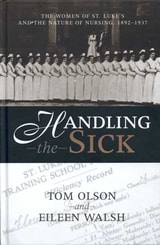
HANDLING THE SICK
Women of St Luke’s and the Nature of Nursing, 1892–1937Tom Olson and Eileen Walsh
The Ohio State University Press, 2004
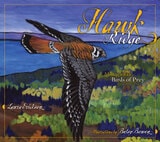
Hawk Ridge
Minnesota's Birds of PreyLaura Erickson
University of Minnesota Press, 2012
Was Caesar like the eagle because of his aquiline (from aquila, for “eagle” in Latin) nose, or does the eagle seem imperial because of his Caesar-like beak? Does the sharp vision of a “hawk-eyed” observer have any basis in nature? And what the heck is “kettling” to a bird-watcher, or, for that matter, a bird? Raptors have captured the imagination from time immemorial and have an especially rich history in Minnesota. The ancient peoples whose pictographs adorn the rock faces of Lake Superior’s North Shore may well have witnessed the first hawk movements along Lake Superior—the same annual migration that today draws as many as twenty thousand people to Duluth’s Hawk Ridge. These birds, passing through in astounding numbers, are among the hawks and accipiters, buteos and harriers, eagles and ospreys pictured and profiled in detail in this book.
Written by one of Minnesota’s best-known bird authorities, with images by one of the state’s favorite illustrators, Hawk Ridge is as fun as it is informative. It introduces the state’s raptors, from the rare visitor to the most familiar hawk, noting each species’ signature traits—osprey wings, for instance, are crooked to help them catch fish; vultures urinate on their legs to cool themselves—and their nesting, breeding, and migrating habits. Did you know that Sharp-shinned Hawks banded at Hawk Ridge have been found throughout Central America and even into South America, and also, in midwinter, in Wisconsin? Laura Erickson offers a broad perspective (a bird’s-eye view!), making sense of the raptor’s role in the larger ornithological scheme.
With descriptions of various species—and helpful distinctions between species, families, and orders—the book gives readers a clear idea of which raptors might be seen in Minnesota, when, where, and how often. It also includes a hawk migration primer that explains the movements that bring these birds in such awe-inspiring numbers to places like Hawk Ridge. Filled with curious facts and practical information for expert and amateur bird-watcher alike, the book is at once a guide to the hawks of Minnesota and a beautifully illustrated album of the most regal members of the avian kingdom.
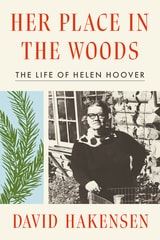
Her Place in the Woods
The Life of Helen HooverDavid Hakensen
University of Minnesota Press, 2025
The biography of one of Minnesota’s most beloved nature writers, from her career in the city to her rustic cabin on Gunflint Lake
During the late 1950s through the early 1970s, Helen Hoover’s stories and essays of life in the wilderness on northern Minnesota’s Gunflint Lake, published in popular magazines and several bestselling books (including The Gift of the Deer in 1966 and A Place in the Woods in 1969), found millions of fans and earned her accolades alongside nature writers like Sigurd Olson, Rachel Carson, Sally Carrighar, and Calvin Rutstrum. Hoover’s own unlikely history of leaving a corporate career in Chicago for a small cabin without electricity or running water—with no interest in hunting or fishing—is just one chapter of the remarkable life that David Hakensen describes in Her Place in the Woods. This first complete biography illuminates how Helen Hoover (1910–1984) made a place for herself and for countless readers in, as she put it, the world of her time.
Hoover defied convention. Self-trained and without an academic degree, she worked in the male-dominated metallurgical field as a researcher at International Harvester, where she solved a long-standing problem with the manufacture of discs for farm implements and earned a patent. She and her husband, Adrian, a commercial artist, had long dreamed of moving to a remote cabin in the woods. As they started the long return drive to Chicago after a summer spent on Gunflint Lake, they finally made the leap, quitting their jobs with a long-distance phone call from Grand Marais and figuring out the rest as they went.
The Hoovers were woefully unprepared for life off the grid and slowly learned how to convert sheds into chicken coops and fend off bears. Social encounters presented their own challenges, with Helen’s fiery personality leading to clashes with hunters and other Gunflint neighbors. Gradually, the Hoovers settled into the rhythms of their remote homestead, and Helen would craft a prolific literary livelihood from her keen observations of nature and encounters with animals in the surrounding woods.
Her Place in the Woods captures both an awakening to the power and fragility of the natural world and the efforts and talents of an extraordinary woman defining herself as a writer. Though Helen Hoover would move on from the secluded North Woods, as she wrote in her final book, The Years of the Forest, “From this time on it would be both here and with me wherever I might be, as long as I should live.”
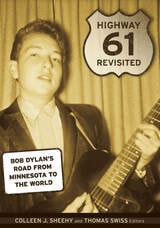
Highway 61 Revisited
Bob Dylan’s Road from Minnesota to the WorldColleen J. Sheehy
University of Minnesota Press, 2009
New essays consider Dylan’s latest work, his Minnesota roots, and his global reach
The young man from Hibbing released Highway 61 Revisited in 1965, and the rest, as they say, is history. Or is it? From his roots in Hibbing, to his rise as a cultural icon in New York, to his prominence on the worldwide stage, Colleen J. Sheehy and Thomas Swiss bring together the most eminent Dylan scholars at work today—as well as people from such far-reaching fields as labor history, African American studies, and Japanese studies—to assess Dylan’s career, influences, and his global impact on music and culture.
The Dylan effect has extended far beyond the United States in recent decades, and the essays here analyze his contribution to the people and cultures of the United Kingdom, Italy, and Japan. With a special focus on his Minnesota roots, including Greil Marcus’s spectacular tour of Dylan’s hometown, authors also take into account his most recent work and Martin Scorsese’s documentary No Direction Home.The first cultural and historical geography of his dramatic rise, storied career, and unmatched iconic status, Highway 61 Revisited maps the terrain of Bob Dylan’s music in the world.Contributors: John Barner, U of Georgia; Daphne Brooks, Princeton U; Court Carney, Stephen F. Austin State U; Alessandro Carrera, U of Houston; Michael Cherlin, U of Minnesota; Marilyn J. Chiat; Susan Clayton; Mick Cochrane, Canisius College; Thomas Crow, New York U; Kevin J. H. Dettmar, Pomona College, Carbondale; Sumanth Gopinath, U of Minnesota; Charles Hughes; C. P. Lee, U of Salford, Manchester, England; Alex Lubet, U of Minnesota; Greil Marcus, U of California, Berkeley; Aldon Lynn Nielsen, Pennsylvania State U; Roberto Polito, The New School; Robert Reginio, Frostburg State U; Heather Stur, U of Southern Mississippi; Mikiko Tachi, Chiba U, Japan; Gayle Wald, George Washington U; Anne Waldman, Naropa U; David Yaffe, Syracuse U.
Homemade
Finnish Rye, Feed Sack Fashion, and Other Simple Ingredients from My Life in FoodBeatrice Ojakangas
University of Minnesota Press, 2018
Beatrice Ojakangas, the oldest of ten children, came by it naturally—the cooking but also the pluck and perseverance that she's served up with her renowned Scandinavian dishes over the years. In the wake of the Moose Lake fires and famine of 1918, Ojakangas tells us in this delightful memoir-cum-cookbook, her grandfather sent for a Finnish mail-order bride—and got one who’d trained as a chef.
Ojakangas’s stories, are, unsurprisingly, steeped in food lore: tales of cardamom and rye, baking salt cake at the age of five on a wood-burning stove, growing up on venison, making egg rolls for Chun King, and sending off a Pillsbury Bake Off–winning recipe without ever making it. And from here, how those early roots flourished through hard work and dedication to a successful (but never easy) career in food writing and a much wider world, from working for pizza roll king Jeno Paulucci to researching food traditions in Finland and appearing with Julia Child and Martha Stewart—all without ever leaving behind the lessons learned on the farm. As she says, “first you have to start with good ingredients and a good idea.”
Chock-full of recipes, anecdotes, and a kind humor that bring to vivid life the Finnish culture of northern Minnesota as well as the wider culinary world, Homemade delivers the savory and the sweet in equal measures and casts a warm light on a rich slice of the country’s cooking heritage.
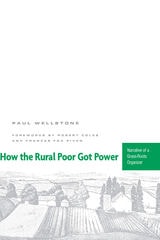
How The Rural Poor Got Power
Narrative Of A Grass-Roots OrganizerPaul Wellstone
University of Minnesota Press, 2003
The gripping story behind Paul Wellstone’s progressive legacy
Before he was a senator, before he was a nationally known advocate for the disenfranchised and a tireless supporter of public policies to alleviate poverty, Paul Wellstone devoted his time and legendary energy to grassroots organizing. How the Rural Poor Got Power describes Wellstone’s experiences as a political activist in rural Minnesota. Working with senior citizens, struggling farmers, and single mothers, Wellstone created a coalition to address transportation, access to health care, and welfare benefits issues. This narrative features interviews with citizens and shows Wellstone observing and participating in the ideals to which he devoted his life: helping poor people gain a political voice.