Results by title
121 books match the query 'Motion picture industry' and 13 start with h

Hardboiled in Hollywood
Five Black Mask Writers and the MoviesUniversity of Wisconsin Press, 1991
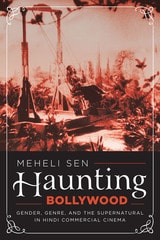
Haunting Bollywood
Gender, Genre, and the Supernatural in Hindi Commercial CinemaBy Meheli Sen
University of Texas Press, 2017
Haunting Bollywood is a pioneering, interdisciplinary inquiry into the supernatural in Hindi cinema that draws from literary criticism, postcolonial studies, queer theory, history, and cultural studies. Hindi commercial cinema has been invested in the supernatural since its earliest days, but only a small segment of these films have been adequately explored in scholarly work; this book addresses this gap by focusing on some of Hindi cinema’s least explored genres.
From Gothic ghost films of the 1950s to snake films of the 1970s and 1980s to today’s globally influenced zombie and vampire films, Meheli Sen delves into what the supernatural is and the varied modalities through which it raises questions of film form, history, modernity, and gender in South Asian public cultures. Arguing that the supernatural is dispersed among multiple genres and constantly in conversation with global cinematic forms, she demonstrates that it is an especially malleable impulse that routinely pushes Hindi film into new formal and stylistic territories. Sen also argues that gender is a particularly accommodating stage on which the supernatural rehearses its most basic compulsions; thus, the interface between gender and genre provides an exceptionally productive lens into Hindi cinema’s negotiation of the modern and the global. Haunting Bollywood reveals that the supernatural’s unruly energies continually resist containment, even as they partake of and sometimes subvert Hindi cinema’s most enduring pleasures, from songs and stars to myth and melodrama.
Headline Hollywood
A Century of Film ScandalMcLean, Adrienne L
Rutgers University Press, 2001
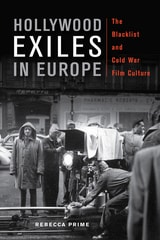
Hollywood Exiles in Europe
The Blacklist and Cold War Film CulturePrime, Rebecca
Rutgers University Press, 2014
Rebecca Prime documents the untold story of the American directors, screenwriters, and actors who exiled themselves to Europe as a result of the Hollywood blacklist. During the 1950s and 1960s, these Hollywood émigrés directed, wrote, or starred in almost one hundred European productions, their contributions ranging from crime film masterpieces like Du rififi chez les hommes (1955, Jules Dassin, director) to international blockbusters like The Bridge on the RiverKwai (1957, Carl Foreman and Michael Wilson, screenwriters) and acclaimed art films like The Servant (1963, Joseph Losey, director).
At once a lively portrait of a lesser-known American “lost generation” and an examination of an important transitional moment in European cinema, the book offers a compelling argument for the significance of the blacklisted émigrés to our understanding of postwar American and European cinema and Cold War relations. Prime provides detailed accounts of the production and reception of their European films that clarify the ambivalence with which Hollywood was regarded within postwar European culture. Drawing upon extensive archival research, including previously classified material, Hollywood Exiles in Europe suggests the need to rethink our understanding of the Hollywood blacklist as a purely domestic phenomenon. By shedding new light on European cinema’s changing relationship with Hollywood, the book illuminates the postwar shift from national to transnational cinema.

Hollywood Independents
The Postwar Talent TakeoverDenise Mann
University of Minnesota Press, 2008
Hollywood Independents explores the crucial period from 1948 to 1962 when independent film producers first became key components of the modern corporate entertainment industry. Denise Mann examines the impact of the radically changed filmmaking climate—the decline of the studios, the rise of television, and the rise of potent talent agencies like MCA—on a group of prominent talent-turned-producers including Burt Lancaster, Joseph Mankiewicz, Elia Kazan, and Billy Wilder.
In order to show how these newly independent filmmakers negotiated through an increasingly fraught, reactionary creative atmosphere, Mann analyzes the reflexive portraits of their altered working conditions in such films as A Face in the Crowd, Sweet Smell of Success, and Will Success Spoil Rock Hunter? These artists, she shows, took on the corporate middle-managers at television networks and talent agencies as a way of challenging the status quo without risking censorship or blacklisting.
This period saw the evolution of film production from the studio-governed system to one of entrepreneurs. Out of this new arrangement, which encouraged greater creative freedom, emerged a nascent form of independent art cinema that sowed the seeds of the Hollywood Renaissance that followed.
Denise Mann is associate professor of film, TV and digital media at UCLA. She is coeditor of Private Screenings: Television and the Female Consumer (Minnesota, 1992).
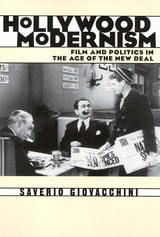
Hollywood Modernism
Film & Politics In Age Of New DealSaverio Giovacchini
Temple University Press, 2001
Seeing Hollywood as a forcefield, Giovacchini examines the social networks, working relationships, and political activities of artists, intellectuals, and film workers who flocked to Hollywood from Europe and the eastern United States before and during the second world war. He creates a complex and nuanced portrait of this milieu, adding breadth and depth to the conventional view of the era's film industry as little more than an empire for Jewish moguls or the major studios. In his rendering Hollywood's newcomers joined with its established elite to develop a modernist aesthetic for film that would bridge popular and avant-garde sensibilities; for them, realism was the most effective vehicle for conveying their message and involving a mass audience in the democratic struggle for process.
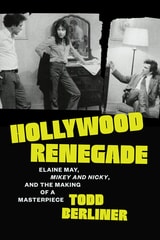
Hollywood Renegade
Elaine May, Mikey and Nicky, and the Making of a MasterpieceTodd Berliner
University of Texas Press, 2026
Examines the career and unorthodox filmmaking practices of director Elaine May, whose Mikey and Nicky, over a span of fifty years, transformed from a fiasco to a masterpiece of seventies cinema.
Elaine May’s Mikey and Nicky stands out in the history of Hollywood. After a troubled production, massive cost overruns, and lawsuits between May and the studio, the film received scathing reviews and failed at the box office. But the very qualities that initially alienated viewers and reviewers led later generations to regard the film as an overlooked masterpiece.
Written and directed by the period’s only female New Hollywood filmmaker, Mikey and Nicky has not received the attention given to other unconventional films of the 1970s. But May worked for years to give each moment of the movie multiple areas of interest. She made every character, even peripheral ones, nuanced and memorable. And she designed every scene, even minor ones, as a performance event. Her lead actors, Peter Falk and John Cassavetes, thrived under her unorthodox directing style, earning acclaim even from reviewers who hated the movie. Decades in the making—years of scriptwriting, a shoot that spanned ten months, and three years spent editing—Mikey and Nicky shows us what Hollywood cinema can accomplish when talented filmmakers challenge Hollywood’s limited notion of professionalism, rejecting the harsh time pressures of commercial filmmaking in order to get the most out of every scene.
Hollywood Shutdown
Production, Distribution, and Exhibition in the Time of COVIDBy Kate Fortmueller
University of Texas Press, 2021
By March 2020, the spread of COVID-19 had reached pandemic proportions, forcing widespread shutdowns across industries, including Hollywood. Studios, networks and production companies, and the thousands of workers who make film and television possible, were forced to adjust their time-honored business and labor practices. In this book, Kate Fortmueller asks what happened when the coronavirus closed Hollywood.
Hollywood Shutdown examines how the COVID-19 pandemic affected film and television production, influenced trends in distribution, reshaped theatrical exhibition, and altered labor practices. From January movie theater closures in China to the bumpy September release of Mulan on the Disney+ streaming platform, Fortmueller probes various choices made by studios, networks, unions and guilds, distributors, and exhibitors during the evolving crisis. In seeking to explain what happened in the first nine months of 2020, this book also considers how the pandemic will transform Hollywood practices in the twenty-first century.
Hollywood Unions
Kate Fortmueller
Rutgers University Press, 2025
Hollywood and Broadcasting
From Radio to CableMichelle Hilmes
University of Illinois Press, 1990
an excellent introduction to a most important subject. This is an invaluable
work for both scholars and students that places film, radio, and television
within the context of the national culture experience."
--- American Historical Review
"Hilmes is one of the few historians
of broadcasting to move beyond a political economy of the media. . . . Her work
should serve as a model for future histories of broadcasting."
--- Journal of Communication
"All media historians will
find this work a critical addition to their bookshelves."
--- American Journalism
"A major addition to media
history literature."
--- Journalism History
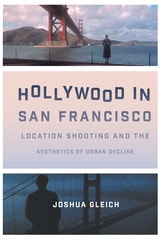
Hollywood in San Francisco
Location Shooting and the Aesthetics of Urban DeclineBy Joshua Gleich
University of Texas Press, 2018
One of the country’s most picturesque cities and conveniently located just a few hours’ drive from Hollywood, San Francisco became the most frequently and extensively filmed American city beyond the production hubs of Los Angeles and New York in the three decades after World War II. During those years, the cinematic image of the city morphed from the dreamy beauty of Vertigo to the nightmarish wasteland of Dirty Harry, although San Francisco itself experienced no such decline. This intriguing disconnect gives impetus to Hollywood in San Francisco, the most comprehensive study to date of Hollywood’s move from studio to location production in the postwar era.
In this thirty-year history of feature filmmaking in San Francisco, Joshua Gleich tracks a sea change in Hollywood production practices, as location shooting overtook studio-based filming as the dominant production method by the early 1970s. He shows how this transformation intersected with a precipitous decline in public perceptions of the American city, to which filmmakers responded by developing a stark, realist aesthetic that suited America’s growing urban pessimism and superseded a fidelity to local realities. Analyzing major films set in San Francisco, ranging from Dark Passage and Vertigo to The Conversation, The Towering Inferno, and Bullitt, as well as the TV show The Streets of San Francisco, Gleich demonstrates that the city is a physical environment used to stage urban fantasies that reveal far more about Hollywood filmmaking and American culture than they do about San Francisco.
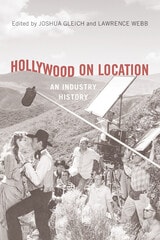
Hollywood on Location
An Industry HistoryGleich, Joshua
Rutgers University Press, 2019
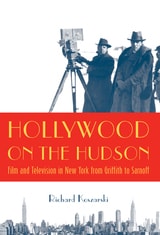
Hollywood on the Hudson
Film and Television in New York from Griffith to SarnoffKoszarski, Richard
Rutgers University Press, 2008