Results by title
99 books match the query 'Motion picture producers and directors' and 4 start with h
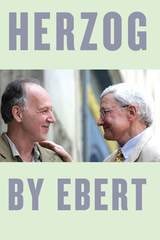
Herzog by Ebert
Roger Ebert
University of Chicago Press, 2017
Herzog by Ebert is a comprehensive collection of Ebert’s writings about the legendary director, featuring all of his reviews of individual films, as well as longer essays he wrote for his Great Movies series. The book also brings together other essays, letters, and interviews, including a letter Ebert wrote Herzog upon learning of the dedication to him of “Encounters at the End of the World;” a multifaceted profile written at the 1982 Cannes Film Festival; and an interview with Herzog at Facet’s Multimedia in 1979 that has previously been available only in a difficult-to-obtain pamphlet. Herzog himself contributes a foreword in which he discusses his relationship with Ebert.
Brimming with insights from both filmmaker and film critic, Herzog by Ebert will be essential for fans of either of their prolific bodies of work.
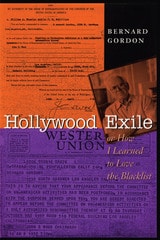
Hollywood Exile, or How I Learned to Love the Blacklist
By Bernard Gordon
University of Texas Press, 2000
The Hollywood blacklist, which began in the late 1940s and ran well into the 1960s, ended or curtailed the careers of hundreds of people accused of having ties to the Communist Party. Bernard Gordon was one of them. In this highly readable memoir, he tells a engrossing insider's story of what it was like to be blacklisted and how he and others continued to work uncredited behind the scenes, writing and producing many box office hits of the era.
Gordon describes how the blacklist cut short his screenwriting career in Hollywood and forced him to work in Europe. Ironically, though, his is a success story that includes the films El Cid, 55 Days at Peking, The Thin Red Line, Krakatoa East of Java, Day of the Triffids, Earth vs. the Flying Saucers, Horror Express, and many others. He recounts the making of many movies for which he was the writer and/or producer, with wonderful anecdotes about stars such as Charlton Heston, David Niven, Sophia Loren, Ava Gardner, and James Mason; directors Nicholas Ray, Frank Capra, and Anthony Mann; and the producer-studio head team of Philip Yordan and Samuel Bronston.
Hollywood's Italian American Filmmakers
Capra, Scorsese, Savoca, Coppola, and TarantinoJonathan J. Cavallero
University of Illinois Press, 2011
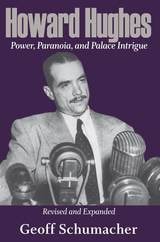
Howard Hughes
Power, Paranoia, and Palace Intrigue, Revised and ExpandedGeoff Schumacher
University of Nevada Press, 2020
Although the public viewed Hughes as a heroic and independent-minded trailblazer, behind closed doors he suffered from germophobia, obsessive-compulsive disorder, and an addiction to painkillers. He became paranoid and reclusive, surrounding himself with a small cadre of loyal caretakers. As executives battled each other over his empire, Hughes’ physical and mental health deteriorated to the point where he lost control of his business affairs.
This second edition includes more insider details on Hughes’ personal interactions with actresses, journalists, and employees. New chapters provide insights into Hughes’s involvement with the mob, his ownership and struggles as the majority shareholder of TWA and the wide-ranging activities of Hughes Aircraft Company, Hughes’s critical role in the Glomar Explorer CIA project (a deep-sea drillship platform built to recover the Soviet submarine K-129), and more. Based on in-depth interviews with individuals who knew and worked with Hughes, this fascinating biography provides a colorful and comprehensive look at Hughes—from his life and career to his final years and lasting influence. This penetrating depiction of the man behind the curtain demonstrates Hughes’s legacy, and enduring impact on popular culture.