Results by title
166 books match the query 'Native American' and 4 start with h
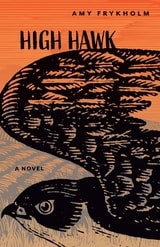
High Hawk
Amy Frykholm
University of Iowa Press, 2024
It’s 1970, and on the Windy Creek Reservation in South Dakota, amidst the rise of AIM in neighboring Pine Ridge, a baby boy appears nestled in a box of Styrofoam peanuts on the doorstep of St. Rose Catholic Church. His appearance disrupts the predictable, lonely life of longtime reservation priest Father Joe Kreitzer. The child, whom they name Bear, finds refuge under the care of Father Joe’s closest friend and ally, Alice Nighthawk.
Thirteen years pass without event, when Alice’s older son, Albert, is mysteriously murdered outside a bar in Rapid City, and Bear is accused of attempting to kill the only person who knows what happened that night. At the same time, Father Joe receives a letter from a person from his past, the only woman who made him question the path of priesthood. She has reached out to Father Joe as one of the few who might help her.
To keep Bear’s case from federal prosecution, Father Joe and Alice begin a search for Bear’s long-lost mother. But their journey unearths more than they bargained for, plunging Father Joe into a labyrinth of secrets and revelations. He is forced not only to confront the choices he’s made and the secrets he keeps, but also to see the truth of the lives of the people around him.
High Hawk is a rich tapestry of love and history, delving into the delicate intricacies of the past and the redemptive power of second chances. Through evocative prose, the lives of those on the fringes of American culture come alive, navigating adversity and forging
connections against all odds.
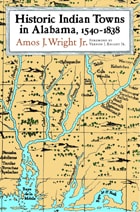
Historic Indian Towns in Alabama, 1540-1838
Amos J. Wright
University of Alabama Press, 2003
Discover the lost towns that shaped Alabama’s earliest history.
This encyclopedic work is a listing of 398 ancient towns recorded within the present boundaries of the state of Alabama, containing basic information on each village's ethnic affiliation, time period, geographic location, descriptions, and (if any) movements. While publications dating back to 1901 have attempted to compile such a listing, none until now has so exhaustively harvested the 214 historic maps drawn between 1544, when Hernando de Soto's entourage first came through the southeastern territory, and 1846, when Indian removal to the Oklahoma Territory was complete. Wright combines the map data with a keen awareness of both previously published information and archival sources, such as colonial town lists, census information, and travel narratives.
The towns are listed alphabetically, and the text of each entry develops chronologically. While only a few of these towns have been accurately located by archaeologists, this volume provides a wealth of information for the future study of cultural geography, southeastern archaeology, and ethnohistory. It will be an enduring reference source for many years to come.
SAMPLE ENTRY,
ALIBAMA TOWN (Alibama)
The Alibama consisted of several towns—Mucclassa, Tawasa, Tomopa, Koarsati (Knight 1981, 27:48). Pickett ([1851] 1962:81) adds Ecanchati, Pawokti, and Autauga. The Alibama Town can also be added. Many maps show the Alibama as a group, but one map, 1796 Thomas and Andrews, locates the "Alabama Town"on the east bank of the Coosa just below Wetumpka.
Swanton ([1922] 1970a:209) wrote that the Tuskegee at the Alabama forks may have been known as the "Alabama Town"; however, this is unlikely, as Major W. Blue, a removal agent, wrote in July 1835 that Coosada, Alabama Town, and Tuskegee were ready to emigrate and they all lived adjoining each other in Macon County (ASP, Military Affairs 1861,6:731).
On 6 July 1838, some twenty-seven towns, including "Alibama" (NA M234 R225), attended the Creek council held in Indian Territory. Thomas Bibb, brother to Alabama territorial govenor William Wyatt Bibb, and others, including Nashville investors, founded the town of Alabama in 1817 at Ten Mile Bluff in Montgomery County (Moser 1980-94, 4:131). The town soon disappeared into history.
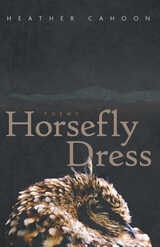
Horsefly Dress
PoemsHeather Cahoon
University of Arizona Press, 2020
Horsefly Dress is a meditation on the experience and beauty of suffering, questioning its triggers and ultimate purpose through the lens of historical and contemporary interactions and complications of Séliš, Qĺispé, and Christian beliefs. Heather Cahoon’s collection explores dark truths about the world through first-person experiences, as well as the experiences of her family and larger tribal community. As a member of the Confederated Salish and Kootenai Tribes, Cahoon crafts poems that recount traditional stories and confront Coyote’s transformation of the world, including his decision to leave certain evils present, such as cruelty, greed, hunger, and death.
By weaving together stories of Cahoon’s family and tribal community with those of Coyote and his family, especially Coyote’s daughter, Horsefly Dress, the interactions and shared experiences show the continued relevance of traditional Séliš and Qĺispé culture to contemporary life. Rich in the imagery of autumnal foliage, migrating birds, and frozen landscapes, Horsefly Dress calls forth the sensory experience of grief and transformation. As the stories and poems reveal, the transformative powers associated with the human experience of loss belong to the past, present, and future, as do the traditional Salish-Pend d’Oreille stories that create the backbone of this intricate collection.
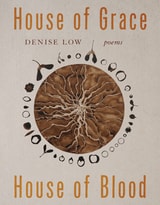
House of Grace, House of Blood
PoemsDenise Low
University of Arizona Press, 2024
In a personal poetic treatment of documents, oral tradition, and images, the author embodies the contradictions she unravels. From a haunting first-person perspective, Low’s formally inventive archival poetry combines prose and lyric, interweaving verse with historical voices in a dialogue with the source material. Each poem builds into a larger narrative on American genocide, the ways in which human loss corresponds to ecological destruction, and how intimate knowledge of the past can enact healing.
Ultimately, these poems not only reconstruct an important historical event, but they also put pressure on the gaps, silences, and violence of the archive. Low asks readers to question not only what is remembered, but how history is remembered—and who is forgotten from it. Reflecting on the injustice of the massacre, the Shawnee leader Tecumseh lamented that though “the Americans murdered all the men, women, and children, even as they prayed to Jesus . . . no American ever was punished, not one.” These poems challenge this attempted erasure.