Results by title
405 books match the query 'Natural history' and 9 start with h
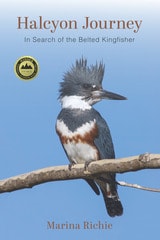
Halcyon Journey
In Search of the Belted KingfisherMarina Richie
Oregon State University Press, 2022
Winner of a 2022 National Outdoor Award
Winner of a Foreword INDIES Award
More than one hundred species of kingfishers brighten every continent but Antarctica. Not all are fishing birds. They range in size from the African dwarf kingfisher to the laughing kookaburra of Australia. This first book to feature North America’s belted kingfisher is a lyrical story of observation, revelation, and curiosity in the presence of flowing waters.
The kingfisher—also known as the halcyon bird—is linked to the mythic origin of halcyon days, a state of happiness that Marina Richie hopes to find outside her back door in Missoula, Montana. Epiphanies and a citizen science discovery punctuate days tracking a bird that outwits at every turn. The female is more colorful than the male (unusual and puzzling) and the birds’ earthen nest holes are difficult to locate.
While the heart of the drama takes place on Rattlesnake Creek in Missoula, the author’s adventures in search of kingfisher kin on the lower Rio Grande, in South Africa, and in London illuminate her relationships with the birds of Montana. In the quiet of winter, she explores tribal stories of the kingfisher as messenger and helper, pivotal qualities for her quest. For all who love birds or simply seek solace in nature, Halcyon Journey is an inviting introduction to the mythic and mysterious belted kingfisher.
Heart Of The Sound
Marybeth Holleman
University of Utah Press, 2004
"You can’t step in the same river twice—although I once believed I could. I believed that the pieces of my life I had chosen, those I held close to my heart, would, once chosen and held, remain the same."—from the book
How does one recover from disaster? That question is at the heart of Marybeth Holleman’s lyrical, elegiac response to the repercussions of the Exxon Valdez oil spill that devastated Alaska’s Prince William Sound in 1989. Twining together the destruction of an ecosystem and the disintegration of her marriage, Holleman explores the resiliency of nature—both wild and human—and the ways in which that resiliency is tested. Like the oil that remains pooled beneath rocks years after the tanker spill, the emotional wounds of the past lie just below the surface. Recovery and restoration from the pain wrought by human hands does not come easily.
If much of nature writing is about the heart’s search for an unspoiled, perfect landscape, The Heart of the Sound is about what happens when the return-to-paradise fantasy is over and paradise is lost. In language rich with passion and hard-won insight, Holleman creates a captivating picture of a woman who found her Eden in the sweeping fjords of Alaska only to lose it to ecological tragedy. But somewhere within that loss, she finds herself.
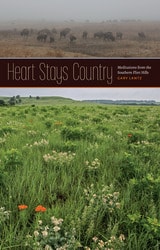
Heart Stays Country
Meditations from the Southern Flint HillsGary Lantz
University of Iowa Press, 2017
As proud grasslanders know, the prairie is biologically fulfilling, unique, and increasingly rare: biologists from the National Park Service and the Nature Conservancy agree that a healthy prairie remains one of the most ecologically diverse and dynamic ecosystems on this planet—as well as one of the rarest left on earth. This landscape that once inspired rapturous exclamations from travelers headed west on horseback now mostly exists in fragments exiled from each other by cropland, cities, and interstate highways.
Historically, tallgrass prairie stretched from Canada to Texas, from central Kansas to Indiana. Now the last major expanse of tallgrass occurs in the Flint Hills, a verdant landscape extending in a north-south strip across eastern Kansas and into northern Oklahoma’s Osage County. In these essays, Gary Lantz brings the beautiful diversity of the prairie home to all of us.
Heritage Futures
Comparative Approaches to Natural and Cultural Heritage PracticesRodney Harrison, Caitlin Desilvey, Cornelius Holtorf, Sharon MacDonald, Nadia Bartolini, Esther Breithoff, Harald Fredheim, Antony Lyons, Sarah May, Jennie Morgan, and Sefryn Penrose
University College London, 2020
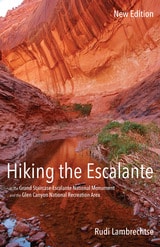
Hiking the Escalante
In the Grand Staircase-Escalante National Monument and the Glen Canyon National Recreation Area, New EditionRudi Lambrechtse
University of Utah Press, 2015
History Within
The Science, Culture, and Politics of Bones, Organisms, and MoleculesMarianne Sommer
University of Chicago Press, 2016
Our interpretation of gene sequences, like our interpretation of other historical evidence, inevitably tells a story laden with political and moral values. Focusing on the work of Henry Fairfield Osborn, Julian Sorell Huxley, and Luigi Luca Cavalli-Sforza in paleoanthropology, evolutionary biology, and human population genetics, History Within asks how the sciences of human origins, whether through the museum, the zoo, or the genetics lab, have shaped our idea of what it means to be human. How have these biologically based histories influenced our ideas about nature, society, and culture? As Marianne Sommer shows, the stories we tell about bones, organisms, and molecules often change the world.
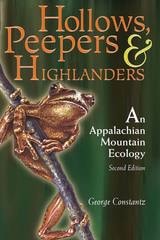
Hollows, Peepers, and Highlanders
An Appalachian Mountain EcologyGeorge Constantz
West Virginia University Press, 2004
In this revised and expanded edition of Hollows, Peepers, and Highlanders, author George Constantz, a biologist and naturalist, writes about the beauty and nature of the Appalachian landscape. While the information is scientific in nature, Constantz's accessible descriptions of the adaptation of various organisms to their environment enable the reader to enjoy learning about the Appalachian ecosystem. The book is divided into three sections: "Stage and Theater," "The Players," and "Seasonal Act." Each section sets the scene and describes the events occurring in nature. "Stage and Theatre" is comprised of chapters that describe the origins of the Appalachia region. "The Players" is an interesting and in-depth look into the ecology of animals, such as the mating rituals of different species, and the evolutionary explanation for the adaptation of Appalachian wildlife. The last section, "Seasonal Act," makes note of the changes in Appalachian weather each season and its effect on the inhabitants.
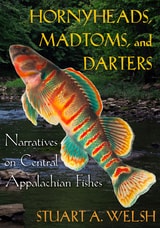
Hornyheads, Madtoms, and Darters
Narratives on Central Appalachian FishesStuart A. Welsh
Ohio University Press, 2023
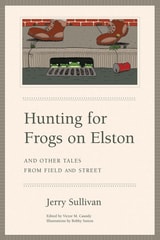
Hunting for Frogs on Elston, and Other Tales from Field & Street
Jerry Sullivan
University of Chicago Press, 2004
Published in association with the Chicago Wilderness coalition, Hunting for Frogs on Elston comprehensively chronicles Chicagoland's unique urban ecology, from its indigenous prairie and oft-delayed seasons to its urban coyotes and passenger pigeons. In witty, informed prose, Sullivan evokes his adventures netting dog-faced butterflies, hunting rattlesnakes, and watching fireflies mate. Inspired by regional flora and fauna, Sullivan ventures throughout the metropolis and its environs in search of sludge worms, gyrfalcons, and wild onions. In reporting his findings to otherwise oblivious urbanites, Sullivan endeavors to make "alienated, atomized, postmodern people feel at home, connected to something beyond ourselves."
In the sprawling Chicagoland region, where an urban ecosystem teeming with remarkable life evolves between skyscrapers and train tracks, no writer chronicled the delicate balance of nature and industry more vividly than Jerry Sullivan. An homage to the urban ecology Sullivan loved so dearly, Hunting for Frogs on Elston is his fitting legacy as well as a lasting gift to the urban naturalist in us all.