129 books match the query 'Natural resources' and 3 start with h
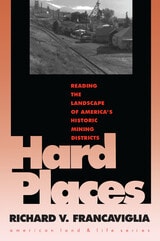
cover of Hard Places: Reading the Landscape of America's Historic Mining Districts

Hard Places

Reading the Landscape of America's Historic Mining Districts

Richard V. Francaviglia

University of Iowa Press, 1997

Working with the premise that there are much meaning and value in the "repelling beauty" of mining landscapes, Richard Francaviglia identifies the visual clues that indicate an area has been mined and tells us how to read them, showing the interconnections among all of America's major mining districts. With a style as bold as the landscape he reads and with photographs to match, he interprets the major forces that have shaped the architecture, design, and topography of mining areas. Covering many different types of mining and mining locations, he concludes that mining landscapes have come to symbolize the turmoil between what our society elects to view as two opposing forces: culture and nature.
[more]
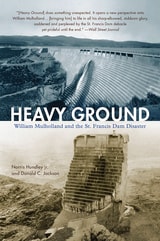
cover of Heavy Ground: William Mulholland and the St. Francis Dam Disaster

Heavy Ground

William Mulholland and the St. Francis Dam Disaster

Norris Hundley

University of Nevada Press, 2020
Heavy Ground explores the social, political, and technological history of the St. Francis Dam Disaster in California, the worst civil engineering disaster in twentieth-century American History. Approximately 400 people died in March 1928, when the concrete gravity dam built by Los Angeles engineer William Mulholland suddenly and tragically collapsed, releasing over 12 billion gallons of water into the Santa Clara River Valley.
 
[more]
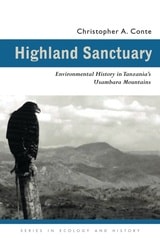
cover of Highland Sanctuary: Environmental History in Tanzania’s Usambara Mountains

Highland Sanctuary

Environmental History in Tanzania’s Usambara Mountains

Christopher A. Conte

Ohio University Press, 2004

For more than a century, the world has recognized the extraordinary biological diversity of the forests of Tanzania’s Usambara Mountains. As international attention has focused on forest conservation, farmers, foresters, biologists, and the Tanzanian state have realized that only complex negotiations will save these treasured, but rapidly disappearing, landscapes. Highland Sanctuary unravels the complex interactions among agriculture, herding, forestry, the colonial state, and the landscape itself. In his examination of the region’s history of ecological transformation, Christopher Conte demonstrates how these forces have combined to create an ever-changing mosaic of forest and field. His study illuminates the debate over conservation, arguing that contingency and chance, the stuff of human history, have shaped forests in ways that rival the power of nature. In Highland Sanctuary, the forest becomes part of human history, rather than something outside of it. Highland Sanctuary cuts through a legacy of contention and ill will to inform contemporary conservation initiatives. Professor Conte explains how ecological changes take divergent paths in similar environments, in this case on mountains that harbor unique flora and fauna, and how these mountain environments achieve international importance as centers of biodiversity.
[more]