Results by title
337 books match the query 'North America' and 8 start with h
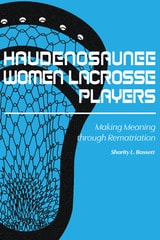
Haudenosaunee Women Lacrosse Players
Making Meaning through RematriationSharity L. Bassett
Michigan State University Press, 2024

Haunted By Waters
Fly Fishing In North American LiteratureMark Browning
Ohio University Press, 1998
As his own story unfolds, Mark Browning analyzes angling literature from the Bible to Norman Maclean, always bringing his inquiry back to the same source: the enigma of this sport.
Haunted by Waters is an exploration of the apparent compulsion of those who fish not only to read about the sport, but to write about it as well. Mark Browning's personal account as a fly fisherman and his perspective as a critic make him uniquely qualified to navigate these waters.
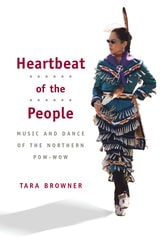
Heartbeat of the People
Music and Dance of the Northern Pow-wowTara Browner
University of Illinois Press, 2002
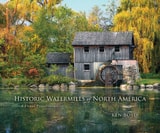
Historic Watermills of North America
A Visual PreservationKen Boyd
University of Alabama Press, 2021
112 full-color artistic photographs of watermills still standing on the North American landscape
The scenic beauty of the watermill is undeniable. The iconic waterwheel has inspired romantics for generations with their warmth and charm. Watermills were once ubiquitous landmarks along brooks, creeks, and rivers across North America. Today, only a scattering of the old watermills grace the countryside, but through these mills, and the turning of their wheels and the whirling of their stones, a small but spectacular part of history lives on.
Through stunningly beautiful images, Historic Watermills of North America: A Visual Preservation presents 112 watermills still standing on the North American landscape. With idealized full-color photographs, Ken Boyd nostalgically hearkens back to a time after European settlement when these structures were the very heart of the communities whose livelihoods they made possible. These mills turned the power of flowing water into mechanical energy to grind corn and wheat into meal and flour, saw timber, loom wool and cotton cloth, and more for the benefit of their operators and communities.
At one time vital to their surrounding regions, most of these surviving mills are in rural areas that have been passed over by modern development. Their designs are as individual as their makers, and their settings are as varied as the landscape. Some have been converted into homes or museums or are part of local tourist attractions. Others have been abandoned but give witness to the significance of their heydays, and others are still in use, doing the same work they have done for generations.
Boyd’s beautifully rendered photographs preserve these extant structures and represent a variety of watermills across the United States and Canada. Each mill photograph is accompanied by a description providing the name of the mill, its location, date of construction, and brief comments highlighting its most noteworthy features. Additional photographs and commentary in the afterword explore the inner workings of watermills.
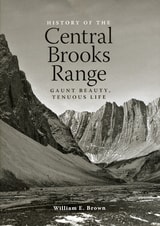
History of the Central Brooks Range
Gaunt Beauty, Tenuous LifeWilliam E. Brown
University of Alaska Press, 2007

History of the Triumphs of Our Holy Faith amongst the Most Barbarous and Fierce Peoples of the New World
Andrés Pérez de Ribas; Translated by Daniel T. Reff, Maureen Ahern, and Richard K. Danford; Annotated and with a Critical Introduction by Daniel T. Reff
University of Arizona Press, 1999
Pérez de Ribas was the first permanent missionary to the Ahome, Zuaque, and Yaqui Indians. After fifteen years on the mission frontier he was recalled to Mexico City, where he held various posts, including Jesuit Provincial. Addressed to novitiates ignorant of the challenges they would face in the field, his Historia was a virtual textbook on missionary work in the New World. Also written to encourage ongoing support of the Jesuit missions, it reflected the author's deep grasp of what rhetorically soothed and moved Church and Crown officials.
Perhaps of greatest interest to the modern reader are Pérez de Ribas's often detailed comments on indigenous beliefs and practices. These firsthand observations provide a rich resource of ethnographic and historical data concerning everything from native subsistence, settlement patterns, and myths to the dynamics of Jesuit-Indian relations. The many cases of conversion that Pérez de Ribas describes are especially rich in ethnographic data, clarifying the values and beliefs from which the Indians were "rescued."
History of the Triumphs is a primary document of great importance, made more valuable here by an exceptionally fluid translation and painstaking annotations. It will be a standard reference for all engaged in research on New Spain and a captivating read for anyone interested in this chapter of American history.
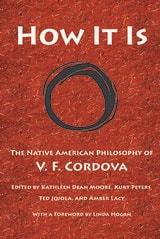
How It Is
The Native American Philosophy of V. F. CordovaV. F. Cordova; Edited by Kathleen Dean Moore, Kurt Peters, Ted Jojola, and Amber Lacy, with a Foreword by Linda Hogan
University of Arizona Press, 2007
In three parts, Cordova sets out a complete Native American philosophy. First she explains her own understanding of the nature of reality itself—the origins of the world, the relation of matter and spirit, the nature of time, and the roles of culture and language in understanding all of these. She then turns to our role as residents of the Earth, arguing that we become human as we deepen our relation to our people and to our places, and as we understand the responsibilities that grow from those relationships. In the final section, she calls for a new reverence in a world where there is no distinction between the sacred and the mundane.
Cordova clearly contrasts Native American beliefs with the traditions of the Enlightenment and Christianized Europeans (what she calls “Euroman” philosophy). By doing so, she leads her readers into a deeper understanding of both traditions and encourages us to question any view that claims a singular truth. From these essays—which are lucid, insightful, frequently funny, and occasionally angry—we receive a powerful new vision of how we can live with respect, reciprocity, and joy.
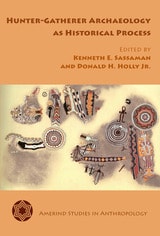
Hunter-Gatherer Archaeology as Historical Process
Edited by Kenneth E. Sassaman and Donald H. Holly Jr.
University of Arizona Press, 2011
Combining the latest empirical studies of archaeological practice with the latest conceptual tools of anthropological and historical theory, this volume seeks to set a new course for hunter-gatherer archaeology by organizing the chapters around three themes. The first section offers diverse views of the role of human agency, challenging the premise that hunter-gatherer societies were bound by their interactions with the natural world. The second section considers how society and culture are constituted. Chapters in the final section take the long view of the historical process, examining how cultural diversity arises out of interaction and the continuity of ritual practices.
A closing commentary by H. Martin Wobst underscores the promise of an archaeology of foragers that does not associate foraging with any particular ideology or social structure but instead invites inquiry into counterintuitive alternatives. Hunter-Gatherer Archaeology as Historical Process seeks to blur the divisions between prehistory and history, between primitive and modern, and between hunter-gatherers and people in other societies. Because it offers alternatives to the dominant discourse and contributes to the agenda of hunter-gatherer research, this book will be of interest to anyone involved in the study of foraging peoples.