Results by title
242 books match the query 'Old Testament' and 10 start with h
Hebrew for Biblical Interpretation
Arthur W. Walker-Jones
SBL Press, 2003
Hidden Critique of Solomon in the Hebrew Bible
Pekka Särkiö
SBL Press, 2025
Hidden Truths from Eden
Esoteric Readings of Genesis 1-3Caroline Vander Stichele
SBL Press, 2014
Examine a rich history of spiritual interpretations from antiquity to the present
Since the sixteenth century CE, the field of biblical studies has focused on the literal meaning of texts. This collection seeks to rectify this oversight by integrating the study of esoteric readings into academic discourse. Case studies focusing on the first three chapters of Genesis cover different periods and methods from early Christian discourse through zoharic, kabbalistic and alchemical literature to modern and post-postmodern approaches.
Features:
- Discussions, comparisons, and analyses of esoteric appropriations of Genesis 1–3
- Essays on creation myths, gender, fate and free will, the concepts of knowledge, wisdom, and gnosis
- Repsonses to papers that provide a range of view points
Historical Roots of the Old Testament (1200-63 BCE)
Richard D. Nelson
SBL Press, 2014
A thorough overview of the history of ancient Israel for research and classroom use
Richard D. Nelson charts the beginning of the Iron Age and the emergence of Israel and its literature, including the kingdoms of Israel and Judah, the downfall of Israel, Judah in the Assyrian and Babylonian periods, Yehud and Persia, and the Hellenistic period. Each chapter provides a summary of the period under consideration, a historical reconstruction of the period, based on biblical and extrabiblical evidence; a critical study of the biblical literature deriving from or associated with the period, and theological conclusions that readers may draw from the relevant biblical texts.
Features:
- Balanced coverage of controversial topics
- Extensive bibliographies at the beginning of each chapter
- Lists of rulers and key dates for reference and classroom use
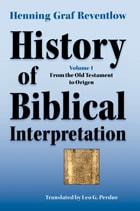
History of Biblical Interpretation, Volume 1
From the Old Testament to OrigenHenning Graf Reventlow
SBL Press, 2009
Homilies on Genesis 18–45
Saint John Chrysostom
Catholic University of America Press, 1990
Homilies on Genesis 46–67
Saint John Chrysostom
Catholic University of America Press, 1992
Homilies on Genesis, 1–17
Saint John Chrysostom
Catholic University of America Press, 1986
Homilies on Jeremiah and 1 Kings 28
Catholic University of America Press, 1998
Hosea’s God
A Metaphorical TheologyMason D. Lancaster
SBL Press, 2023
The book of Hosea is a labyrinth of juxtaposed images for God and God’s people, with such disparate metaphors as God the devouring lion and God the reviving dew. In Hosea’s God: A Metaphorical Theology, Mason D. Lancaster demonstrates that recent advances in metaphor theory help untangle these divergent portrayals of God. He analyzes fifteen metaphor clusters in Hosea 4–14 individually, then discerns patterns and reversals between the clusters. Finally, respecting the ancient value for emphasizing individual aspects of a depiction over a homogenized picture of the whole, the book identifies five characteristics of God prominent among the metaphors of Hosea. Based on this analysis, Lancaster asserts that Hosea’s metaphorical depiction of Yahweh ultimately derives from the primacy of Yahweh’s fidelity to Israel.