Results by title
74 books match the query 'Origin' and 2 start with h
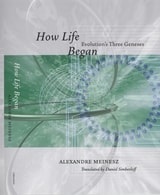
How Life Began
Evolution's Three GenesesAlexandre Meinesz
University of Chicago Press, 2008
The origin of life is a hotly debated topic. The Christian Bible states that God created the heavens and the Earth, all in about seven days roughly six thousand years ago. This episode in Genesis departs markedly from scientific theories developed over the last two centuries which hold that life appeared on Earth about 3.5 billion years ago in the form of bacteria, followed by unicellular organisms half a millennia later. It is this version of genesis that Alexandre Meinesz explores in this engaging tale of life's origins and evolution.
How Life Began elucidates three origins, or geneses, of life—bacteria, nucleated cells, and multicellular organisms—and shows how evolution has sculpted life to its current biodiversity through four main events—mutation, recombination, natural selection, and geologic cataclysm. As an ecologist who specializes in algae, the first organisms to colonize Earth, Meinesz brings a refreshingly novel voice to the history of biodiversity and emphasizes here the role of unions in organizing life. For example, the ingestion of some bacteria by other bacteria led to mitochondria that characterize animal and plant cells, and the chloroplasts of plant cells.
As Meinesz charmingly recounts, life’s grandeur is a result of an evolutionary tendency toward sociality and solidarity. He suggests that it is our cohesion and collaboration that allows us to solve the environmental problems arising in the decades and centuries to come. Rooted in the science of evolution but enlivened with many illustrations from other disciplines and the arts, How Life Began intertwines the rise of bacteria and multicellular life with Vermeer’s portrait of Antoni van Leeuwenhoek, the story of Genesis and Noah, Meinesz’s son’s early experiences with Legos, and his own encounters with other scientists. All of this brings a very human and humanistic tone to Meinesz’s charismatic narrative of the three origins of life.
[more]
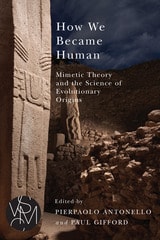
How We Became Human
Mimetic Theory and the Science of Evolutionary OriginsPierpaolo Antonello
Michigan State University Press, 2015
From his groundbreaking Violence and the Sacred and Things Hidden since the Foundation of the World, René Girard’s mimetic theory is presented as elucidating “the origins of culture.” He posits that archaic religion (or “the sacred”), particularly in its dynamics of sacrifice and ritual, is a neglected and major key to unlocking the enigma of “how we became human.” French philosopher of science Michel Serres states that Girard’s theory provides a Darwinian theory of culture because it “proposes a dynamic, shows an evolution and gives a universal explanation.” This major claim has, however, remained underscrutinized by scholars working on Girard’s theory, and it is mostly overlooked within the natural and social sciences. Joining disciplinary worlds, this book aims to explore this ambitious claim, invoking viewpoints as diverse as evolutionary culture theory, cultural anthropology, archaeology, cognitive psychology, ethology, and philosophy. The contributors provide major evidence in favor of Girard’s hypothesis. Equally, Girard’s theory is presented as having the potential to become for the human and social sciences something akin to the integrating framework that present-day biological science owes to Darwin—something compatible with it and complementary to it in accounting for the still remarkably little understood phenomenon of human emergence.
[more]