Results by title
179 books match the query 'Past' and 5 start with h
Health and Labor Force Participation over the Life Cycle
Evidence from the PastEdited by Dora L. Costa
University of Chicago Press, 2003
The twentieth century saw significant increases in both life expectancy and retirement rates-changes that have had dramatic impacts on nearly every aspect of society and the economy. Forecasting future trends in health and retirement rates, as we must do now, requires investigation of such long-term trends and their causes.
To that end, this book draws on new data-an extensive longitudinal survey of Union Army veterans born between 1820 and 1850-to examine the factors that affected health and labor force participation in nineteenth-century America. Contributors consider the impacts of a variety of conditions-including social class, wealth, occupation, family, and community-on the morbidity and mortality of the group. The papers investigate and address a number of special topics, including the influence of previous exposure to infectious disease, migration, and community factors such as lead in water mains. They also analyze the roles of income, health, and social class in retirement decisions, paying particular attention to the social context of disability.
Economists and historians who specialize in demography or labor, as well as those who study public health, will welcome the unique contributions offered by this book, which offers a clearer view than ever before of the workings and complexities of life, death, and labor during the nineteenth century.
[more]

History and Philanthropy
Past, Present, FutureEdited by David Cannadine and Jill Pellew
University of London Press, 2008
[more]
History as Art and as Science
Twin Vistas on the PastH. Stuart Hughes
University of Chicago Press, 1975
"Professor Hughes offers an earnest warning: 'Unless there is some emotional tie, some elective affinity linking the student to his subject of study, the results will be pedantic and perfunctory.' In other words, it is only a step from the sublime to the meticulous. Those eager to guard against that sad descent will find History as Art and as Science a guide, a tonic, and an inspiration. Its short, electrifying essays are so magnificently sane and persuasive they should be required reading for every student who contemplates a major in history."—Geoffrey Bruun, Saturday Review
[more]
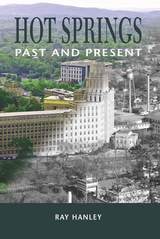
Hot Springs
Past and PresentRay Hanley
University of Arkansas Press, 2014
A century ago Hot Springs, Arkansas, was a world-renown resort city. Today, the town remains the most unique city in Arkansas but with much of its Victorian-to-1950s views nearly unrecognizable. Hot Springs: Past and Present shows vividly the before and after of hundreds of sites, answering questions such as “What used to be on this corner?” and “What was here before it was a parking lot?” The answer to those questions is often an opulent hotel, a theater, a bathhouse, a gambling house, or a mansion. Fire destroyed many buildings, even more were demolished, and some sites remain not so unlike they used to be. Hot Springs: Past and Present makes a perfect walking companion for anyone visiting the town and wishing to learn more about this one-of-a-kind place through not only the photographs but also the informative text that provides a good overview of the town’s history.
[more]
How Trees Die
The Past, Present, and Future of our ForestsJeff Gillman
Westholme Publishing, 2009
Lessons About Our Environment from the World’s Oldest Living Things
Trees have been essential to the success of human beings, providing food, shelter, warmth, transportation, and products (consider the paper you are holding). Trees are also necessary for a healthy atmosphere, literally connecting the earth with the sky. Once in wild abundance— the entire eastern North America was a gigantic forest—they have receded as we have clearcut the landscape in favor of building cities and farms, using up and abusing our forests in the process. Over the centuries, we have trained food trees, such as peach and apple trees, to produce more and better fruit at the expense of their lives. As Jeff Gillman, a specialist in the production and care of trees, explains in his acclaimed work, How Trees Die: The Past, Present, and Future of Our Forests, the death of a tree is as important to understanding our environment as how it lives. While not as readily apparent as other forms of domestication, our ancient and intimate relationship with trees has caused their lives to be inseparably entwined with ours. The environment we have created—what we put into the air and into the water, and how we change the land through farming, construction, irrigation, and highways—affects the world’s entire population of trees, while the lives of the trees under our direct care in farms, orchards, or along a city boulevard depend almost entirely on our actions. Taking the reader on a fascinating journey through time and place, the author explains how we kill trees, often for profit, but also unintentionally with kindness through overwatering or overmulching, and sometimes simply by our movements around the globe, carrying foreign insects or disease. No matter how a tree’s life ends, though, understanding the reason is essential to understanding the future of our environment.
Trees have been essential to the success of human beings, providing food, shelter, warmth, transportation, and products (consider the paper you are holding). Trees are also necessary for a healthy atmosphere, literally connecting the earth with the sky. Once in wild abundance— the entire eastern North America was a gigantic forest—they have receded as we have clearcut the landscape in favor of building cities and farms, using up and abusing our forests in the process. Over the centuries, we have trained food trees, such as peach and apple trees, to produce more and better fruit at the expense of their lives. As Jeff Gillman, a specialist in the production and care of trees, explains in his acclaimed work, How Trees Die: The Past, Present, and Future of Our Forests, the death of a tree is as important to understanding our environment as how it lives. While not as readily apparent as other forms of domestication, our ancient and intimate relationship with trees has caused their lives to be inseparably entwined with ours. The environment we have created—what we put into the air and into the water, and how we change the land through farming, construction, irrigation, and highways—affects the world’s entire population of trees, while the lives of the trees under our direct care in farms, orchards, or along a city boulevard depend almost entirely on our actions. Taking the reader on a fascinating journey through time and place, the author explains how we kill trees, often for profit, but also unintentionally with kindness through overwatering or overmulching, and sometimes simply by our movements around the globe, carrying foreign insects or disease. No matter how a tree’s life ends, though, understanding the reason is essential to understanding the future of our environment.
[more]