Results by title
221 books match the query 'Personal narratives' and 5 start with h
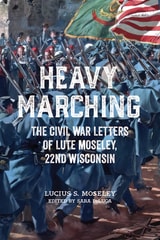
Heavy Marching
The Civil War Letters of Lute Moseley, 22nd WisconsinLucius S. Moseley, edited by Sara DeLuca
University of Wisconsin Press, 2023
From 1862 to 1865, Moseley fought in the Civil War as an infantry soldier in Wisconsin’s 22nd Volunteers. Briefly captured and interred in a Confederate POW Camp, he returned to action and participated in Sherman’s Atlanta campaign. He marched in the Washington, D.C., Grand Review before returning to the Beloit area, where he remained for the rest of his life.
Mosely wrote detailed missives to his family in Beloit about his wartime experiences, demonstrating a flair for describing both camp life and battles. Frank and forthright, he was remarkably articulate, insightful, and thoughtful, whether describing mundane activities or the nearly unfathomable death of President Lincoln. These 125 letters, never before made available to scholars or students of the war, became touchstones and sources of pride for the Moseley family—and provide a uniquely candid and vivid view of this tumultuous period in US history.
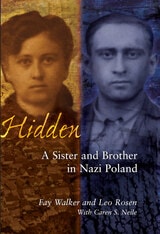
Hidden
A Sister and Brother in Nazi PolandFay Walker
University of Wisconsin Press, 2002
Of the Rosenbluth family, only the older children, Faiga and Luzer, had gone into hiding before the SS rounded up the Jews of Kanczuga, Poland. Hidden is Faiga and Luzer’s story, a memoir whose intimate and quiet particularity makes the incomprehensible enormity of the Holocaust immediate, human, and devastatingly real.
In alternating first-person narratives, Faiga (Fay) and Luzer (Leo) take readers into their very different but inextricably linked experiences in Nazi-occupied Poland. Faiga, the once-dignified young lady from a good home with servants and a seat by the eastern wall of the synagogue, spends two years wandering the perilous countryside, hoping to be taken for a peasant. Mere miles away, knowing nothing of his sister’s fate, Luzer, the leather wholesaler’s only son, lies silent all day in the stifling dark corner of a barn, where the smell of the cows’ warm hides are a piquant reminder of his lost world. Hidden deftly summons that world, as the familiar comforts and squabbles of life in a well-to-do, religious Jewish family are slowly overwhelmed by the grim news coming out of Germany. We follow Faiga and Luzer through the early forebodings and deprivations of the war, into hiding among righteous Poles and erstwhile neighbors-turned-betrayers, and finally, at war’s end, back once more into the world—but not necessarily into safety. Told in a confident, clear, and unsentimental prose, this is a story of heroism and tragedy writ large and small, of two young people coming of age in a world in chaos and then trying to return to "normal" after experiences as unimaginable as they are unforgettable.

Holocaust And Memory In The Global Age
Daniel Levy
Temple University Press, 2005
Originally published in Germany, The Holocaust and Memory in the Global Age examines the nature of collective memory in a globalized world, and how the memory of one particular event—the Holocaust—helped give rise to an emerging global consensus on human rights.
Daniel Levy and Natan Sznaider show how memories of the Holocaust have been de-contextualized from the original event and offer a framework for interpreting contemporary acts of injustice such as ethnic cleansing and genocide. Representations of mass atrocities in Bosnia and Kosovo during the 1990s resonated with iconographies of the Holocaust and played a significant role in the political and military interventions in the Balkans. Subsequently, these representations have had a crucial impact on the consolidation of international human rights and related issues of transitional justice, reparations, and restitution.
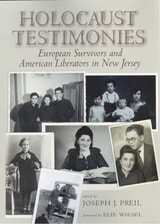
Holocaust Testimonies
European Survivors and American Liberators in New JerseyPreil, Joseph J
Rutgers University Press, 2001
A project of the Holocaust Resource Center of Kean University, New Jersey, this book is a reference tool for teaching the Holocaust, for Holocaust survivors and their families, and for the general reader. Drawing on the center’s central missions is to produce and preserve a series of oral-history videotapes based on the personal experiences of Holocaust survivors who reside in New Jersey. Joseph J. Preil brings together the most compelling testimonies of 153 Holocaust survivors as well as twenty concentration-camp liberators. Through these riveting accounts, the book traces the mass murder of the Jews across Europe in a geographical as well as chronological order. The testimonies in each chapter are grouped by the witnesses’ country or region of origin, preceded by a brief introduction of the history of events in a particular area. In the last part of the book, American soldiers recount their impressions of being present at the liberation of the camps.
“If you can imagine that the Jew to the German was like a cockroach. In the United States, if you step on a cockroach . . . it doesn’t mean anything to you. The same thing, exactly the same thing, the Jew was to the German—a cockroach. . . . One particular Shabbos (Sabbath), they shot twelve or thirteen people in my area. In other words, the German had the right, if he saw me, any Jew that he saw in the street, he could go over to you calmly, take out his revolver, and put it to your head, and shoot you down like a . . . roach. . . . It was a free-for-all.”—Testimony of Sol Einhorn, cited in Holocaust Testimonies: European Survivors and American Liberators in New Jersey
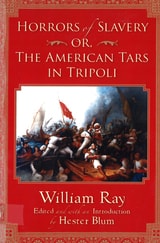
Horrors of Slavery
Or, The American Tars in TripoliBlum, Hester
Rutgers University Press, 2008
Hester Blum's introduction situates Horrors of Slavery in its literary, historical, and political contexts, bringing to light a crucial episode in the early history of our country's relations with Islamic states.
A volume in the Subterranean Lives series, edited by Bradford Verter