212 books match the query 'Peru' and 6 start with h
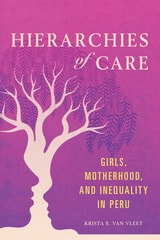
cover of Hierarchies of Care: Girls, Motherhood, and Inequality in Peru

Hierarchies of Care

Girls, Motherhood, and Inequality in Peru

Krista E. Van Vleet

University of Illinois Press, 2019
Palomitáy is an orphanage in highland Peru that provides a home for unmarried mothers as young as twelve years old. In their ordinary lives, these young women encounter diverse social expectations and face moral dilemmas. They endeavor to create a ‘good life’ for themselves and their children in a context complicated by competing demands, economic uncertainties, and structured relations of power. Drawing on a year of qualitative on-site research, Krista E. Van Vleet offers a rich ethnography of Palomitáy's young women. She pays particular attention to the moral entanglements that emerge via people's efforts to provide care amid the inequalities and insecurities of today's Peru. State and nonstate participants involved in the women's intimate lives influence how the women see themselves as mothers, students, and citizens. Both deserving of care and responsible for caring for others, the young women must navigate practices interwoven with a range of a racial, gendered, and class hierarchies. Groundbreaking and original, Hierarchies of Care highlights the moral engagement of young women seeking to understand themselves and their place in society in the presence of circumstances that are both precarious and full of hope.
[more]
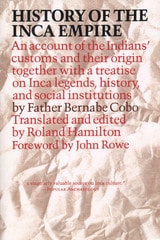
cover of History of the Inca Empire: An Account of the Indians' Customs and Their Origin, Together with a Treatise on Inca Legends, History, and Social Institutions

History of the Inca Empire

An Account of the Indians' Customs and Their Origin, Together with a Treatise on Inca Legends, History, and Social Institutions

By Bernabe Cobo

University of Texas Press, 1979

The Historia del Nuevo Mundo, set down by Father Bernabe Cobo during the first half of the seventeenth century, represents a singulary valuable source on Inca culture. Working directly frorn the original document, Roland Hamilton has translated that part of Cobo's massive manuscripts that focuses on the history of the kingdom of Peru. The volume includes a general account of the aspect, character, and dress of the Indians as well as a superb treatise on the Incas—their legends, history, and social institutions.
[more]
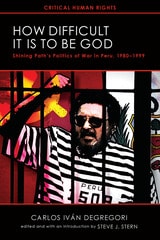
cover of How Difficult It Is to Be God: Shining Path’s Politics of War in Peru, 1980–1999

How Difficult It Is to Be God

Shining Path’s Politics of War in Peru, 1980–1999

Carlos Iván Degregori; Edited and with an introduction by Steve J. Stern; Translated by Nancy Appelbaum, Joanna Drzewieniecki, Héctor Flores, Eric Hershberg, Judy Rein, Steve J. Stern, and Kimberly Theidon

University of Wisconsin Press, 2012

The revolutionary war launched by Shining Path, a Maoist insurgency, was the most violent upheaval in modern Peru’s history, claiming some 70,000 lives in the 1980s–1990s and drawing widespread international attention. Yet for many observers, Shining Path’s initial successes were a mystery. What explained its cult-like appeal, and what actually happened inside the Andean communities at war?

In How Difficult It Is to Be God, Carlos Iván Degregori—the world’s leading expert on Shining Path and the intellectual architect for Peru’s highly regarded Truth and Reconciliation Commission—elucidates the movement’s dynamics. An anthropologist who witnessed Shining Path’s recruitment of militants in the 1970s, Degregori grounds his findings in deep research and fieldwork. He explains not only the ideology and culture of revolution among the insurgents, but also their capacity to extend their influence to university youths, Indian communities, and competing social and political movements.

Making Degregori’s most important work available to English-language readers for the first time, this translation includes a new introduction by historian Steve J. Stern, who analyzes the author’s achievement, why it matters, and the debates it sparked. For anyone interested in Peru and Latin America’s age of “dirty war,” or in the comparative study of revolutions, Maoism, and human rights, this book will provide arresting new insights.
[more]
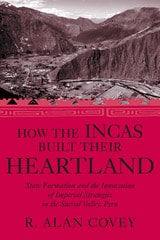
cover of How the Incas Built Their Heartland: State Formation and the Innovation of Imperial Strategies in the Sacred Valley, Peru

How the Incas Built Their Heartland

State Formation and the Innovation of Imperial Strategies in the Sacred Valley, Peru

R. Alan Covey

University of Michigan Press, 2006

Inca archaeology has traditionally been intimately tied to the study of the Spanish chronicles, but archaeologists are often asked to explain how Inca civilization relates to earlier states and empires in the Andean highlands-a time period with little coinciding documentary record. Until recently, few archaeologists working in and around the Inca heartland conducted archaeological research into the period between AD 1000 and AD 1400, leaving a great divide between pre-Inca archaeology and Inca studies.

In How the Incas Built Their Heartland R. Alan Covey supplements an archaeological approach with the tools of a historian, forming an interdisciplinary study of how the Incas became sufficiently powerful to embark on an unprecedented campaign of territorial expansion and how such developments related to earlier patterns of Andean statecraft. In roughly a hundred years of military campaigns, Inca dominion spread like wildfire across the Andes, a process traditionally thought to have been set in motion by a single charismatic ruler, Pachacuti Inca Yupanqui. Taking nearly a century of archaeological research in the region around the Inca capital as his point of departure, Covey offers an alternative description of Inca society in the centuries leading up to imperial expansion. To do so, Covey proposes a new reading of the Spanish chronicles, one that focuses on processes, rather than singular events, occurring throughout the region surrounding Cusco, the Inca capital. His focus on long-term regional changes, rather than heroic actions of Inca kings, allows the historical and archaeological evidence to be placed on equal interpretive footing. The result is a narrative of Inca political origins linking Inca statecraft to traditions of Andean power structures, long-term ecological changes, and internal social transformations. By reading the Inca histories in a compatible way, Covey shows that it is possible to construct a unified theory of how the Inca heartland was transformed after AD 1000.


R. Alan Covey is Assistant Professor of Anthropology at Southern Methodist University.


[more]
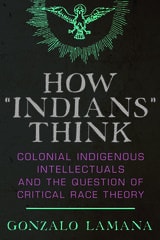
cover of How “Indians” Think: Colonial Indigenous Intellectuals and the Question of Critical Race Theory

How “Indians” Think

Colonial Indigenous Intellectuals and the Question of Critical Race Theory

Gonzalo Lamana

University of Arizona Press, 2019
The conquest and colonization of the Americas marked the beginning of a social, economic, and cultural change of global scale. Most of what we know about how colonial actors understood and theorized this complex historical transformation comes from Spanish sources. This makes the few texts penned by Indigenous intellectuals in colonial times so important: they allow us to see how some of those who inhabited the colonial world in a disadvantaged position thought and felt about it.
 
This book shines light on Indigenous perspectives through a novel interpretation of the works of the two most important Amerindian intellectuals in the Andes, Felipe Guaman Poma de Ayala and Garcilaso de la Vega, el Inca. Building on but also departing from the predominant scholarly position that views Indigenous-Spanish relations as the clash of two distinct cultures, Gonzalo Lamana argues that Guaman Poma and Garcilaso were the first Indigenous activist intellectuals and that they developed post-racial imaginaries four hundred years ago. Their texts not only highlighted Native peoples’ achievements, denounced injustice, and demanded colonial reform, but they also exposed the emerging Spanish thinking and feeling on race that was at the core of colonial forms of discrimination. These authors aimed to alter the way colonial actors saw each other and, as a result, to change the world in which they lived.
[more]
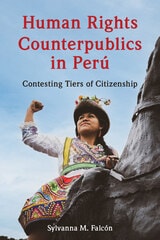
cover of Human Rights Counterpublics in Perú

Human Rights Counterpublics in Perú

Sylvanna M. Falcón

University of Illinois Press, 2024

In 2003, Perú’s Comisión de la Verdad y Reconciliación (CVR) issued its groundbreaking final report on the human rights abuses perpetuated by two revolutionary groups and the country’s armed forces and police from 1980 to 2000. Sylvanna M. Falcón examines how local communities in Lima have formed oppositional spaces, movements, and communities to challenge a status quo that erases Perú’s history of internal violence. These counterpublics focus on human rights-oriented memory that acknowledges the legacies of racism and misogyny underlying the violence. Falcón’s decolonial feminist analysis challenges the rise of authoritarianism in democratic societies while exploring the limits of liberalism to counteract it. As she shows, projects shaped by counterpublic memory best equip Perúvians to enact real, liberatory, and transformative justice for human rights violations both past and present.

Engaging and intimate, Human Rights Counterpublics in Perú illuminates the power of human rights and memory work.

[more]