Results by title
68 books match the query 'Philosophical anthropology' and 5 start with h

Hamletics
Shakespeare, Kafka, BeckettMassimo Cacciari
Seagull Books, 2023
During the dramatic course of the twentieth century, amid the clash of the titans which marked that era, humanity could still think in terms of partisan struggles in which large masses took sides against one another. The new millennium, by contrast, appears to have opened under the guise of generalized insecurity, which pertains not only to the historical and social situation, or to one’s personal psychological predicament, but to our very being. The Earth’s current faltering and the twilight of every convention that might govern it—where roles, images, and languages become confused by a lack of direction and distance—were already powerfully prophesied in Shakespeare’s Hamlet, and later in the works of Kafka and Beckett. In Hamletics, Massimo Cacciari, one of Italy’s foremost philosophers and leftist political figures, establishes a dialogue between these fateful authors, exploring the relationship between European nihilism and the aporias of action in the present.
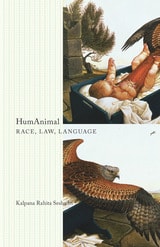
HumAnimal
Race, Law, LanguageKalpana Rahita Seshadri
University of Minnesota Press, 2012
HumAnimal explores the experience of dehumanization as the privation of speech. Taking up the figure of silence as the space between human and animal, it traces the potential for an alternate political and ethical way of life beyond law. Employing the resources offered by deconstruction as well as an ontological critique of biopower, Kalpana Rahita Seshadri suggests that humAnimal, as the site of impropriety opened by racism and manifested by silence, can be political and hazardous to power.
Through the lens of such works as Coetzee’s Foe, Chesnutt’s “The Dumb Witness,” Dr. Itard’s “wild child,” and aerialist Philippe Petit’s Man on Wire, Seshadri lucidly brings Derrida’s concept of the trace and his theory of sovereignty into conversation with Agamben’s investigation of the analytics of power. The task is twofold: on the one hand, to question the logocentric presumption that determines the separation between human and animal, and on the other to examine the conflation of this separation as an instrument of power in the practice of racism. Thus HumAnimal details the differences and intersections between Derrida and Agamben in their respective approaches to power, claiming that to think simultaneously within the registers of deconstruction (which conceives of power as a symptom of the metaphysics of presence) and biopolitics (which conceives of power as the operation of difference) entails a specification of the political and ethical consequences that attends the two perspectives.
When considered as the potential of language to refuse the law of signification and semantics, silence can neutralize the exercise of power through language, and Seshadri’s inquiry discloses a counterpower that does not so much oppose or destroy the politics of the subject but rather neutralizes it and renders it ineffective.
Human Being
A Philosophical AnthropologyThomas Langan, Edited by Antonio Calcagno
University of Missouri Press, 2009
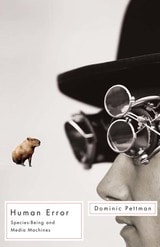
Human Error
Species-Being and Media MachinesDominic Pettman
University of Minnesota Press, 2010
In Human Error, Pettman describes the three sides of the cybernetic triangle—human, animal, and machine—as a rubric for understanding key figures, texts, and sites where our species-being is either reinforced or challenged by our relationship to our own narcissistic technologies. Consequently, species-being has become a matter of specious-being, in which the idea of humanity is not only a case of mistaken identity but indeed the mistake of identity.
Human Error boldly insists on the necessity of relinquishing our anthropomorphism but also on the extreme difficulty of doing so, given how deeply this attitude is bound with all our other most cherished beliefs about forms of life.
Human Predicaments
And What to Do about ThemJohn Kekes
University of Chicago Press, 2016
Kekes considers how we might deal with these predicaments by comparing how others in different times and cultures have approached them. He examines what is good, bad, instructive, and dangerous in the sexually charged politics of the Shilluk, the Hindu caste system, Balinese role-morality, the religious passion of Cortes and Simone Weil, the fate of Colonel Hiromichi Yahara during and after the battle for Okinawa, the ritual human sacrifices of the Aztecs, and the tragedies to which innocence may lead. In doing so, he shakes us out of our deep-seated ways of thinking, enlarging our understanding of the possibilities available to us as we struggle with the problems that stand in the way of how we want to live. The result is a highly interesting journey through time and space that illuminates and helps us cope with some of the most basic predicaments we all face as human beings.