Results by title
187 books match the query 'Place' and 5 start with h

Harbin and Manchuria
Place, Space, and Identity, Volume 99Thomas Lahusen, ed.
Duke University Press, 0
Crossing the boundaries of their specializations, contributors respond to the complexity of this history while considering the concrete concept of place and its relation to the more abstract idea of space. A rare encounter between scholars of East Asian and Slavic studies, this well-illustrated collections includes discussions of history, politics, economics, anthropology, sociology, cinema, and cultural studies. An eclectic and comprehensive exploration of memory and its reconstruction in the Harbin-Manchuria diaspora, Harbin and Manchuria provides the first full treatment of this colonial encounter.
Contributors. Olga Bakich, Sabine Breuillard, James Carter, Elena Chernolutskaya, Prasenjit Duara, Thomas Lahusen, Hyun-Ok Park, Andre Schmid, Mariko Asano Tamanoi, David Wolff
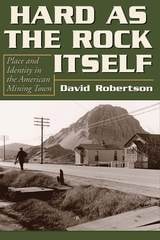
Hard as the Rock Itself
Place and Identity in the American Mining TownDavid Robertson
University Press of Colorado, 2006
Robertson documents the history of Toluca, Illinois; Cokedale, Colorado; and Picher, Oklahoma, from the mineral discovery phase through mine closure, telling for the first time how these century-old mining towns have survived and how sense of place has played a vital role.
Acknowledging the hardships that mining's social, environmental, and economic legacies have created for current residents, Robertson argues that the industry's influences also have contributed to the creation of strong, cohesive communities in which residents have always identified with the severe landscape and challenging, but rewarding way of life.
Robertson contends that the tough, unpretentious appearance of mining landscapes mirrors qualities that residents value in themselves, confirming that a strong sense of place in mining regions, as elsewhere, is not necessarily wedded to an attractive aesthetic or even to a thriving economy.
Mining historians, geographers, and other students of place in the American landscape will find fascinating material in Hard As the Rock Itself.
Haunted by Waters
A Journey through Race and Place in the American WestRobert T. Hayashi
University of Iowa Press, 2007
Even though race influenced how Americans envisioned, represented, and shaped the American West, discussions of its history devalue the experiences of racial and ethnic minorities. In this lyrical history of marginalized peoples in Idaho, Robert T. Hayashi views the West from a different perspective by detailing the ways in which they shaped the western landscape and its meaning.
As an easterner, researcher, angler, and third-generation Japanese American traveling across the contemporary Idaho landscape—where his grandfather died during internment during World War II—Hayashi reconstructs a landscape that lured emigrants of all races at the same time its ruling forces were developing cultured processes that excluded nonwhites. Throughout each convincing and compelling chapter, he searches for the stories of dispossessed minorities as patiently as he searches for trout.
Using a wide range of materials that include memoirs, oral interviews, poetry, legal cases, letters, government documents, and even road signs, Hayashi illustrates how Thomas Jefferson’s vision of an agrarian, all-white, and democratic West affected the Gem State’s Nez Perce, Chinese, Shoshone, Mormon, and particularly Japanese residents. Starting at the site of the Corps of Discovery’s journey into Idaho, he details the ideological, aesthetic, and material manifestations of these intertwined notions of race and place. As he ?y-?shes Idaho’s fabled rivers and visits its historical sites and museums, Hayashi reads the contemporary landscape in light of this evolution.

High Mountains Rising
Appalachia in Time and PlaceEdited by Richard A. Straw and H. Tyler Blethen
University of Illinois Press, 2004
The first half of the fourteen essays deal with historical issues including Native Americans, pioneer settlement, slavery, the Civil War and Reconstruction, industrialization, the Great Depression, migration, and finally, modernization. The remaining essays take a more cultural focus, addressing stereotypes, music, folklife, language, literature, and religion.
Bringing together many of the most prestigious scholars in Appalachian studies, this volume has been designed for general and classroom use, and includes suggestions for further reading.
House Hold
A Memoir of PlaceAnn Peters
University of Wisconsin Press, 2013
More than a memoir of remembered landscapes, House Hold is also an expansive contemplation of America, a meditation on place and property, and an exploration of how literature shapes our thinking about the places we live. A gifted prose stylist, Peters seamlessly combines her love of buildings with her love of books. She wanders through the rooms of her past but also through what Henry James called “the house of fiction,” interweaving personal narrative with musings on James, Willa Cather, William Dean Howells, Paule Marshall, William Maxwell, and others. Peters reflects on the romance of pastoral retreat, the hazards of nostalgia, America’s history of expansion and land ownership, and the conflicted desires to put down roots and to hit the road. Throughout House Hold, she asks how places make us who we are.