267 books match the query 'Poetics' and 8 start with h
cover of Held by Form: Feminism, Poetics, Critical Practice

Held by Form

Feminism, Poetics, Critical Practice

Anna Moser

University of Chicago Press, 2026

How contemporary poetry illuminates the workings—and struggles—of commitment in feminism.

In this lucid and vigorous defense of poetics for feminism, Anna Moser situates the practice of contemporary poetry in an exploratory dialogue with the work of philosophical, critical, and historical thinkers—placing Denise Riley in conversation with Judith Butler, Lyn Hejinian with Hannah Arendt, m. nourbeSe philip with Saidiya Hartman, and Susan Howe with Emily Dickinson. 

Moser’s central theme is these poets’ questioning, agonistic commitment to feminism. What, the book asks, does it mean to be committed? How does such a commitment materialize? What are its consequences? What does it mean not to take for granted an affiliation like “feminist” (or even “woman”), but rather to involve one’s art in probing its historical formations, present conditions, and future trajectories? Moser explores both the risks and possibilities of making art in this equivocal condition. She reveals that the poetry of certain contemporary writers not only unfolds within this space of agonistic commitment, but that, in doing so, it offers an important contribution to feminist thinking. Moser’s book also shows that while form is a constraint that limits these poets’ freedom, it also holds them in a more sustaining sense, allowing something belatedly and imperfectly to be said. 

In dialogue with feminist political theory, philosophy, historiography, and aesthetics, Held by Form reveals poetics as a unique mode of critical practice: one that models relations of care and collectivity, refigures inherited forms in ways that contest their hierarchies of value, and responds with generosity and openness to the complexities of living in gender.
[more]
cover of Heracles' Bow: Essays On The Rhetoric & Poetics Of The Law

Heracles' Bow

Essays On The Rhetoric & Poetics Of The Law

James B. White

University of Wisconsin Press, 1989

The law has traditionally been regarded as a set of rules and institutions. In this thoughtful series of essays, James Boyd White urges a fresh view of the law as an essentially literary, rhetorical, and ethical activity. Defining and elaborating his conception, he artfully bridges the fields of jurisprudence, literature, philosophy, history, and political science. The result, a new approach that may change the way we perceive the legal process, will engage not only lawyers and law students but anyone interested in the relationship between ethics, persuasion, and community.

White’s essays, though bound by a common perspective, are thematically varied. Each of these pieces makes eloquent and insightful reading. Taken as a whole, they establish, by triangulation, a position from which they all proceed: a view of poetry, law, and rhetoric as essentially synonymous. Only when we perceive the links between these processes, White stresses, can we begin to unite the concerns of truth, beauty, and justice in a single field of action and expression.
[more]
cover of Hewing to Experience: Essays and Reviews on Recent American Poetry and Poetics, Nature and Culture

Hewing to Experience

Essays and Reviews on Recent American Poetry and Poetics, Nature and Culture

Sherman Paul

University of Iowa Press, 1989

Hewing to Experience charts Sherman Paul's course of coming to know William Carlos Williams, Hart Crane, Charles Olson, Robert Creeley, and Gary Snyder and the critical scholarship devoted to them as it provides an assessment of recent criticism. The initial section, on criticism and poetry, sets out many of the insistences that give this valuable collection of essays and reviews its coherence. Considered are criticism, poetics, poetry and old age, ethnopoetics, the gift exchange of imagination, and the recent and controversial enterprise of canon formation.
The final section of Hewing to Experience provides an important, meditative rereading of the work of Barry Lopez that convincingly places ecological writing within the large revisionist project of avant-garde poetry. Of particular note, too, is the full commentary on the Olson-Creeley correspondence.
Throughout, Paul's humane enthusiasm is evident. Hewing to Experience merits the readership of all those who are interested in contemporary poetry and concerned with the ongoing criticism of major poets and with critical practice.
[more]
cover of Hip-Hop Archives: The Politics and Poetics of Knowledge Production

Hip-Hop Archives

The Politics and Poetics of Knowledge Production

Mark V. Campbell and Murray Forman

Intellect Books, 2025

A collection of essays on archiving the history of hip-hop, featuring a range of official, unofficial, DIY, and community archives.

Despite the vast popularity and cultural influence of hip-hop, efforts to archive its history are still in fairly early stages. This book focuses on the cultural and political aspects of those undertakings. It addresses practical aspects, including methods of collection, curation, preservation, and digitization, and critically analyzes institutional power, community engagement, urban economics, public access, and the ideological implications of hip-hop culture’s enduring tensions with dominant social values. A wide swath of hip-hop culture is covered by the contributors, including dance, graffiti, clothing, and battle rap.
 
[more]
cover of History and Poetics in the Early Writings of William Morris, 1855–1870

History and Poetics in the Early Writings of William Morris, 1855–1870

Florence S. Boos

The Ohio State University Press, 2015

Florence S. Boos’s History and Poetics in the Early Writings of William Morris, 1855–1870 examines Morris’s literary development in the context of his Victorian contemporaries, probing the cross-influences of temperament, cultural ambiance, early reader reactions, and his restless search for an authentic poetic voice. Boos argues that to understand this development, we must understand how Morris reinterpreted and transformed medieval history and legend into modern guise. In doing so, Morris preserved a duality of privacy and detachment—the intimacy of personal lyrics and the detachment (and silences) of historical judgment.              
Boos’s study is the first to utilize surviving original manuscripts, periodical publications, and poems unpublished during Morris’s lifetime. History and Poetics in the Early Writings of William Morris, 1855–1870traces Morris’s literary evolution through his juvenile poems; the essays, poems, and prose romances of the Oxford and CambridgeMagazine; the startlingly original verses of The Defence of Guenevere; and the ten years of experimentation that preceded his two best-known epics, The Life and Deathof Jason and The Earthly Paradise. This book explores the young poet’s successive efforts to find a balancing ethical framework through poetry—a framework that was at once a motivation for action and a template for authentic, shared popular art, one that reemerges forcefully in his later work.
[more]
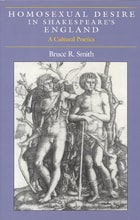
cover of Homosexual Desire in Shakespeare's England: A Cultural Poetics

Homosexual Desire in Shakespeare's England

A Cultural Poetics

Bruce R. Smith

University of Chicago Press, 1994

In the most comprehensive study yet of homosexuality in the English Renaissance, Bruce R. Smith examines and rejects the assessments of homosexual acts in moral philosophy, laws, and medical books in favor of a poetics of homosexual desire. Smith isolates six different "myths" from classical literature and discusses each in relation to a particular Renaissance literary genre and to a particular part of the social structure of early modern England. Smith's new Preface places his work in the context of the continuing controversies in gay, lesbian, and bisexual studies.

"The best single analysis of the homoerotic element in Renaissance English literature."—Keith Thomas, New York Review of Books

"Smith's lucid and subtle book offer[s] a poetics of homosexual desire. . . . Its scholarship, impressively broad and deftly deployed, aims to further a serious social purpose: the redemptive location of homosexual desire in history and the recuperation for our own time, through an understanding of its discursive embodiments, of that desire's changing imperatives and parameters."—Terence Hawkes, Times Literary Supplement

"The great strength of Bruce Smith's book is that it does not sidestep the complex challenge of engaging in the sexual politics of the present while attending to the resistant discourses and practices of Renaissance England. Homosexual Desire in Shakespeare's England demonstrates how a commitment to the present opens up our understanding of the past."—Peter Stallybrass, Shakespeare Quarterly

"A major contribution to the understanding of homosexuality in Renaissance England and by far the best and most comprehensive account yet offered of the homoeroticism that suffuses Renaissance literature."—Claude J. Summers, Journal of Homosexuality
[more]
cover of How Poems Think

How Poems Think

Reginald Gibbons

University of Chicago Press, 2015
To write or read a poem is often to think in distinctively poetic ways—guided by metaphors, sound, rhythms, associative movement, and more. Poetry’s stance toward language creates a particular intelligence of thought and feeling, a compressed articulation that expands inner experience, imagining with words what cannot always be imagined without them. Through translation, poetry has diversified poetic traditions, and some of poetry’s ways of thinking begin in the ancient world and remain potent even now. In How Poems Think, Reginald Gibbons presents a rich gallery of poetic inventiveness and continuity drawn from a wide range of poets—Sappho, Pindar, Shakespeare, Keats, William Carlos Williams, Marina Tsvetaeva, Gwendolyn Brooks, and many others. Gibbons explores poetic temperament, rhyme, metonymy, etymology, and other elements of poetry as modes of thinking and feeling. In celebration and homage, Gibbons attunes us to the possibilities of poetic thinking.
[more]
cover of How to Draw a Circle: On Reading and Writing

How to Draw a Circle

On Reading and Writing

Dan Beachy-Quick

University of Michigan Press, 2024

What is it to write a poem? What work do words do when placed with care and vision into the intensely charged space of poetic effort? How to Draw a Circle does not seek to answer those questions, but to encounter them as fully and honestly as one can. The thread running through the essays is an ongoing investigation into poetry as an epistemological experiment, one which binds the imagination to the worldly, and trusts that creative endeavor is a form of participation in the ongoing creation of the world. It does so in part by focusing on thinkers, poets, writers, and literary movements where such thinking for a while prevailed, from Socrates to Melville, Mythology to Romanticism. Here the poem is approached as something deeply rooted in human consciousness, done so not to make an atavistic claim about poetry's history, but to show the ways in which oldest tradition gives us ever-new eyes. The hope this book gathers around is that poetry—poetic expression, the wild wonder of working in words—turns us back toward the world in more vibrant, more open, more ethical ways. How to Draw a Circle summons lyric powers—not an argument, but a participation in the ways poetry works in us and on us. 
[more]