Results by title
336 books match the query 'Political Economy' and 3 start with h
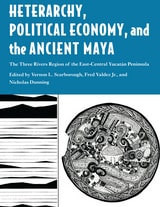
Heterarchy, Political Economy, and the Ancient Maya
The Three Rivers Region of the East-Central Yucatán PeninsulaEdited by Vernon L. Scarborough, Fred Valdez Jr., and Nicholas Dunning
University of Arizona Press, 2003
The ancient Maya of the southern Yucatán peninsula remain a mystery to many scholars attempting to explain early complex societies. Their dispersed settlement patterns and land-use techniques suggest a decentralized and less coordinated use of resources than is seen in other regions. Yet the Maya managed a complex political economy based on structured landscaping, and over several generations they significantly altered their environment. In recent years the Three Rivers region of Belize and Guatemala has been the site of some of the most intensive archaeological research in the Maya lowlands, providing a wealth of regional data. This volume brings together articles reporting on findings and interpretations of the Programme for Belize Archaeological Project that range over a 10- to 12-year period and that shed new light on how ecology, economy, and political order developed in the ancient past. The contributors explore the applicability of heterarchical models to the Three Rivers region, emphasizing the role of economic interdependency and political cooperation in the development of ancient Maya statecraft. As their findings reflect, this region appears to support a model of resource-specialized communities that affected the region's political and economic development and complexity from the Preclassic through the Late Classic periods. The articles explore the levels of interdependency among the large sites in the region and present a variety of data that emphasize both the engineered landscape and the complex agricultural signatures and ecological indicators left by the Maya. This geographic region captures in microcosm both ecological and cultural differences found in the greater Maya Lowlands. The heterarchical model presented here regarding resource-specialized communities and the interpretations of regional diversity in this area represent a breakthrough in research for the region and will prompt new debate in Maya studies.
[more]

Hezbollah
The Political Economy of Lebanon's Party of GodJoseph Daher
Pluto Press, 2016
Few political parties have been as misunderstood—or as roundly condemned—as Lebanon’s Hezbollah. With this book, Joseph Daher presents a new way of looking at Hezbollah: through the lens of political economy.
By discarding more common approaches to the party that focus on religious discourse or military questions, Daher is freed up to analyze what the party actually is: an organization that is operating within a specific political and socio-economic context, one that simultaneously offers it a rich ground of support and limits its range of action. Daher clearly and carefully positions Hezbollah within that context, focusing on its historic ties with its main sponsor, Iran, its media and cultural wings, its relationship with Western economic policies, and the impact of the Shi’a population on the sectarian politics of Lebanon. Offering additional attention to the party’s positions on worker’s rights and women’s issues, this fresh take on Hezbollah will be incredibly useful for understanding the world’s most tumultuous region.
By discarding more common approaches to the party that focus on religious discourse or military questions, Daher is freed up to analyze what the party actually is: an organization that is operating within a specific political and socio-economic context, one that simultaneously offers it a rich ground of support and limits its range of action. Daher clearly and carefully positions Hezbollah within that context, focusing on its historic ties with its main sponsor, Iran, its media and cultural wings, its relationship with Western economic policies, and the impact of the Shi’a population on the sectarian politics of Lebanon. Offering additional attention to the party’s positions on worker’s rights and women’s issues, this fresh take on Hezbollah will be incredibly useful for understanding the world’s most tumultuous region.
[more]
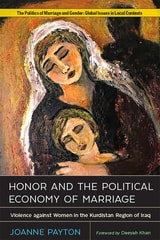
Honor and the Political Economy of Marriage
Violence against Women in the Kurdistan Region of IraqJoanne Payton
Rutgers University Press, 2020
'Honor' is used as a justification for violence perpetrated against women and girls considered to have violated social taboos related to sexual behavior. Several ‘honor’-based murders of Kurdish women, such as Fadime Sahindal, Banaz Mahmod and Du’a Khalil Aswad, and campaigns against 'honor'-based violence by Kurdish feminists have drawn international attention to this phenomenon within Kurdish communities.
Honor and the Political Economy of Marriage provides a description of ‘honor’-based violence that focuses upon the structure of the family rather than the perpetrator’s culture. The author, Joanne Payton, argues that within societies primarily organized by familial and marital connections, women’s ‘honor’ is a form of symbolic capital within a ‘political economy’ in which marriage organizes intergroup connections.
Drawing on statistical analysis of original data contextualized with historical and anthropological readings, Payton explores forms of marriage and their relationship to ‘honor’, sketching changing norms around the familial control of women from agrarian/pastoral roots to the contemporary era.
[more]