Results by title
102 books match the query 'Poor' and 5 start with h
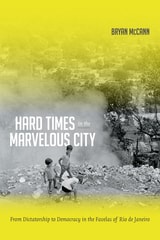
Hard Times in the Marvelous City
From Dictatorship to Democracy in the Favelas of Rio de JaneiroBryan McCann
Duke University Press, 2013
Health Policy and the Disadvantaged
Lawrence D. Brown, ed.
Duke University Press, 1991
Focusing on the particular needs of disadvantaged groups—the elderly, children, people with AIDS, the mentally ill, the chemically dependent, the homeless, the hungry, the medically uninsured—these essays develop strong policy statements. The authors describe the growth in U.S. health care programs, from Kerr-Mills to Medicare, Medicaid, and subsequent revisions, and stress the serious omissions resulting from incremental policy expansion, both in identifying disadvantaged groups and in implementing programs. They report the weakness of the U.S. health care system compared to systems of other technologically developed countries.
Contributors. Deborah A. Stone and Theodore R. Marmor, Judith Feder, Alice Sardell, Bruce C. Vladeck, Michael Lipsky and Marc A. Thibodeau, Daniel M. Fox, William E. McAuliffe, M. Gregg Bloche and Francine Cournos, Lawrence D. Brown, James A. Morrone
Health Work with the Poor
A Practical GuideKiefer, Christie W
Rutgers University Press, 2000
Christie Kiefer vividly brings home the meaning of poverty in peoples’ lives as he examines both their access to—and their lack of—health care.
Aimed at both students and professionals in the field, this book argues that individuals serving the poor have the means and obligation to address the root causes of ill health of the poor, not just the symptoms. These causes, Kiefer argues, are overwhelmingly social and political. In a ringing indictment of the factors that perpetuate poverty, he declares that the work of healing at its best must include advocacy.
Health Work with the Poor offers to both health workers and activists a wealth of practical information. Kiefer’s trenchant analysis of the factors that help cause and perpetuate poverty offers students the needed intellectual framework not only to accomplish short-term change but also to strive toward long-term social advocacy. Each chapter ends with a set of discussion questions—a real boon for instructors. Appendices on Internet resources for the study of poverty and on a proposed program detailing how to teach health workers in a way that promotes social awareness make this book a valuable resource for courses on poverty and health. It will also be an indispensable manual for all those who work with the poor.
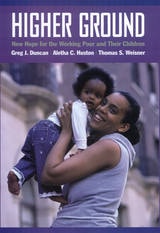
Higher Ground
New Hope for the Working Poor and Their ChildrenGreg J. Duncan
Russell Sage Foundation, 2007
Hope, Heart, and the Humanities
How a Free College Course is Changing LivesJean Cheney and L. Jackson Newell, editors, with Hikmet Sidney Loe, Jeff Metcalf, and Bridget M. Newell
University of Utah Press, 2016
Hope, Heart, and the Humanities tells the story of how Venture, a free, interdisciplinary college humanities course inspired by the national Clemente Course, has helped open doors to improve the lives of people with low incomes who face barriers to attending college. For over a decade, this course has given hundreds of adults, some of them immigrants or refugees, the knowledge, confidence, and power to rechart their lives.
Readers will go inside Venture classrooms to see what occurs when adults enter serious discussions about literature, critical writing, art history, American history, and philosophy. Apparent also are the difficulties nontraditional students, who range in age from 18 to 60, often encounter in a college classroom and the hard choices they and their teachers make. What readers may remember most are the stories and words from people whose views of the world broaden and whose directions in life changed.
Interview with Tom Williams at Access Utah