Results by title
471 books match the query 'Power' and 12 start with h
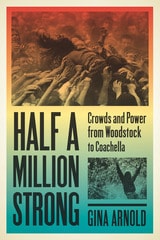
Half a Million Strong
Crowds and Power from Woodstock to CoachellaGina Arnold
University of Iowa Press, 2018
From baby boomers to millennials, attending a big music festival has basically become a cultural rite of passage in America. In Half a Million Strong, music writer and scholar Gina Arnold explores the history of large music festivals in America and examines their impact on American culture. Studying literature, films, journalism, and other archival detritus of the countercultural era, Arnold looks closely at a number of large and well-known festivals, including the Newport Folk Festival, Woodstock, Altamont, Wattstax, the New Orleans Jazz and Heritage Festival, Hardly Strictly Bluegrass, and others to map their cultural significance in the American experience. She finds that—far from being the utopian and communal spaces of spiritual regeneration that they claim for themselves— these large music festivals serve mostly to display the free market to consumers in its very best light.
Hall of Mirrors
Power, Witchcraft, and Caste in Colonial MexicoLaura A. Lewis
Duke University Press, 2003
Using judicial records from a variety of colonial courts, Lewis highlights the ethnographic details of legal proceedings as she demonstrates how Indians, in particular, came to be the masters of witchcraft, a domain of power that drew on gendered and hegemonic caste distinctions to complicate the colonial hierarchy. She also reveals the ways in which blacks, mulattoes, and mestizos mediated between Spaniards and Indians, alternatively reinforcing Spanish authority and challenging it through alliances with Indians. Bringing to life colonial subjects as they testified about their experiences, Hall of Mirrors discloses a series of contradictions that complicate easy distinctions between subalterns and elites, resistance and power.
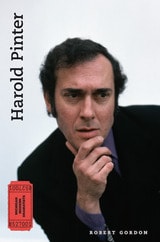
Harold Pinter
The Theatre of PowerRobert Gordon
University of Michigan Press, 2013
The latest volume in the Michigan Modern Dramatists series offers an authoritative but accessible look at Harold Pinter, one of the greatest and most influential postwar British playwrights and author of classic works such as The Birthday Party and The Homecoming. Pinter was awarded the Nobel Prize for Literature in 2005 for his remarkable body of work and plays that "uncover the precipice under everyday prattle and force entry into oppression's closed rooms."
Harold Pinter: The Theatre of Power focuses on the playwright's continuously innovative experiments in theatrical form while tracing the recurrence of a consistent set of ethical and epistemological concerns. Exploring important plays from across this prolific writer’s career, author Robert Gordon argues that the motivating force in almost all of Pinter's drama is the ceaseless desire for power, represented in his work as a compulsive drive to achieve or maintain dominance—whether it be the struggle to defend one's own territory from intruders, the father's battle with his sons to assert his patriarchal position in the family, the manipulation of erotic feelings in the gender warfare that motivates sexual relationships, the abuse of brute force by dictatorships and democracies, or simply the masculine obsession to dominate. Gordon demonstrates the adventurousness of Pinter's experimentation with form while at the same time exposing the ethical, epistemological, and aesthetic preoccupations that have persisted with remarkable consistency throughout his career.
Hearing Southeast Asia
Sounds of Hierarchy and Power in ContextEdited by Nathan Porath
National University of Singapore Press, 2019
Hegemony And Power
On the Relation between Gramsci and MachiavelliBenedetto Fontana
University of Minnesota Press, 1993
Presents a comparative and textual exploration of Gramsci's interpretation of Machiavelli's political analyses. This valuable contribution to our understanding of Gramsci includes a comparison of the major Machiavellian ideas such as the nature of political knowledge, the new principality, the concept of the people, and the relation between thought and action, to Gramsci's concepts of hegemony, moral and intellectual reform, and the collective will.
Hidden Genocides
Power, Knowledge, MemoryAlexander Laban Hinton, Thomas La Pointe, and Douglas Irvin-Erickson
Rutgers University Press, 2014
Why are some genocides prominently remembered while others are ignored, hidden, or denied? Consider the Turkish campaign denying the Armenian genocide, followed by the Armenian movement to recognize the violence. Similar movements are building to acknowledge other genocides that have long remained out of sight in the media, such as those against the Circassians, Greeks, Assyrians, the indigenous peoples in the Americas and Australia, and the violence that was the precursor to and the aftermath of the Holocaust.
The contributors to this collection look at these cases and others from a variety of perspectives. These essays cover the extent to which our biases, our ways of knowing, our patterns of definition, our assumptions about truth, and our processes of remembering and forgetting as well as the characteristics of generational transmission, the structures of power and state ideology, and diaspora have played a role in hiding some events and not others. Noteworthy among the collection’s coverage is whether the trade in African slaves was a form of genocide and a discussion not only of Hutus brutalizing Tutsi victims in Rwanda, but of the execution of moderate Hutus as well.
Hidden Genocides is a significant contribution in terms of both descriptive narratives and interpretations to the emerging subfield of critical genocide studies.
Contributors: Daniel Feierstein, Donna-Lee Frieze, Krista Hegburg, Alexander Laban Hinton, Adam Jones, A. Dirk Moses, Chris M. Nunpa, Walter Richmond, Hannibal Travis, and Elisa von Joeden-Forgey
Histories of the Present
People and Power in EcuadorNorman E. Whitten Jr. and Dorothea Scott Whitten
University of Illinois Press, 2011
History, Power, and Identity
Ethnogenesis in the Americas, 1492-1992Jonathan D. Hill
University of Iowa Press, 1996
For the past five centuries, indigenous and African American communities throughout the Americas have sought to maintain and recreate enduring identities under conditions of radical change and discontinuity. The essays in this groundbreaking volume document this cultural activity—this ethnogenesis—within and against the broader contexts of domination; the authors simultaneously encompass the entanglements of local communities in the webs of national and global power relations as well as people's unique abilities to gain control over their history and identity.
By defining ethnogenesis as the synthesis of people's cultural and political struggles, History, Power, and Identity breaks out of the implicit contrast between isolated local cultures and dynamic global history. From the northeastern plains of North America to Amazonia, colonial and independent states in the Americas interacted with vast multilingual and multicultural networks, resulting in the historical emergence of new ethnic identities and the disappearance of many earlier ones. The importance of African, indigenous American, and European religions, myths, and symbols, as historical cornerstones in the building of new ethnic identities, emerges as one of the central themes of this convincing collection.
Hope for Justice and Power
Broad-based Community Organizing in the Texas Industrial Areas FoundationKathleen Staudt
University of North Texas Press, 2020
How Democracies Live
Power, Statecraft, and Freedom in Modern SocietiesStein Ringen
University of Chicago Press, 2022
In the new century, the triumph of democracy at the end of the Cold War turned to retrenchment. The core democracies, in America and Britain, succumbed to polarization and misrule. Dictatorships, such as China, made themselves assertive. New democracies in Central Europe turned to muddled ideologies of “illiberal democracy.” In this book, Stein Ringen offers a meditation on what democracy is, the challenges it faces, and how it can be defended. Ringen argues that democracy must be rooted in a culture that supports the ability of citizens to exchange views and information among themselves and with their rulers.
Drawing on the ideas of Machiavelli, Aristotle, Tocqueville, Max Weber, and others, Ringen shows how power is the fuel of government, and statecraft turns power into effective rule. Democracy should prize freedom and minimizing unfairness, especially poverty. Altogether, Ringen offers powerful insight on the meaning of democracy, including a new definition, and how countries can improve upon it and make it function more effectively. Timely and thought-provoking, How Democracies Live is a sober reminder of the majesty of the democratic enterprise.
Howard Hughes
Power, Paranoia, and Palace Intrigue, Revised and ExpandedGeoff Schumacher
University of Nevada Press, 2020
Although the public viewed Hughes as a heroic and independent-minded trailblazer, behind closed doors he suffered from germophobia, obsessive-compulsive disorder, and an addiction to painkillers. He became paranoid and reclusive, surrounding himself with a small cadre of loyal caretakers. As executives battled each other over his empire, Hughes’ physical and mental health deteriorated to the point where he lost control of his business affairs.
This second edition includes more insider details on Hughes’ personal interactions with actresses, journalists, and employees. New chapters provide insights into Hughes’s involvement with the mob, his ownership and struggles as the majority shareholder of TWA and the wide-ranging activities of Hughes Aircraft Company, Hughes’s critical role in the Glomar Explorer CIA project (a deep-sea drillship platform built to recover the Soviet submarine K-129), and more. Based on in-depth interviews with individuals who knew and worked with Hughes, this fascinating biography provides a colorful and comprehensive look at Hughes—from his life and career to his final years and lasting influence. This penetrating depiction of the man behind the curtain demonstrates Hughes’s legacy, and enduring impact on popular culture.
Hydraulic Societies
Water, Power, and Control in East and Central Asian HistoryNicholas B. Breyfogle
Oregon State University Press, 2023
Hydraulic Societies explores the linked themes of water, power, state-building, and hydraulic control. Bringing together a range of ecological, geographical, chronological, and methodological perspectives, the essays in this book address the how humans have long harnessed water and sought to contain its destructive power for political, economic and social ends. Water defines every aspect of life and remains at the center of human activity: in irrigation and agriculture; waste and sanitation; drinking and disease; floods and droughts; religious beliefs and practices; fishing and aquaculture; travel and discovery; scientific study; water pollution and conservation; multi-purpose dam building; boundaries and borders; politics and economic life; and wars and diplomacy.
From the earliest large irrigation works thousands of years ago, control over water has involved control over people, as the essays in this volume reflect. The intersections of water and political, economic, and social power historically span international as well as domestic politics and operate at scales ranging from the local to the global. The authors consider the role of water in national development schemes, water distribution as a tool of political power, international disputes over waterways and water supplies, and the place of water in armed conflicts. They explore the ways in which political power and social hierarchies have themselves been defined and redefined by water and its control, how state leaders legitimized their rule both culturally and economically through the control of water, and how water management schemes were a means to impose and refine colonial power.