Results by title
159 books match the query 'Present' and 7 start with h
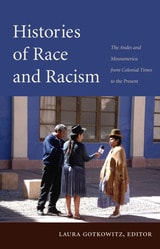
Histories of Race and Racism
The Andes and Mesoamerica from Colonial Times to the PresentLaura Gotkowitz, ed.
Duke University Press, 2012
Ninety percent of the indigenous population in the Americas lives in the Andean and Mesoamerican nations of Bolivia, Ecuador, Mexico, Peru, and Guatemala. Recently indigenous social movements in these countries have intensified debate about racism and drawn attention to the connections between present-day discrimination and centuries of colonialism and violence. In Histories of Race and Racism, anthropologists, historians, and sociologists consider the experiences and representations of Andean and Mesoamerican indigenous peoples from the early colonial era to the present. Many of the essays focus on Bolivia, where the election of the country’s first indigenous president, Evo Morales, sparked fierce disputes over political power, ethnic rights, and visions of the nation. The contributors compare the interplay of race and racism with class, gender, nationality, and regionalism in Bolivia, Ecuador, Guatemala, Mexico, and Peru. In the process, they engage issues including labor, education, census taking, cultural appropriation and performance, mestizaje, social mobilization, and antiracist legislation. Their essays shed new light on the present by describing how race and racism have mattered in particular Andean and Mesoamerican societies at specific moments in time.
Contributors
Rossana Barragán
Kathryn Burns
Andrés Calla
Pamela Calla
Rudi Colloredo-Mansfeld
María Elena García
Laura Gotkowitz
Charles R. Hale
Brooke Larson
Claudio Lomnitz
José Antonio Lucero
Florencia E. Mallon
Khantuta Muruchi
Deborah Poole
Seemin Qayum
Arturo Taracena Arriola
Sinclair Thomson
Esteban Ticona Alejo
[more]
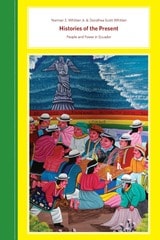
Histories of the Present
People and Power in EcuadorNorman E. Whitten Jr. and Dorothea Scott Whitten
University of Illinois Press, 2011
The wellspring of critical analysis in this book emerges from Ecuador's major Indigenous Uprising of 1990 and its ongoing aftermath in which indigenous and Afro-Ecuadorian action transformed the nation-state and established new dimensions of human relationships. The authors weave anthropological theory with longitudinal Ecuadorian ethnography to produce a unique contribution to Latin American studies.
[more]
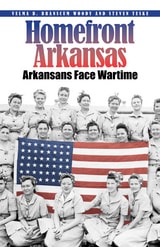
Homefront Arkansas
Arkansans Face Wartime Past and PresentVelma B. Branscum Woody
Butler Center for Arkansas Studies, 2009
For almost two hundred years, Arkansans have been part of America’s struggle to maintain democracy and keep the peace at home and around the globe. Homefront Arkansas: Arkansans Face Wartime Past and Present shows how war has affected those at home as well as those who served as soldiers. The chapters include: * A wounded Civil War soldier stumbles onto a homestead after a battle at Poison Springs, Arkansas, forever changing the family there * In 1875, Arkansans take sides in the Brooks-Baxter War, involving two men each claiming to be the governor of Arkansas * Arkansas volunteers follow Teddy Roosevelt into the Spanish-American War, and find troops crowded into a filthy camp as they wait to be shipped out * An African American girl leaves her native state to escape persecution, only to find that a world war is threatening to envelop her new home in England Woody’s stories provide a factual and compelling backdrop for Arkansas’s history as seen through its conflicts. Fascinated readers will follow the chronology of Arkansans who met the nation’s call both at home and abroad.
[more]
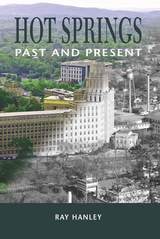
Hot Springs
Past and PresentRay Hanley
University of Arkansas Press, 2014
A century ago Hot Springs, Arkansas, was a world-renown resort city. Today, the town remains the most unique city in Arkansas but with much of its Victorian-to-1950s views nearly unrecognizable. Hot Springs: Past and Present shows vividly the before and after of hundreds of sites, answering questions such as “What used to be on this corner?” and “What was here before it was a parking lot?” The answer to those questions is often an opulent hotel, a theater, a bathhouse, a gambling house, or a mansion. Fire destroyed many buildings, even more were demolished, and some sites remain not so unlike they used to be. Hot Springs: Past and Present makes a perfect walking companion for anyone visiting the town and wishing to learn more about this one-of-a-kind place through not only the photographs but also the informative text that provides a good overview of the town’s history.
[more]
How Trees Die
The Past, Present, and Future of our ForestsJeff Gillman
Westholme Publishing, 2009
Lessons About Our Environment from the World’s Oldest Living Things
Trees have been essential to the success of human beings, providing food, shelter, warmth, transportation, and products (consider the paper you are holding). Trees are also necessary for a healthy atmosphere, literally connecting the earth with the sky. Once in wild abundance— the entire eastern North America was a gigantic forest—they have receded as we have clearcut the landscape in favor of building cities and farms, using up and abusing our forests in the process. Over the centuries, we have trained food trees, such as peach and apple trees, to produce more and better fruit at the expense of their lives. As Jeff Gillman, a specialist in the production and care of trees, explains in his acclaimed work, How Trees Die: The Past, Present, and Future of Our Forests, the death of a tree is as important to understanding our environment as how it lives. While not as readily apparent as other forms of domestication, our ancient and intimate relationship with trees has caused their lives to be inseparably entwined with ours. The environment we have created—what we put into the air and into the water, and how we change the land through farming, construction, irrigation, and highways—affects the world’s entire population of trees, while the lives of the trees under our direct care in farms, orchards, or along a city boulevard depend almost entirely on our actions. Taking the reader on a fascinating journey through time and place, the author explains how we kill trees, often for profit, but also unintentionally with kindness through overwatering or overmulching, and sometimes simply by our movements around the globe, carrying foreign insects or disease. No matter how a tree’s life ends, though, understanding the reason is essential to understanding the future of our environment.
Trees have been essential to the success of human beings, providing food, shelter, warmth, transportation, and products (consider the paper you are holding). Trees are also necessary for a healthy atmosphere, literally connecting the earth with the sky. Once in wild abundance— the entire eastern North America was a gigantic forest—they have receded as we have clearcut the landscape in favor of building cities and farms, using up and abusing our forests in the process. Over the centuries, we have trained food trees, such as peach and apple trees, to produce more and better fruit at the expense of their lives. As Jeff Gillman, a specialist in the production and care of trees, explains in his acclaimed work, How Trees Die: The Past, Present, and Future of Our Forests, the death of a tree is as important to understanding our environment as how it lives. While not as readily apparent as other forms of domestication, our ancient and intimate relationship with trees has caused their lives to be inseparably entwined with ours. The environment we have created—what we put into the air and into the water, and how we change the land through farming, construction, irrigation, and highways—affects the world’s entire population of trees, while the lives of the trees under our direct care in farms, orchards, or along a city boulevard depend almost entirely on our actions. Taking the reader on a fascinating journey through time and place, the author explains how we kill trees, often for profit, but also unintentionally with kindness through overwatering or overmulching, and sometimes simply by our movements around the globe, carrying foreign insects or disease. No matter how a tree’s life ends, though, understanding the reason is essential to understanding the future of our environment.
[more]
How to Make It as a Woman
Collective Biographical History from Victoria to the PresentAlison Booth
University of Chicago Press, 2004
How to Make It as a Woman outlines the history of prosopography or group biography, focusing on the all-female collections that took hold in nineteenth-century Britain and America. The queens, nurses, writers, reformers, adventurers, even assassins in these collective female biographies served as models to guide the moral development of young women. But often these famous historical women presented untrustworthy examples.
Beginning in the fifteenth century with Christine de Pizan, Alison Booth traces the long tradition of this genre, investigating the varied types and stories most often grouped together in illustrated books designed for entertainment and instruction. She claims that these group biographies have been instrumental in constructing modern subjectivities as well as relations among classes, races, and nations.
From Joan of Arc to Virginia Woolf, Booth examines a host of models of womanhood—both bad and good. Incorporating a bibliography that includes more than 900 all-female collections published in English between 1830 and 1940, Booth uses collective biographies to decode the varied advice on how to make it as a woman.
[more]
How to Read a Moment
The American Novel and the Crisis of the PresentMathias Nilges
Northwestern University Press, 2021
In How to Read a Moment, Mathias Nilges shows that time is inseparable from the stories we tell about it, demonstrating that the contemporary American novel offers new ways to make sense of the temporality that governs our present.
“Time is a thing that grows scarcer every day,” observes one of Don DeLillo’s characters. “The future is gone,” The Baffler argues. “Where’s my hoverboard!?” a meme demands. Contemporary capitalism, a system that insists that everything happen at once, creates problems for social thought and narrative alike. After all, how does one tell the time of instantaneity? In this moment of on-demand service and instant trading, it has become difficult to imagine the future.
The novel emerged as the art form of a rapidly changing modern world, a way of telling time in its progress. Nilges argues that this historical mission is renewed today through works that understand contemporaneity as a form of time shaping that props up our material world and cultural imagination. But the contemporary American novel does not simply associate our present with a crisis of futurity. Through analyses of works by authors such as DeLillo, Jennifer Egan, Charles Yu, and Colson Whitehead, Nilges illustrates that the novel presents ways to make sense of the temporality that controls our purportedly fully contemporary world. In so doing, the novel recovers a sense of possibility and hope, forwarding a dazzling argument for its own importance today.
[more]