Results by title
214 books match the query 'Presidents & Heads of State' and 7 start with h
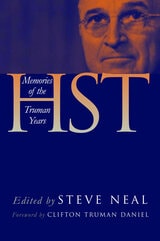
HST
Edited by Steve Neal. Foreword by Clifton Truman Daniel
Southern Illinois University Press, 2003
Believing that Americans should understand their leadership, Harry Truman was the first American president to authorize an oral history of his life and times. In that vein, almost forty years ago, the Truman Library in the president’s native Independence, Missouri, began the daunting task of compiling the words of Truman’s contemporaries, including his senior aides, foreign policy and military advisors, political strategists, and close friends. Longtime Chicago journalist Steve Neal has edited twenty of these remarkable interviews for HST: Memories of the Truman Years.
Candid and insightful, the recollections include those of statesmen Dean Acheson and Averell Harriman; soldiers Omar Bradley and Lucius Clay; Truman’s best friend Thomas Evans; associates Clark Clifford and Matt Connelly; 1948 Republican vice-presidential nominee Earl Warren; artist Thomas Hart Benton; West German leader Konrad Adnauer; former New Dealers Sam Rosenman and James Rowe; journalist Richard L. Strout; and many others.
An honest portrait of Truman emerges from the twenty firsthand accounts of those who knew him best. HST: Memories of the Truman Years spans Truman’s rise to the presidency and his responses to the challenges of World War II, the Soviet blockade of Berlin, the rebuilding of postwar Europe, the 1948 campaign, his controversial firing of General Douglas MacArthur, and his courageous leadership on civil rights.
“The goal of these histories,” explains Truman’s grandson, Clifton Truman Daniel, in the foreword, “in keeping with Grandpa’s stated desire that the [Truman Library] be about his presidency, not a monument to him, was to preserve forever the perspective of those who had shared his life and times and, in many cases, helped him shape the world.”
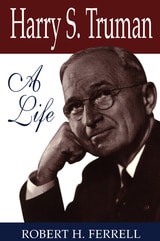
Harry S. Truman
A LifeRobert H. Ferrell
University of Missouri Press, 1995
Few U.S. presidents have captured the imagination of the American people as has Harry S. Truman, “the man from Missouri.”
In this major new biography, Robert H. Ferrell, widely regarded as an authority on the thirty-third president, challenges the popular characterization of Truman as a man who rarely sought the offices he received, revealing instead a man who—with modesty, commitment to service, and basic honesty—moved with method and system toward the presidency.
Truman was ambitious in the best sense of the word. His powerful commitment to service was accompanied by a remarkable shrewdness and an exceptional ability to judge people. He regarded himself as a consummate politician, a designation of which he was proud. While in Washington, he never succumbed to the “Potomac fever” that swelled the heads of so many officials in that city. A scrupulously honest man, Truman exhibited only one lapse when, at the beginning of 1941, he padded his Senate payroll by adding his wife and later his sister.
From his early years on the family farm through his pivotal decision to use the atomic bomb in World War II, Truman’s life was filled with fascinating events. Ferrell’s exhaustive research offers new perspectives on many key episodes in Truman’s career, including his first Senate term and the circumstances surrounding the Truman Doctrine and the Marshall Plan. In addition, Ferrell taps many little-known sources to relate the intriguing story of the machinations by which Truman gained the vice presidential nomination in 1944, a position which put him a heartbeat away from the presidency.
No other historian has ever demonstrated such command over the vast amounts of material that Robert Ferrell brings to bear on the unforgettable story of Truman’s life. Based upon years of research in the Truman Library and the study of many never-before-used primary sources, Harry S. Truman is destined to become the authoritative account of the nation’s favorite president.
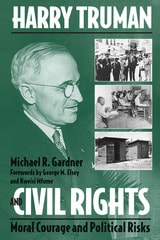
Harry Truman and Civil Rights
Moral Courage and Political RisksMichael R. Gardner. Forewords by George M. Elsey and Kweisi Mfume
Southern Illinois University Press, 2002
Given his background, President Truman was an unlikely champion of civil rights. Where he grew up—the border state of Missouri—segregation was accepted and largely unquestioned. Both his maternal and paternal grandparents had owned slaves, and his mother, victimized by Yankee forces, railed against Abraham Lincoln for the remainder of her ninety-four years. When Truman assumed the presidency on April 12, 1945, Michael R. Gardner points out, Washington, DC, in many ways resembled Cape Town, South Africa, under apartheid rule circa 1985.
Truman’s background notwithstanding, Gardner shows that it was Harry Truman—not Franklin D. Roosevelt, Dwight D. Eisenhower, or John F. Kennedy—who energized the modern civil rights movement, a movement that basically had stalled since Abraham Lincoln had freed the slaves. Gardner recounts Truman’s public and private actions regarding black Americans. He analyzes speeches, private conversations with colleagues, the executive orders that shattered federal segregation policies, and the appointments of like-minded civil rights activists to important positions. Among those appointments was the first black federal judge in the continental United States.
One of Gardner’s essential and provocative points is that the Frederick Moore Vinson Supreme Court—a court significantly shaped by Truman—provided the legal basis for the nationwide integration that Truman could not get through the Congress. Challenging the myth that the civil rights movement began with Brown v. Board of Education under Chief Justice Earl Warren, Gardner contends that the life-altering civil rights rulings by the Vinson Court provided the necessary legal framework for the landmark Brown v. Board of Education decision.
Gardner characterizes Truman’s evolution from a man who grew up in a racist household into a president willing to put his political career at mortal risk by actively supporting the interests of black Americans.
Heath
Denis MacShane
Haus Publishing, 2006
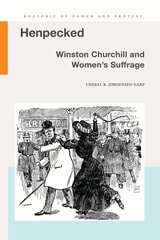
Henpecked
Winston Churchill and Women's SuffrageCheryl R. Jorgensen-Earp
Michigan State University Press, 2027
Henpecked: Winston Churchill and Women’s Suffrage explores the recurrent interactions between Winston Churchill and the women’s suffrage movement in Britain. Churchill purposely concealed, under a discursive veil, his complex and shifting perceptions of women’s competency to use the franchise. In balancing a public stance that vaguely favored the “principle” of women’s suffrage with his, often private, opposition to the movement’s legislative efforts, he employed every available rhetorical tool. This book presents a new understanding of his early Parliamentary career, his ability to manipulate public and private discourse, and his complicated stance on women’s right to vote. This rhetorical history challenges the view that Winston Churchill was only dissuaded in his support of women’s suffrage by the militancy of suffrage activists.
Herndon on Lincoln
LettersWilliam H. Herndon, edited by Douglas L. Wilson and Rodney O. Davis
University of Illinois Press, 2019
Herndon's Informants
Letters, Interviews, and Statements about Abraham LincolnEdited by Douglas L. Wilson and Rodney O. Davis
University of Illinois Press, 2020
More than 600 letters and interviews providing information about Abraham Lincoln's prepolitical and prelegal careers are included in this volume, a priceless collection never before available in one place.
Women to whom Lincoln proposed marriage, political allies and adversaries, judges and fellow attorneys, longtime comrades, erstwhile friends--all speak out here in words first gathered by William H. Herndon, Lincoln's law partner, between 1865 and 1890. Historian David Herbert Donald has called Herndon's materials "the basic source for Abraham Lincoln's early years."
Some of those Herndon questioned were illiterate; others could read but barely write. Completion of this undertaking took the editors to three major collections for the mammoth task of transcribing documents that often were nearly illegible.
Invaluable to Lincoln scholars and intriguing to anyone curious about Lincoln and his times, the book includes an introduction, scholarly annotations, a registry of the informants, and a detailed topical index.