Results by title
74 books match the query 'Public welfare' and 2 start with h
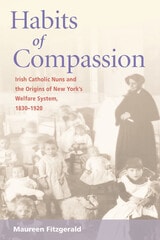
Habits of Compassion
Irish Catholic Nuns and the Origins of New York's Welfare System, 1830-1920Maureen Fitzgerald
University of Illinois Press, 2006
The Irish-Catholic Sisters accomplished tremendously successful work in founding charitable organizations in New York City from the Irish famine through the early twentieth century. Maureen Fitzgerald argues that their championing of the rights of the poor—especially poor women—resulted in an explosion of state-supported services and programs.
Parting from Protestant belief in meager and means-tested aid, Irish Catholic nuns argued for an approach based on compassion for the poor. Fitzgerald positions the nuns' activism as resistance to Protestantism's cultural hegemony. As she shows, Roman Catholic nuns offered strong and unequivocal moral leadership in condemning those who punished the poor for their poverty and unmarried women for sexual transgression. Fitzgerald also delves into the nuns' own communities, from the class-based hierarchies within the convents to the political power they wielded within the city. That power, amplified by an alliance with the local Irish Catholic political machine, allowed the women to expand public charities in the city on an unprecedented scale.

Human Capital versus Basic Income
Ideology and Models for Anti-Poverty Programs in Latin AmericaFabián A. Borges
University of Michigan Press, 2022
There were two distinct models of CCTs: a “human capital” model based on means-tested targeting and strict enforcement of program conditions, exemplified by the program launched by Mexico’s right, and a more universalistic “basic income” model with more permissive enforcement of conditionality, exemplified by Brazil’s program under Lula. These two models then spread across the region. Whereas right and center governments, with assistance from international financial institutions, enacted CCTs based on the human capital model, the left, with assistance from Brazil, enacted CCTs based on the basic income model.
The existence of two distinct types of CCTs and their relation to ideology is supported by quantitative analyses covering the entire region and in-depth case studies based on field research in three countries. Left-wing governments operate CCTs that cover more people and spend more on those programs than their center or right-wing counterparts. Beyond coverage, a subsequent analysis of the 10 national programs adopted after Lula’s embrace of CCTs confirms that program design—evaluated in terms of scope of the target population, strictness of conditionality enforcement, and stipend structure—is shaped by government ideology. This finding is then fleshed out through case studies of the political processes that culminated in the adoption of basic income CCTs by left-wing governments in Argentina and Bolivia and a human capital CCT by a centrist president in Costa Rica.