Results by title
237 books match the query 'Race & Ethnic Relations' and 5 start with h
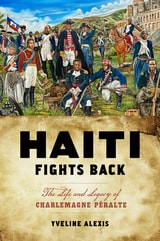
Haiti Fights Back
The Life and Legacy of Charlemagne PéralteYveline Alexis
Rutgers University Press, 2021
Haiti Fights Back: The Life and Legacy of Charlemagne Péralte is the first US scholarly examination of the politician and caco leader (guerrilla fighter) who fought against the US military occupation of Haiti. The occupation lasted close to two decades, from 1915-1934. Alexis argues for the importance of documenting resistance while exploring the occupation’s mechanics and its imperialism. She takes us to Haiti, exploring the sites of what she labels as resistance zones, including Péralte’s hometown of Hinche and the nation’s large port areas--Port-au-Prince and Cap-Haïtien. Alexis offers a new reading of U.S. military archival sources that record Haitian protests as banditry. Haiti Fights Back illuminates how Péralte launched a political movement, and meticulously captures how Haitian women and men resisted occupation through silence, military battles, and writings. She locates and assembles rare, multilingual primary sources from traditional repositories, living archives (oral stories), and artistic representations in Haiti and the United States. The interdisciplinary work draws on legislation, cacos’ letters, newspapers, and murals, offering a unique examination of Péralte’s life (1885-1919) and the significance of his legacy through the twenty-first century. Haiti Fights Back offers a new approach to the study of the U.S. invasion of the Americas by chronicling how Caribbean people fought back.
Heritage and Hate
Old South Rhetoric at Southern UniversitiesStephen M. Monroe
University of Alabama Press, 2021
How southern universities continue to wrestle with the words and symbols that embody and perpetuate Old South traditions
The US South is a rhetorical landscape that pulsates with division, a place where words and symbols rooted in a deeply problematic past litter the ground and contaminate the soil. Stephen M. Monroe’s provocative study focuses on predominantly white southern universities where Old South rhetoric still reverberates, where rebel flags cast a shadow over attempts at racial harmony, school cheers to reinforce racial barriers, and student yearbooks to create and protect an oppressive culture of exclusion. Across the region, in college towns like Oxford, Mississippi; Athens, Georgia; and Tuscaloosa, Alabama—communities remain locked in a difficult, recursive, and inherently rhetorical struggle that wrestles with this troubling legacy.
Words, images, and symbols are not merely passive artifacts of southern history, Monroe argues, but formative agents that influence human behavior and shape historical events. Drawing on research from many disciplines, including rhetoric, southern studies, history, sociology, and African American studies, Monroe develops the concept of confederate rhetoric: the collection of Old South words and symbols that have been and remain central to the identity conflicts of the South. He charts examples of such rhetoric at work in southern universities from Reconstruction to the present day.
Tracing the long life and legacy of Old South words and symbols at southern universities, this book provides close and nuanced analysis of the rhetorical conflicts that have resulted at places like the University of Mississippi and the University of Missouri. Some conflicts erupted during the civil rights movement, when the first African American students sought admission to all-white southern universities and colleges, and others are brewing now, as African Americans (and their progressive white peers) begin to cement genuine agency and voice in these communities. Tensions have been, and remain, high.
Ultimately, Monroe offers hope and optimism, contending that if words and symbols can be used to damage and divide, then words and symbols can also be used to heal and unify. Racist rhetoric can be replaced by antiracist rhetoric. The old South can become new. While resisting naïve or facile arguments, Heritage and Hate ultimately finds the promise of progress within the tremendous power of language.
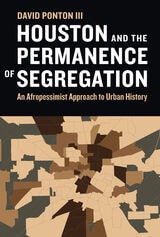
Houston and the Permanence of Segregation
An Afropessimist Approach to Urban HistoryDavid Ponton
University of Texas Press, 2024
2025 Most Significant Scholarly Book, Texas Institute of Letters
A history of racism and segregation in twentieth-century Houston and beyond.
Through the 1950s and beyond, the Supreme Court issued decisions that appeared to provide immediate civil rights protections to racial minorities as it relegated Jim Crow to the past. For black Houstonians who had been hoping and actively fighting for what they called a “raceless democracy,” these postwar decades were often seen as decades of promise. In Houston and the Permanence of Segregation, David Ponton argues that these were instead “decades of capture”: times in which people were captured and constrained by gender and race, by faith in the law, by antiblack violence, and even by the narrative structures of conventional histories. Bringing the insights of Black studies and Afropessimism to the field of urban history, Ponton explores how gender roles constrained thought in black freedom movements, how the “rule of law” compelled black Houstonians to view injustice as a sign of progress, and how antiblack terror undermined Houston’s narrative of itself as a “heavenly” place.
Today, Houston is one of the most racially diverse cities in the United States, and at the same time it remains one of the most starkly segregated. Ponton’s study demonstrates how and why segregation has become a permanent feature in our cities and offers powerful tools for imagining the world otherwise.
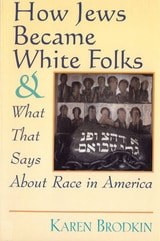
How Jews Became White Folks and What That Says About Race in America
Brodkin, Karen
Rutgers University Press, 1998
The history of Jews in the United States is one of racial change that provides useful insights on race in America. Prevailing classifications have sometimes assigned Jews to the white race and at other times have created an off-white racial designation for them. Those changes in racial assignment have shaped the ways American Jews of different eras have constructed their ethnoracial identities. Brodkin illustrates these changes through an analysis of her own family's multi-generational experience. She shows how Jews experience a kind of double vision that comes from racial middleness: on the one hand, marginality with regard to whiteness; on the other, whiteness and belonging with regard to blackness.
Class and gender are key elements of race-making in American history. Brodkin suggests that this country's racial assignment of individuals and groupsconstitutes an institutionalized system of occupational and residential segregation, is a key element in misguided public policy, and serves as a pernicious foundational principle in the construction of nationhood. Alternatives available to non-white and alien "others" have been either to whiten or to be consigned to an inferior underclass unworthy of full citizenship. The American ethnoracial map-who is assigned to each of these poles-is continually changing, although the binary of black and white is not. As a result, the structure within which Americans form their ethnoracial, gender, and class identities is distressingly stable. Brodkin questions the means by which Americans construct their political identities and what is required to weaken the hold of this governing myth.

Humanity's Last Stand
Confronting Global CatastropheMark Schuller
Rutgers University Press, 2021
Humanity’s Last Stand dares to ask these big questions, exploring the interconnections between climate change, global capitalism, xenophobia, and white supremacy. As it unearths how capitalism was born from plantation slavery and the slaughter of Indigenous people, it also invites us to imagine life after capitalism. The book teaches its readers how to cultivate an anthropological imagination, a mindset that remains attentive to local differences even as it identifies global patterns of inequality and racism.
Surveying the struggles of disenfranchised peoples around the globe from frontline communities affected by climate change, to #BlackLivesMatter activists, to Indigenous water protectors, to migrant communities facing increasing hostility, anthropologist Mark Schuller argues that we must develop radical empathy in order to move beyond simply identifying as “allies” and start acting as “accomplices.” Bringing together the insights of anthropologists and activists from many cultures, this timely study shows us how to stand together and work toward a more inclusive vision of humanity before it’s too late.
More information and instructor resources (https://humanityslaststand.org)