144 books match the query 'Reading' and 3 start with h
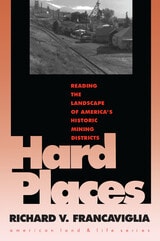
cover of Hard Places: Reading the Landscape of America's Historic Mining Districts

Hard Places

Reading the Landscape of America's Historic Mining Districts

Richard V. Francaviglia

University of Iowa Press, 1997

Working with the premise that there are much meaning and value in the "repelling beauty" of mining landscapes, Richard Francaviglia identifies the visual clues that indicate an area has been mined and tells us how to read them, showing the interconnections among all of America's major mining districts. With a style as bold as the landscape he reads and with photographs to match, he interprets the major forces that have shaped the architecture, design, and topography of mining areas. Covering many different types of mining and mining locations, he concludes that mining landscapes have come to symbolize the turmoil between what our society elects to view as two opposing forces: culture and nature.
[more]
cover of Hegel's Energy: A Reading of The Phenomenology of Spirit

Hegel's Energy

A Reading of The Phenomenology of Spirit

Michael Marder

Northwestern University Press, 2021
Hegel’s The Phenomenology of Spirit has been one of the most important works of philosophy since the nineteenth century, while the question of energy has been crucial to life in the twenty-first century. In this book, Michael Marder integrates the two, narrating a story about the trials and tribulations of energy embedded in Hegel’s dialectics. Through an original interpretation of actuality (Wirklichkeit) as energy in the Hegelian corpus, the book provides an exciting lens for understanding the dialectical project and the energy‑starved condition of our contemporaneity. To elaborate this theory, Marder undertakes a meticulous rereading of major parts of the Phenomenology, where the energy deficit of mere consciousness gives way to the energy surplus of self‑consciousness and its self‑delimitation in the domain of reason. In so doing, he denounces the current understanding of energy as pure potentiality, linking this mindset to pollution, profit-driven economies, and environmental crises. Surprising and deeply engaged with its contemporary implications, this book doesn’t simply illuminate aspects of The Phenomenology of Spirit—it provides an entirely new understanding of Hegel’s ideas.
 
[more]
cover of How to Draw a Circle: On Reading and Writing

How to Draw a Circle

On Reading and Writing

Dan Beachy-Quick

University of Michigan Press, 2024

What is it to write a poem? What work do words do when placed with care and vision into the intensely charged space of poetic effort? How to Draw a Circle does not seek to answer those questions, but to encounter them as fully and honestly as one can. The thread running through the essays is an ongoing investigation into poetry as an epistemological experiment, one which binds the imagination to the worldly, and trusts that creative endeavor is a form of participation in the ongoing creation of the world. It does so in part by focusing on thinkers, poets, writers, and literary movements where such thinking for a while prevailed, from Socrates to Melville, Mythology to Romanticism. Here the poem is approached as something deeply rooted in human consciousness, done so not to make an atavistic claim about poetry's history, but to show the ways in which oldest tradition gives us ever-new eyes. The hope this book gathers around is that poetry—poetic expression, the wild wonder of working in words—turns us back toward the world in more vibrant, more open, more ethical ways. How to Draw a Circle summons lyric powers—not an argument, but a participation in the ways poetry works in us and on us. 
[more]