Results by title
92 books match the query 'Regimental histories' and 4 start with h
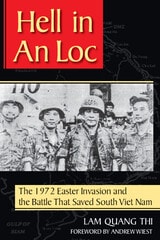
Hell in An Loc
The 1972 Easter Invasion and the Battle That Saved South Viet NamQuang Thi Lam
University of North Texas Press, 2009
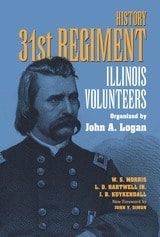
History 31st Regiment
Illinois Volunteers Organized by John A. LoganW. S. Morris, J. B. Kuykendall, and L. D. Hartwell. Foreword by John Y. Simon
Southern Illinois University Press, 1998
The story of John A. Logan’s famed 31st Regiment Illinois Volunteers, told by three veterans, follows the regiment from the battles of Belmont, Fort Donelson, Vicksburg, Kenesaw Mountain, and Atlanta through the March to the Sea and into North Carolina. "Few regiments," notes historian John Y. Simon in the foreword, "fought longer or more fiercely, suffered more casualties, or won more victories."
Logan proved a valiant and valuable Union commander, yet when the Civil War first began, it was far from clear whether he would lead Union or Confederate troops. In dramatic fashion, however, he broke what Simon calls an "ominous silence ... interpreted by many as sympathy for the South." Speaking from a wagon platform in Marion, Illinois, Logan proclaimed: "[The] time has come when a man must be for or against his country." Logan accepted a commission from Illinois governor Richard Yates, recruited heavily in southern Illinois, and formed the 31st Regiment Illinois Volunteers.
The 31st became a prime component in Grant’s western campaigns, fighting for the first time at Belmont, Missouri. In February of 1862, the 31st foiled Confederate general Gideon J. Pillow’s dramatic escape from the Union siege at Fort Donelson. Although this is often listed as one of the proudest moments for the 31st, casualties ran high (fifty-eight killed), with Logan so severely wounded that at first he was reported dead. Logan’s valor at Fort Donelson won him promotion to brigadier general.
History of the 33d Iowa Infantry Volunteer Regiment, 1863–6
A.F. Sperry
University of Arkansas Press, 2002
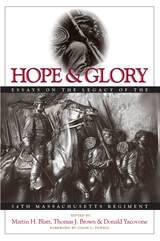
Hope and Glory
Essays on the Legacy of the 54th Massachusetts RegimentMartin H. Blatt
University of Massachusetts Press, 2009
The monument by Augustus Saint-Gaudens to Robert Gould Shaw and the 54th Massachusetts Regiment, located on Boston Common, stands at a symbolic crossroads of American history. A reminder of the nation's ongoing struggle over race, it captures the Civil War's higher purpose—the end of slavery—and memorializes those black soldiers and white officers who made common cause in the service of freedom. The monument and the saga of the 54 th Massachusetts remain powerful touchstones, inspiring enduring meditations such as Robert Lowell's poem “For the Union Dead” and the popular film Glory.
This volume brings together the best scholarship on the history of the 54th, the formation of collective memory and identity, and the ways Americans have responded to the story of the regiment and the Saint-Gaudens monument. Contributors use the historical record and popular remembrance of the 54th as a lens for examining race and community in the United States. The essays range in time from the mid-nineteenth century to the present and encompass history, literature, art, music, and popular culture.
In addition to the editors and Colin Powell, who writes about the memory and example of the 54th in his own career, contributors include Stephen Belyea, David W. Blight, Thomas Cripps, Kathryn Greenthal, James Oliver Horton, Edwin S. Redkey, Marilyn Richardson, Kirk Savage, James Smethurst, Cathy Stanton, Helen Vendler, Denise Von Glahn, and Joan Waugh.